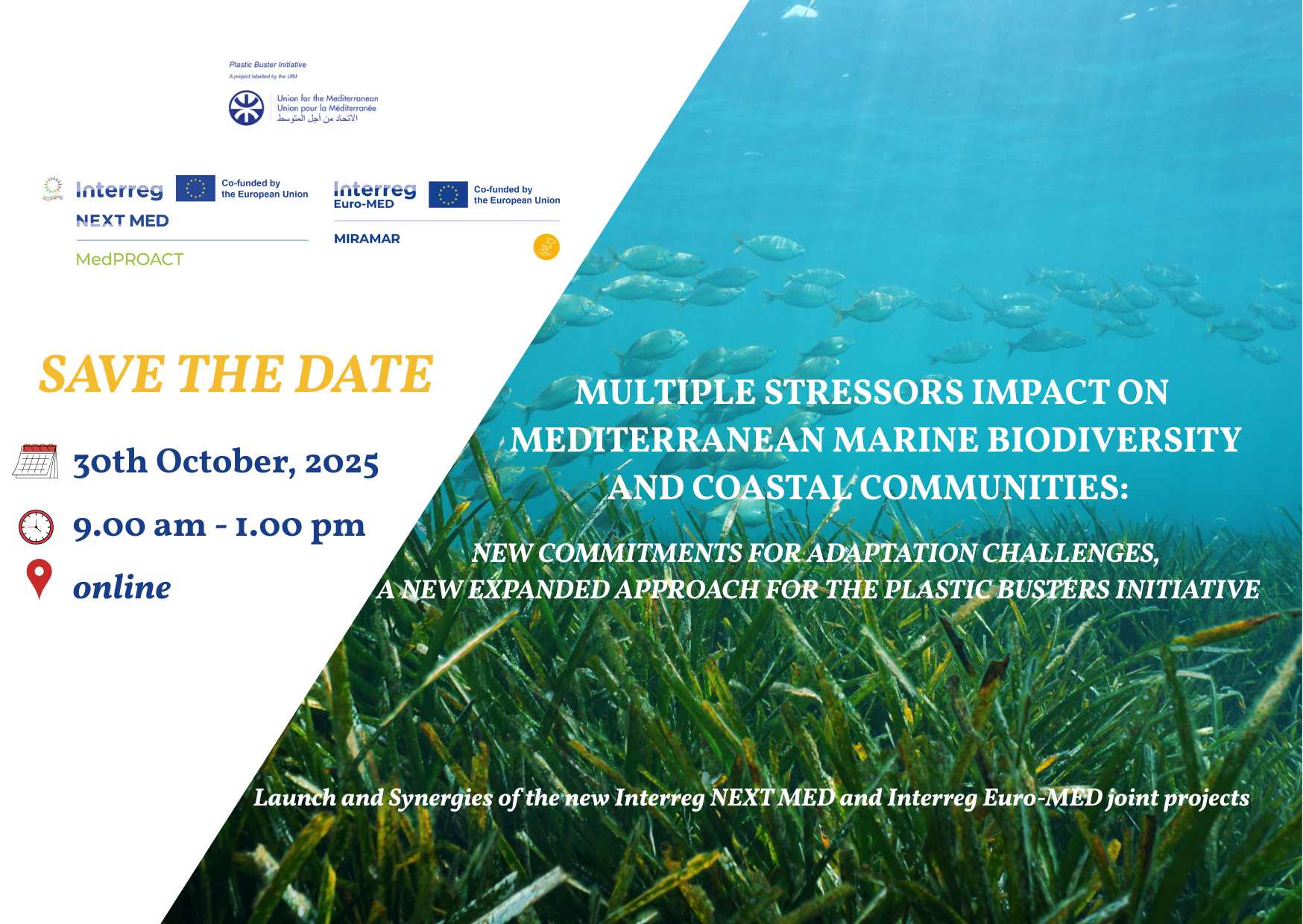
The Interreg NEXT MED MedPROACT (Mediterranean Pilot Actions for Climate Change Adaptation) project launch event will be held in the prestigious venue of the Union for the Mediterranean headquarters in Barcelona, on Thursday the 30th of October.
This is a new milestone in the Plastic Buster Initiative, a step forward to a cleaner Mediterranean the institution is taking together with MedPROACT and another new Interreg-funded project, the Interreg Euro-MED MIRAMAR project.
This event will gather representatives from across the region – including countries, research institutions, civil society organisations, regional partners, other interreg programmes, and key Mediterranean stakeholders – to reinforce cooperation towards a sustainable and resilient Mediterranean Sea. For MedPROACT, the initiative will represent the lauch event and new synergies and collaborations will be laid here.
Labelled by the UfM in 2016, the Plastic Busters initiative embodies a joint commitment between the EU, Mediterranean countries, and the UfM Secretariat to tackle marine litter and safeguard marine biodiversity. Building on the achievements of previous Interreg-funded projects such as Plastic Busters MPAs, Plastic Busters CAP, and COMMON, the initiative is now expanding its scope to address broader environmental stressors threatening the Mediterranean basin.
As the region’s unique biodiversity continues to face mounting pressures, the new phase recognises that marine ecosystems are heavily exposed emerging contaminants, marine litter including microplastics, underwater noise, and habitat destruction resulting from ever-increasing human activities. These stressors, compounded by climate change, are causing long-term impacts on ecosystem stability and the well-being of coastal communities.
The new projects will focus on enhancing scientific knowledge and strengthening regional cooperation to respond to these complex challenges. In particular, the initiative has identified three ecologically significant ecosystems in the Euro-Mediterranean region – seagrass beds, wetlands, and habitats of endangered species – as priority areas for action. These ecosystems play a crucial role in maintaining biodiversity, supporting fisheries, and protecting shorelines from erosion and climate impacts. The projects aims to develop an innovative harmonized methodology to monitor cumulative impact of selected stressors in 9 pilot areas in the three identified habitats. Showcases of Good Practices, highlighting successful examples of ecosystem restoration and pollution mitigation.
MedPROACT, financed by the Interreg NEXT MED programme, and MIRAMAR, funded by Interreg Euro-MED, aim to enhance the adaptive capacity of Mediterranean coastal communities, promote evidence-based policy dialogue, and strengthen scientific collaboration and data sharing across borders. Together, these projects will reinforce synergies and contribute directly in advancing the shared goal of a cleaner, healthier, and more resilient Mediterranean Sea.
Join us to explore how Mediterranean cooperation continues to drive progress toward cleaner seas and stronger, climate-resilient coastal communities.
👉 Register here to join online: Https://abalingua.zoom.us/meeting/register/OSXAuFU7R6i207yEVSRTPA
 Next Med