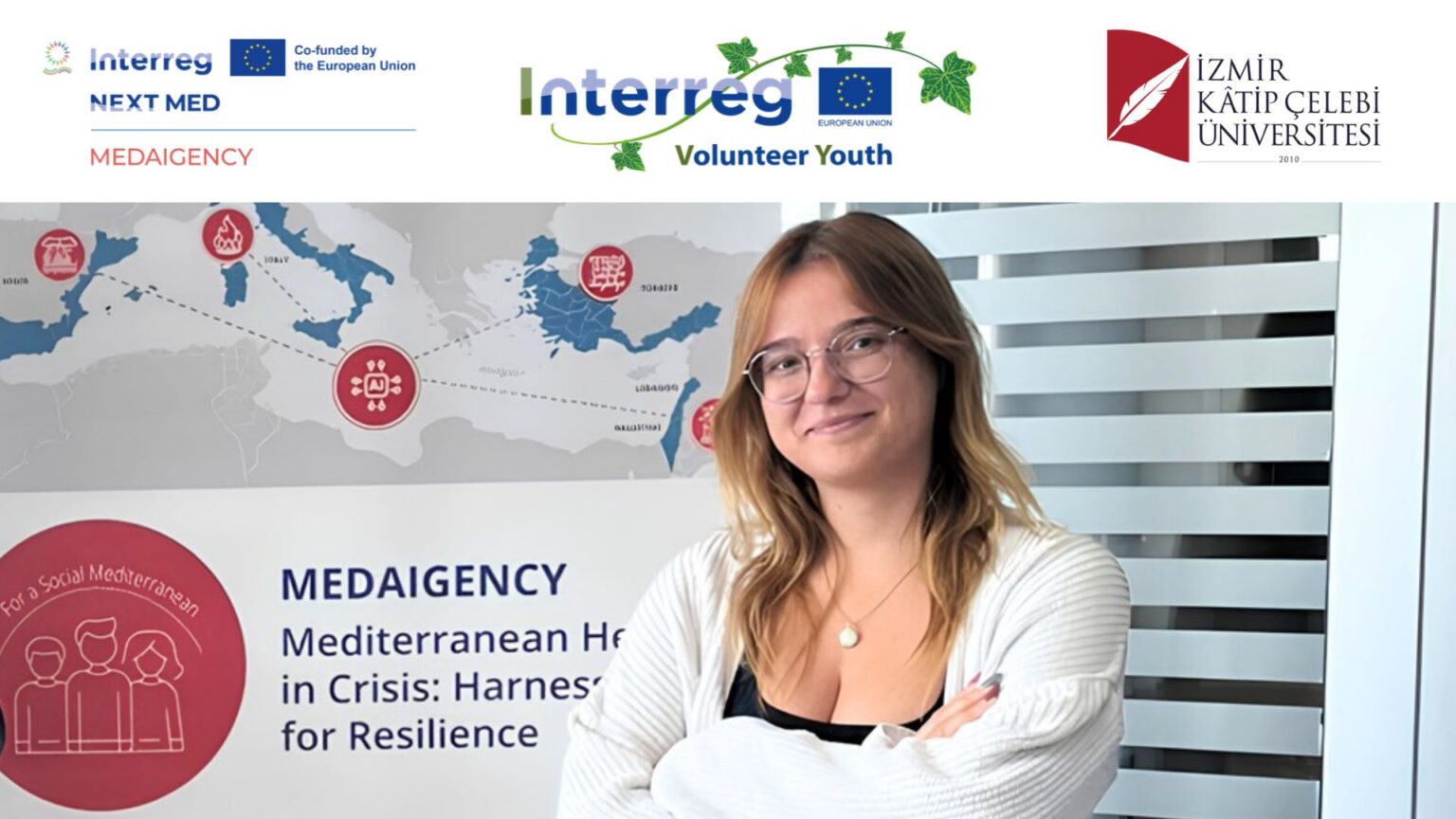
Youth at the Heart of Cooperation: An ‘Interreg Volunteer Youth’ (IVY) Perspective on MEDAIGENCY

Through Interreg Volunteer Youth (IVY), biomedical engineer Ece Minel Bursalı is supporting MEDAIGENCY’s technical teams at İzmir Kâtip Çelebi University in Türkiye. She shares how preparing user guides, exploring responsible AI and meeting partners across the Mediterranean are shaping her understanding of healthcare innovation and international cooperation.

Publication Date
18/11/2026
Reading Time
3 minutes

For Ece Minel Bursalı, working with artificial intelligence has usually meant focusing on models, data and performance. Joining MEDAIGENCY has brought another question into focus: how can these technologies become useful to people facing stressful, unpredictable emergencies?

A biomedical engineer and master’s student at İzmir Kâtip Çelebi University (İKÇÜ) in Türkiye, Ece joined the project in September 2026 through Interreg Volunteer Youth (IVY). Her research interests span AI, biosensors and healthcare technologies. Volunteering with MEDAIGENCY offered an opportunity to apply that background while discovering how researchers and organizations across the Mediterranean work towards a shared goal.

Interreg Volunteer Youth (IVY) is an initiative that gives young people the opportunity to volunteer with Interreg programmes and projects, supporting cooperation across borders. Through their placements, volunteers contribute to project activities, learn from participating organizations and help communicate the value of cooperation to wider audiences. Ece’s placement at İKÇÜ connects this opportunity with MEDAIGENCY’s work on AI for health emergencies.

“What made me particularly excited was the international aspect of it,” she explains. “I wanted to experience what cooperation between different countries actually looks like.”

Connecting technical development with users’ needs

Hosted by İKÇÜ, Ece supports the technical teams working on MEDAIGENCY’s AI-powered solutions, alongside documentation, communication and dissemination activities. Her current contributions include preparing user guides for the upcoming piloting phase.

This work requires her to understand the technologies and consider how to explain them to someone encountering or utilizing them for the first time. It has also encouraged her to explore the ethical and privacy questions surrounding their use.

For Ece, the opportunity to take initiative has helped her find her place in the team. She has been able to contribute her engineering knowledge while developing skills beyond her usual academic work.

“Although I’m still at the beginning of my career, I feel that my ideas and contributions are valued,” she says.

Discovering the people behind the partnership

Shortly after beginning her placement, Ece attended MEDAIGENCY’s Steering Committee Meeting in İzmir. Meeting partners from Lebanon, Palestine, Italy and Spain early on helped her understand both the scale of the project and the relationships that sustain its work.

Some of the most memorable exchanges took place outside the formal presentations, where she could get to know partners and hear about their experiences.

“What stood out to me was that, behind all the work packages, deliverables and deadlines, there are people who genuinely want to solve a problem together.”

These encounters gave Mediterranean cooperation a personal meaning: an opportunity to exchange ideas, contribute to a shared purpose and build connections beyond her academic environment.

Bringing ethics into the engineering process

Ece also participated in MEDAIGENCY’s AI for Health Emergencies: Foundations, Ethics and Responsible Use training held back in October. As someone who develops AI models in her own research, she found the ethical discussions particularly relevant.

“Ethics shouldn’t be a final checkpoint before releasing a technology; it should shape the questions we ask from the very beginning,” she reflects.

The training reinforced her interest in understanding where AI can fail, who could be affected and what makes a technology trustworthy. It is a perspective she intends to carry into both MEDAIGENCY and her research.

Her involvement in the project has also broadened how she thinks about technical success. Beyond performance in a controlled environment, she is increasingly considering how a tool could help someone communicate or make decisions during an emergency.

“A technically impressive solution is not necessarily a good solution if it cannot be trusted.”

Giving young people a place in cooperation

Through her placement, Ece has come to see healthcare innovation as a shared regional effort involving engineering, ethics, communication, user needs and implementation. Understanding how these elements connect has changed how she defines a successful research project.

It has also strengthened her appreciation of opportunities that enable young people to participate directly in international cooperation.

“I’m really thankful that initiatives like IVY make these experiences accessible to young people and give us a place in the conversation,” she says.

As her placement continues, Ece looks forward to contributing to the piloting phase and seeing how the solutions progress. She also hopes to introduce more students to IVY and European cooperation opportunities, particularly those who may not yet know they exist.

For her own future, she hopes to continue working at the intersection of healthcare innovation and international research.

“I hope this experience is the beginning of my involvement in European cooperation rather than a six-month chapter that ends here.”

Last Update

18/11/2026