WISEMED Promotes Smarter and More Resilient Water Management in Lebanon

WISEMED is supporting Lebanon’s transition towards more efficient, resilient, and sustainable water management through practical solutions tailored to local needs.

Publication Date
04/08/2026
Reading Time
3 minutes

From water scarcity and declining quality to smarter irrigation and safe water reuse

Lebanon’s water challenge

Lebanon faces growing water management challenges, as do many countries across the Mediterranean. Available local water resources meet only part of the country’s overall demand, highlighting the importance of improving water-use efficiency and strengthening sustainable water management practices. ¹

Climate change is intensifying droughts, reducing recharge of groundwater aquifers and increasing the variability of rainfall. At the same time, population growth, urbanization and tourism increase pressure on already limited water resources.

Agriculture—one of the main water consumers—still relies largely on traditional irrigation methods with low efficiency (around 60%), leading to water losses, low productivity and degradation of soils and ecosystems.²

The National Water Strategy 2024–2035 highlights the urgent need to improve water-use efficiency, modernize irrigation, strengthen water quality protection and reuse, and integrate digital tools for better decision-making. The strategy sets a concrete objective to increase irrigation efficiency from 60% to 75% by 2035.³

A crisis becoming more complex

Recent years have added a new layer of vulnerability. Recurrent conflicts—especially in southern Lebanon—have damaged water and sanitation infrastructure, disrupted services and created serious environmental risks.

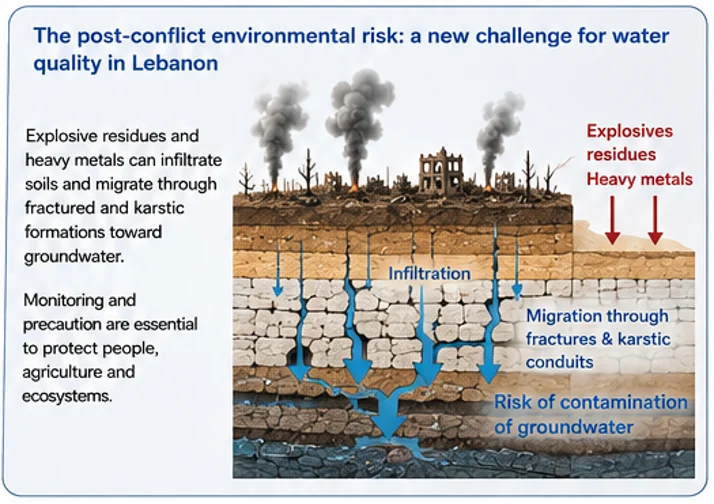
Recent scientific analysis warns that residues from explosives and munitions (nitrates, heavy metals such as Pb, Cd, Cu, Zn, Hg, as well as other chemical compounds) can infiltrate soils and migrate through karstic and fractured geological formations toward groundwater.⁴ These contaminants may threaten the quality of water resources that communities, agriculture and ecosystems depend on in the long term.

In response, the Lebanese Ministries of Agriculture and Environment announced in February 2026 a joint monitoring plan following chemical spraying in several areas of the South, including systematic sampling of soil, water and vegetation.⁵ This initiative underlines the importance of evidence-based management, continuous monitoring and precautionary approaches in water and environmental protection.
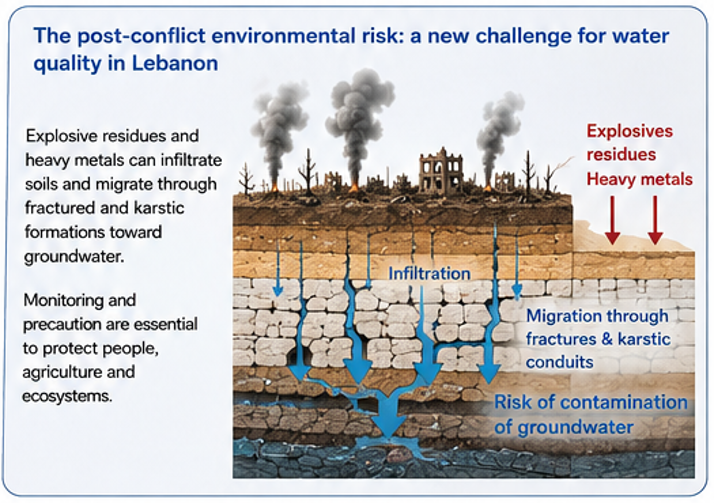
Figure 1. Post-conflict environmental risk: a new challenge for water quality in Lebanon. Based on El-Hajj [4].

WISEMED: practical solutions for resilient water management

In this changing context, water management can no longer focus only on how much water is available. It must increasingly address where water comes from, how efficiently it is used, how its quality is monitored, and how alternative water resources can be safely integrated into agriculture.

The WISEMED Project — “MEDiterranean joint Water management and conservatIon SustainablE solutions” funded by the European Union under the Interreg NEXT MED Programme, supports Mediterranean regions facing water scarcity. Its overall objective is to promote access to water and sustainable water management by testing and scaling up solutions that combine water use efficiency (WUE), non-conventional water (NCW) use and digital innovation.⁶

WISEMED approach in Lebanon

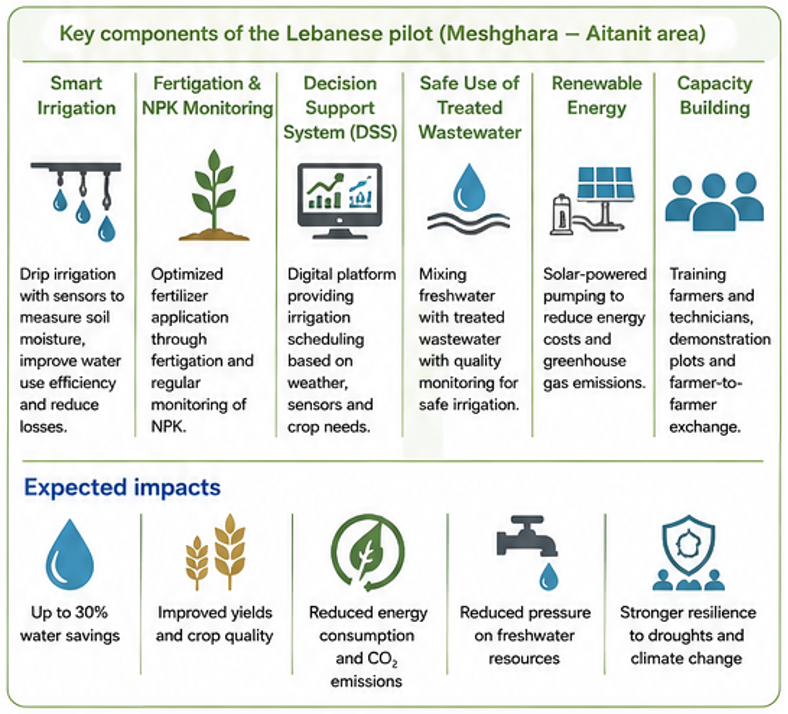
In the Western Bekaa, the Lebanese University, partner of the WISEMED Project, is leading a pilot that responds to local needs through an integrated package of solutions co-designed with farmers, public authorities, researchers and private partners.⁷

Figure 2. Key components of the Lebanese pilot (Meshghara–Aitanit area) and expected impacts.

Working together for a water-secure future

WISEMED demonstrates that innovation, collaboration and sound governance can turn water challenges into opportunities. By combining efficient irrigation, safe reuse, digital tools and capacity building, the project contributes to Lebanon’s National Water Strategy 2024–2035 and helps build a more resilient and sustainable water sector for people, agriculture and ecosystems.


References

  1. Ministry of Energy and Water (MoEW). National Water Strategy 2024–2035. Beirut, June 2024.
  2. Ministry of Energy and Water (MoEW). National Water Strategy 2024–2035. Beirut, June 2024, pp. 26–34.
  3. Ministry of Energy and Water (MoEW). National Water Strategy 2024–2035. Beirut, June 2024, p. 33.
  4. El-Hajj, A. (2026, July 27). “Au Liban-Sud, l’héritage invisible de la guerre menace l’avenir de l’eau.” L’Orient-Le Jour.
  5. Ministry of Agriculture & Ministry of Environment. Joint Statement on Field Monitoring Following Chemical Spraying in the South. February 2026.
  6. WISEMED Project (A_T_2.3_0390). 2024.
  7. Lebanese University (PP5). WISEMED National Action Plan – Activity 3.1.2. Beirut, 19 February 2026.

Last Update

04/08/2026