University of Palermo presents the first STORM simulation results at SDEWES 2026 in Spain
Presented under the title ‘Performance Assessment of a Solar-Based BTES System Integrated with an Innovative Hybrid Thermo-Electric Cogeneration Unit for Mediterranean Buildings’, the study uses five-year simulations to show how the served thermal load changes seasonal storage use, photovoltaic contribution and building comfort.
A first international research milestone for the University of Palermo’s activities within STORM was reached at the 21st Conference on Sustainable Development of Energy, Water and Environment Systems, held in Gran Canaria from 30 August to 3 September 2026, where UNIPA presented paper SDEWES2026-0688, entitled “Performance Assessment of a Solar-Based BTES System Integrated with an Innovative Hybrid Thermo-Electric Cogeneration Unit for Mediterranean Buildings”, which was included in the official conference programme.
Authored by Fabio Cardona, Maurizio La Villetta, Alessandro Buscemi, Pietro Catrini and Antonio Piacentino, the paper presented the first results obtained from the fully integrated TRNSYS model developed by UNIPA to investigate the interaction among a linear parabolic Concentrating Solar Power collector (CSP), a Photovoltaic generation with Battery storage (PV-B), a reversible Ground-Coupled Heat Pump (GCHP), a water Thermal Energy Storage tank (TES) and a Borehole Thermal Energy Storage (BTES) field. These findings refer exclusively to the preliminary model based on a standardized five-zone office building under Palermo weather conditions and should therefore be interpreted as an initial system-level assessment rather than as a performance forecast for the future pilot installation at Building 9.
The model was simulated over five consecutive years to represent the repeated seasonal charging and discharging cycles of the underground storage: from April to October, the CSP field transferred approximately 15.4 MWh of solar thermal energy per year to the BTES, while during winter the stored energy was recovered and supplied to the evaporator of the heat pump. Throughout the simulated cycles, the average ground temperature remained close to 22.5 °C, with an annual variation of approximately 5 °C and a maximum temperature of around 25 °C, demonstrating the capacity of the modelled ground volume to act as a comparatively stable seasonal thermal buffer.
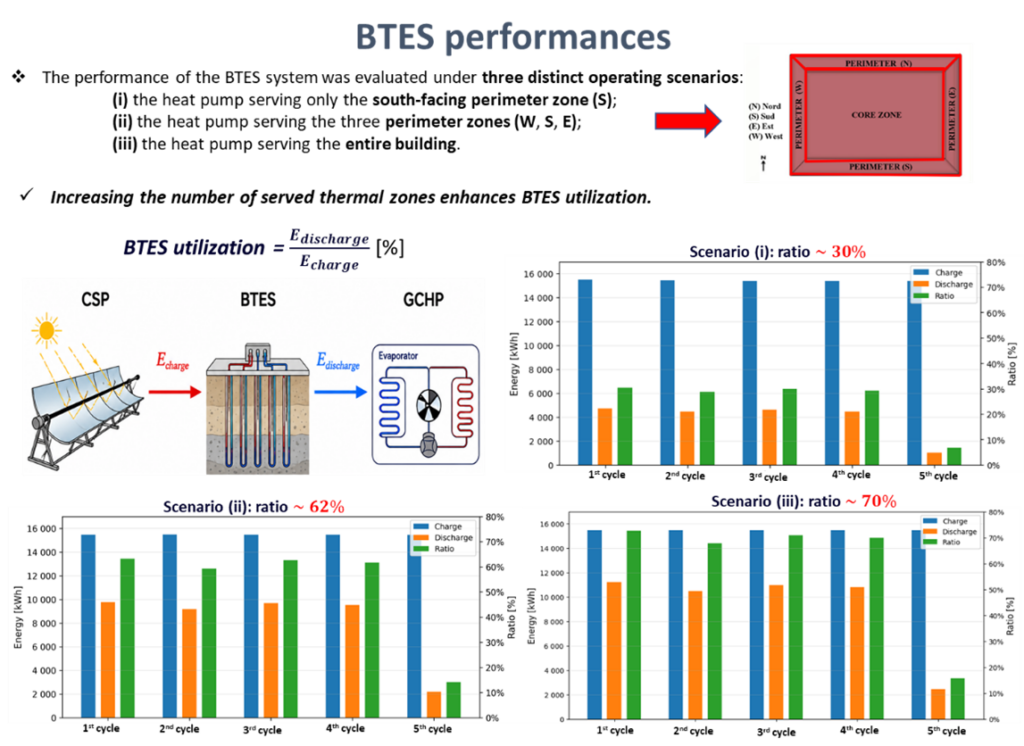
To investigate the relationship between storage use and the thermal demand connected to the system, three operating scenarios were considered: the heat pump serving only the south-facing perimeter zone, serving three perimeter zones, or serving the entire five-zone standardized office (Figure 1). Under quasi-steady operating conditions, the BTES utilization factor increased from approximately 29-30% in the single-zone scenario to 60-63% when three zones were served, reaching approximately 68-72% when the complete standardized building was connected.
Figure 1 – BTES utilization for one-zone, three-zone and five-zone operating scenarios.
The amount of thermal energy recovered from the ground followed the same trend, increasing from approximately 4.4-4.6 MWh per year in the single-zone case to 9.2-9.7 MWh for the three-zone configuration and 10.5-11.2 MWh when all five zones were served. These results highlighted that the effectiveness of seasonal thermal storage depends strongly on the magnitude and temporal profile of the connected building demand and that the BTES and the thermal loads it serves must therefore be designed and assessed together.
The conference contribution also highlighted the interaction between the thermal and electrical subsystems: as the number of conditioned zones and the electricity demand of the heat pump increased, the share of heat-pump consumption supplied by the fixed-size PV-B system decreased from approximately 49-51% in the single-zone scenario to 31-33% in the three-zone case and 28-30% when the entire standardized building was served. This outcome showed that increasing the use of the thermal energy stored in the BTES does not automatically lead to a higher renewable-electricity share and that underground thermal storage, photovoltaic generation, battery capacity and heat-pump demand need to be evaluated as parts of the same integrated system. The simulations also maintained indoor temperatures close to 25 °C during summer, whereas the winter analysis identified more challenging comfort conditions, mainly related to the comparatively weak envelope of the standardized reference building and to the decision to size the heat pump for a significant share of the annual demand rather than for the full heating peak.
As an initial international research and dissemination milestone, the SDEWES contribution has therefore provided UNIPA with a structured basis for the subsequent development of the STORM pilot, while also identifying the aspects requiring further refinement before physical implementation. The next modelling phase will refine the BTES configuration by evaluating alternative positions and spatial arrangements of the borehole heat exchangers while maintaining the same equivalent underground storage volume, thereby allowing the influence of the borehole layout on the effective thermal storage capacity and BTES outlet temperature to be assessed. In parallel, the standardized office model will be replaced by the detailed thermal model of the actual Building 9 at the University of Palermo, including its real geometry, low window-to-wall ratio, internal adjacencies, conditioned and unconditioned spaces, solar exposure and external shading. These refinements will enable the preliminary findings presented at SDEWES to be translated into more representative equipment-sizing, control and operating decisions for the pilot plant that will be implemented by UNIPA at Building 9.
Last Update
05/10/2026
The Interreg NEXT MED website uses technical, analytics and third-party cookies. By continuing to browse, you accept the use of cookies. Privacy Policy
 Next Med