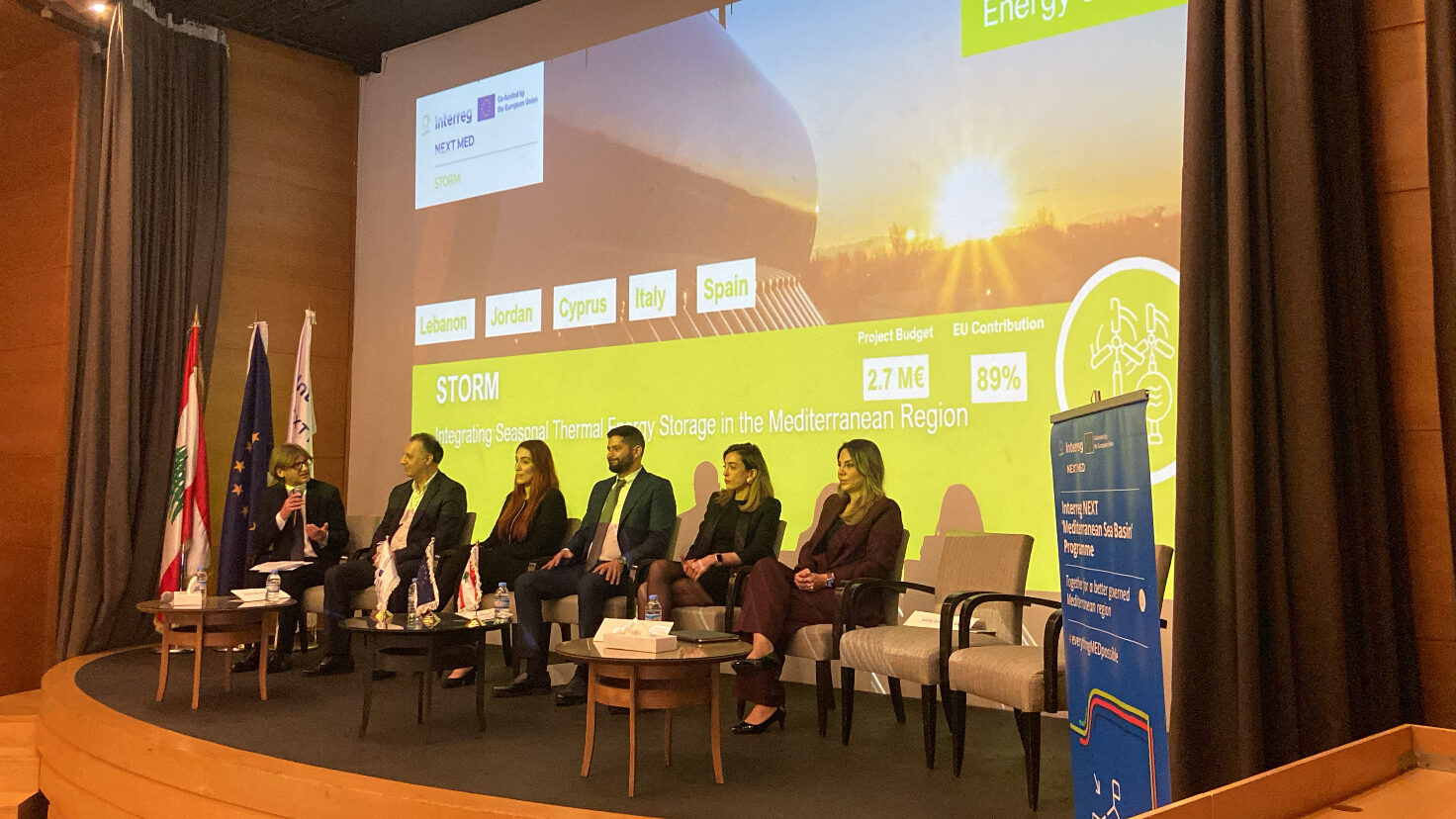
The STORM project took part in the Launch Event of Interreg NEXT MED projects funded in Lebanon, contributing to the panel discussion on “Advancing the Green Transition and Climate Action.”
Represented by Dr. Shadi Najjar from the American University of Beirut, STORM showcased how Seasonal Thermal Energy Storage (STES) can transform the way Mediterranean buildings heat and cool — reducing greenhouse gas emissions while strengthening energy resilience.
During the panel, Dr. Najjar highlighted that reality of heating and cooling energy consumption in Mediterranean buildings, and how the region remains heavily dependent on fossil fuels. He emphasized that STORM is not only piloting innovative Borehole and Tank Thermal Energy Storage systems, but also building the design tools, digital platforms, and policy pathways needed to scale these solutions across the region.
He underlined that:
“Through STORM’s three pilots in Lebanon, Italy and Jordan, we are testing Seasonal Thermal Energy Storage in different climatic and geological contexts. This allows us not only to validate the technology, but to generate region-specific design tools and transferable knowledge for the entire Mediterranean.”
The discussion brought together leading projects addressing wildfire mitigation, circular economy, and energy innovation, demonstrating Lebanon’s active contribution to a smarter, greener, and more inclusive Mediterranean.
🔗 Discover more about STORM: https://www.interregnextmed.eu/project-page/storm/about/
 Next Med