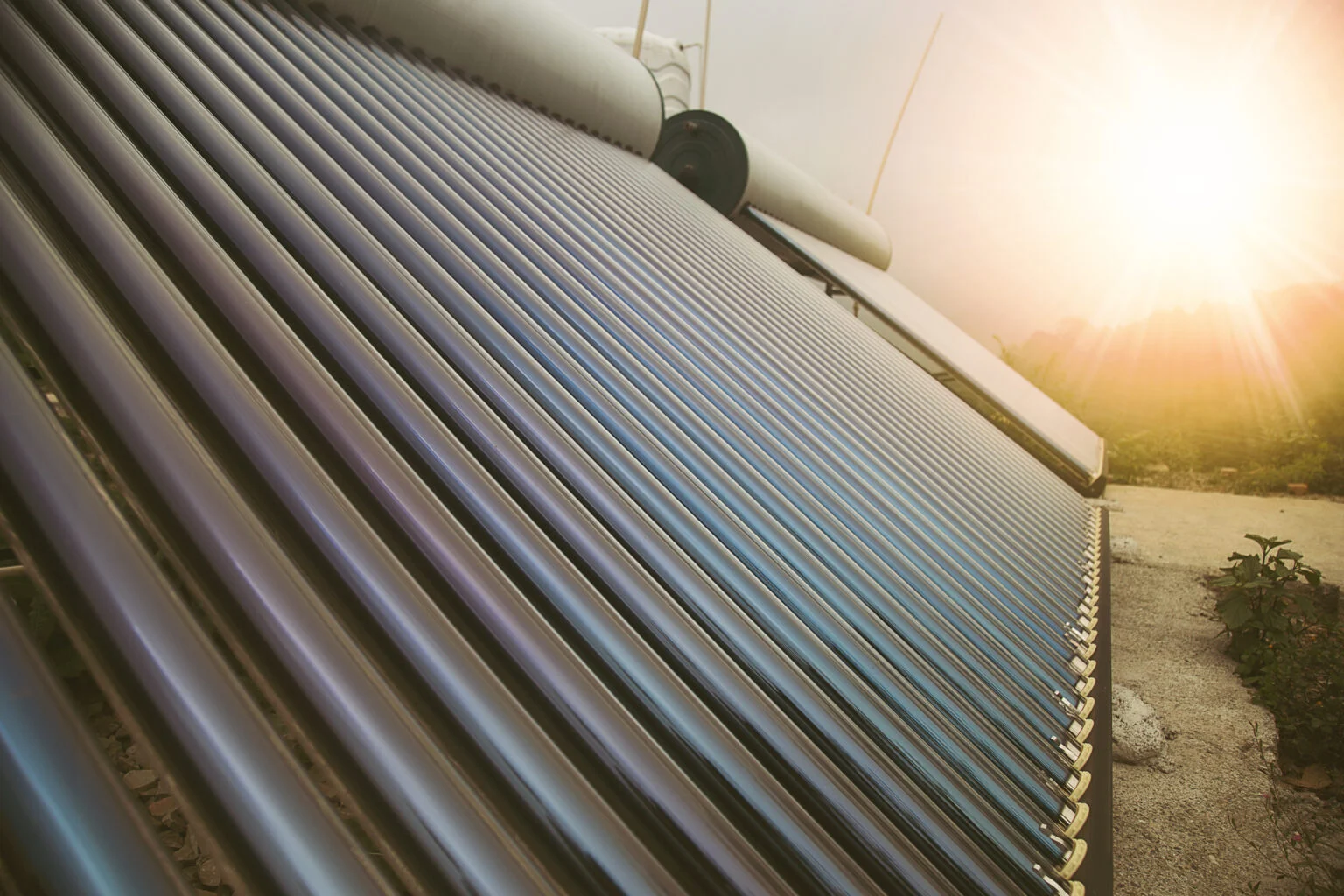
Solar Borehole Thermal Energy Storage (SBTES) is a seasonal thermal energy storage technology that captures solar energy and stores it in in the ground during summer to be used for space heating of buildings in winter. SBTES systems consist of solar thermal collectors and an array of vertical boreholes that are fitted with U-tube heat exchangers installed in soil or bedrock. Hot fluid (generally a mix of water and glycol) circulates from the solar collectors to these tubes, transferring heat to the surrounding ground, rendering the borehole system a natural thermal battery. During winter, cold water is circulated through the BTES where it is heated and pumped to the building to provide renewable space heating. Since its emergence during the 1970s energy crisis, numerous demonstration projects have confirmed the technical feasibility, reliability, and long-term performance of SBTES systems.
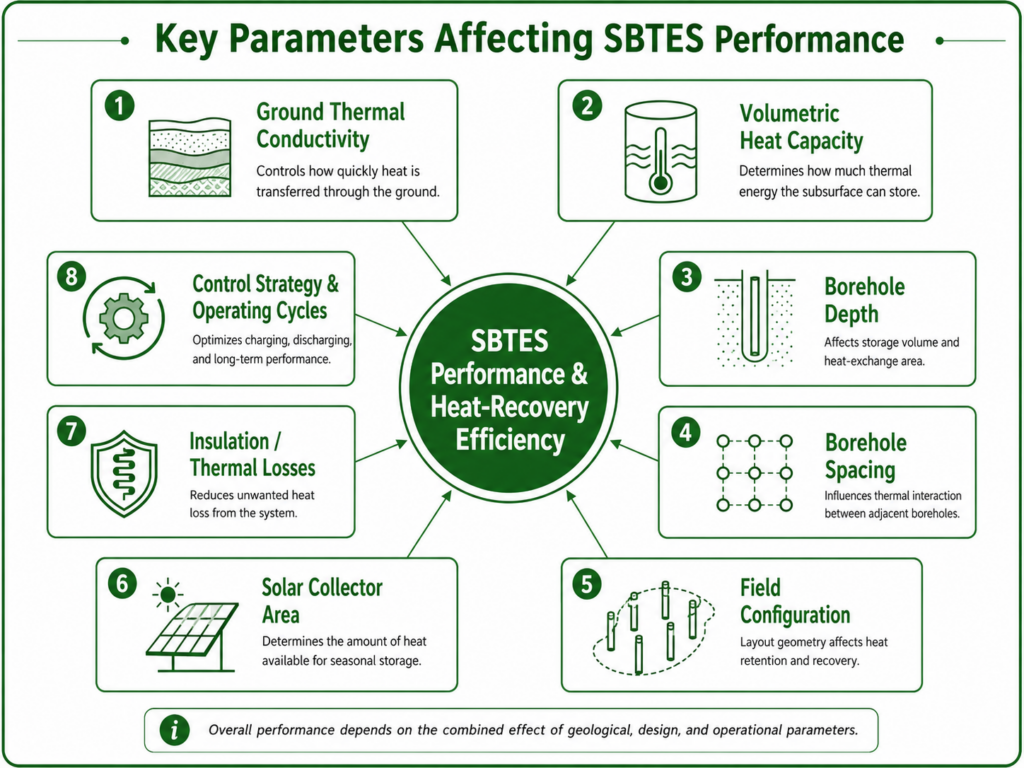
Performance of SBTES systems is governed by several interrelated design and operating parameters. Ground thermal conductivity and volumetric heat capacity strongly influence heat transfer rates and overall subsurface storage capacity. Borehole depth, spacing, and field configuration determine thermal interactions between adjacent boreholes and affect storage efficiency and heat recovery. Adequate top insulation minimizes thermal losses from the BTES, while solar collector sizing governs the amount of thermal energy available for seasonal storage. Effective control strategies are essential for optimizing charging/discharging cycles, and long-term operation improves performance as the underground temperature field gradually reaches a stable annual cycle. Numerical investigations have also shown that optimized borehole layouts can reduce peripheral heat losses.
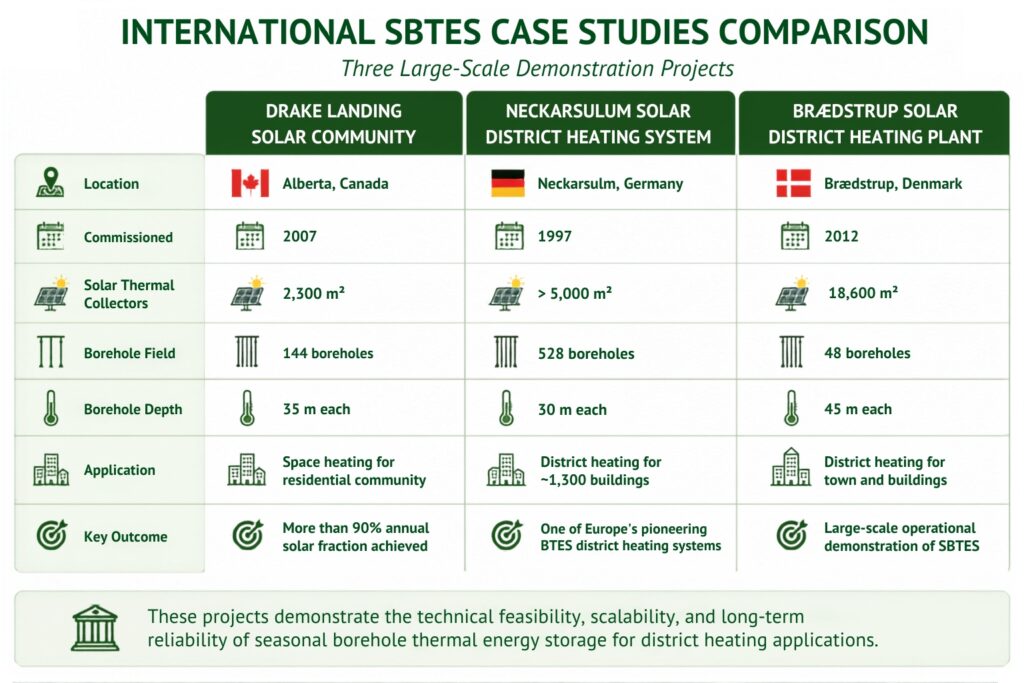
Among the most widely documented examples of SBTES systems is the Drake Landing Solar Community in Alberta, Canada, which has been in operation since 2007. The system combines approximately 2,300 m² of solar thermal collectors with a BTES field consisting of 144 boreholes, each 35m deep. Following several years of thermal charging, it consistently achieved annual solar fractions exceeding 90% for residential space heating. In Germany, the Neckarsulm Solar District Heating System has operated since 1997 as one of Europe’s pioneering BTES projects. The installation integrates more than 5,000 m² of solar collectors with 528 30m-deep boreholes, to supply renewable heat to a planned target of 1300 residential buildings. Another notable example is the Brædstrup Solar District Heating Plant in Denmark, commissioned in 2012. It incorporates 18,600 m² of solar collectors and 48 45-m deep boreholes, illustrating the scalability and long-term operational reliability of seasonal underground heat storage.
These full-scale projects demonstrate the versatility of the SBTES technology across different climates and applications. The value of SBTES systems lies in addressing the seasonal mismatch between solar energy availability and heating demand, increasing renewable energy utilization, reducing greenhouse gas emissions, and decreasing dependence on fossil fuels. When integrated with high-efficiency heat pumps and advanced energy management systems, SBTES can further improve system efficiency and enhance the reliability of renewable heating supply.
Continued advances in solar collector technology, borehole field optimization, control strategies, and numerical modeling is expected to enhance efficiency of SBTES systems while reducing installation and operating costs. With the ability of the system to store large quantities of renewable thermal energy over seasonal timescales being its main advantage, SBTES has a strong potential in future low-carbon energy systems, contributing to improved energy security, reduced greenhouse gas emissions, and the transition toward net-zero heating.
*Visuals are AI generated for Illustration purposes.
 Next Med