MAENA project is driving the restoration of the Small Water Cycle (SWC) by establishing specialized demonstration farms across Tunisia, Lebanon, and Italy. These flagship sites serve as a “proof of concept” for sustainable agro-ecological practices designed for scale-up and deployment across approximately twenty private beneficiary farms in partner Mediterranean countries (Tunisia, Jordan, Lebanon, Italy, and Spain). Field actions target water conservation, soil remediation, water-energy nexus solutions, and advanced digital monitoring.
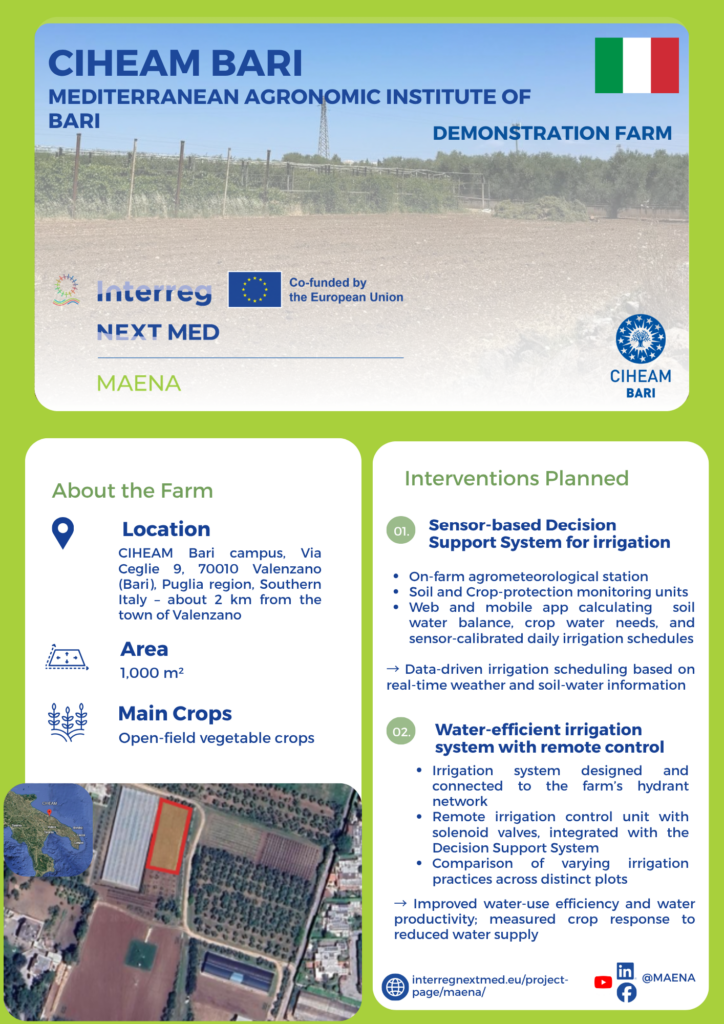
In Italy, the demonstration site is hosted by CIHEAM Bari at its Valenzano campus in the province of Bari (Puglia, Southern Italy). The campus experimental facility encompasses open-field and greenhouse vegetable crops, olive groves, and vineyards managed under diverse conditions and irrigated via groundwater wells and artificial accumulation basins. Within this setting, a dedicated 0.10-hectare plot was selected to host MAENA interventions.
Cultivated with open-field vegetable crops, the plot will serve as a dynamic demonstration, testing, and knowledge-transfer hub for students, agricultural technicians, farmers, and researchers once fully operational.
The planned interventions prioritize advanced monitoring tools and data-driven Decision Support Systems (DSS) tailored to the specific agro-climatic conditions of the site.
At the core of this deployment is a Sensor-Based Decision Support System (DSS) for precision irrigation. This setup integrates an on-farm agrometeorological station alongside soil-monitoring units that continuously track moisture dynamics and temperature profiles across multiple depths. Additionally, a crop-protection monitoring unit assesses leaf wetness and canopy microclimates to evaluate disease risks. All streams feed into an interactive, cloud-based DSS platform accessible via web and mobile applications, which calculates soil water balances and crop water needs to generate daily irrigation schedules dynamically calibrated against real-time soil sensor data.
Ultimately, this system enables precision, data-driven irrigation scheduling governed by live weather feeds and soil-water availability metrics.
Complementing the monitoring infrastructure is a water-efficient remote-controlled irrigation system. It features a modernized network layout specifically engineered for the demonstration plot and connected directly to the farm’s hydrant network. Automated control is managed via a remote irrigation unit equipped with solenoid valves that interface seamlessly with the central DSS platform. This infrastructure supports a comparative trial design that evaluates distinct irrigation practices.
Together, these measures drive optimized water-use efficiency and enhanced water productivity while allowing researchers to quantify precise crop physiological responses to reduced water supply.
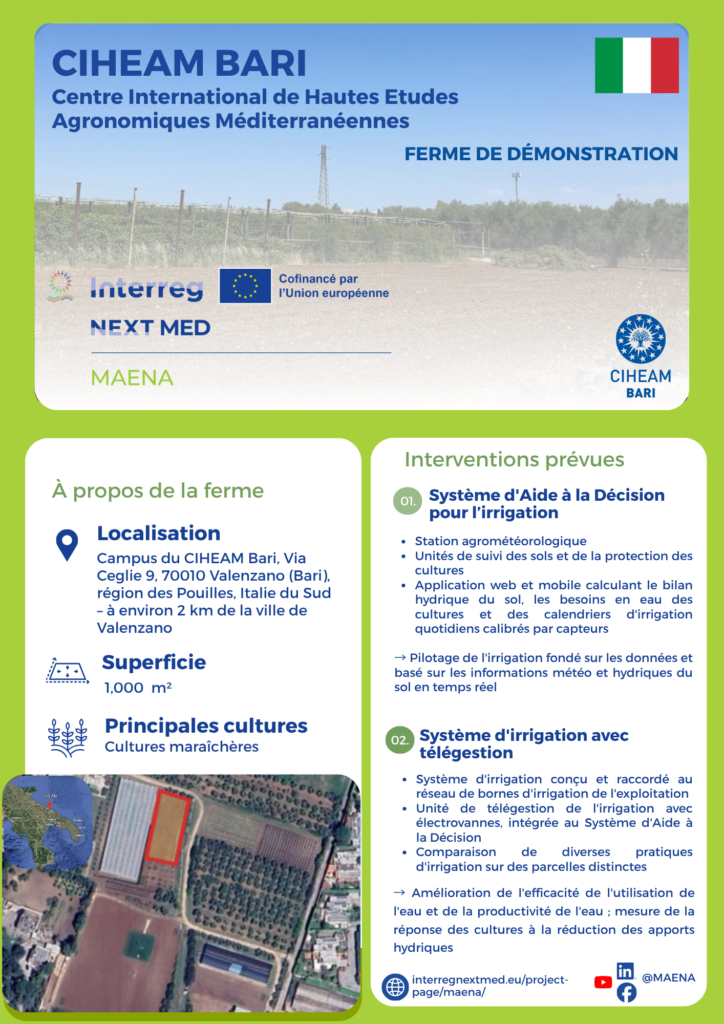
Information sheets outlining key information about the demonstration farm, in English and French, are attached
 Next Med