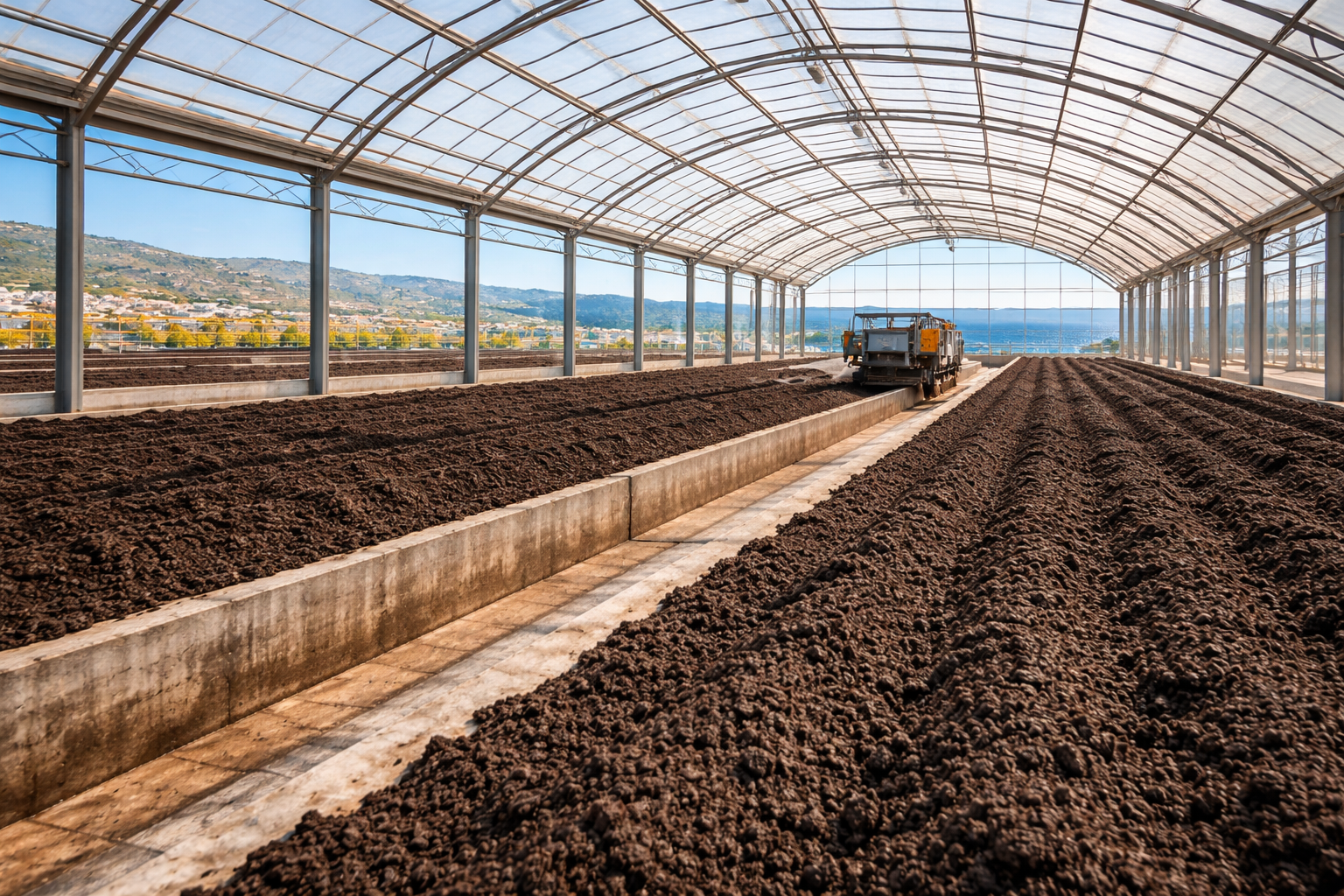
Before sewage sludge can be effectively converted into useful outputs, it needs to be prepared. Solar drying is a low-impact way to reduce moisture and improve the handling and consistency of sludge, transforming it into a more suitable input for further treatment.
What happens during solar drying?
Solar drying uses solar radiation and controlled airflow to gradually remove water from sludge. As moisture decreases, the material becomes more stable, easier to store and transport, and better suited for processes that require uniform feedstock quality.
Why it is a strategic advantage in the Mediterranean
In many Mediterranean areas, solar drying is already part of common sludge-management practices. This creates a major opportunity: by relying on an existing, low-emission pre-treatment step, the overall process can focus resources on maximising the performance of the conversion technology, rather than spending energy on drying.
Within Sludge2Energy, solar drying supports the project’s broader goal of improving energy efficiency and reducing emissions in sludge management. By preparing the sludge through drying, the project can test and optimise the next stage of the process, aiming to demonstrate practical pathways for cleaner and more circular sludge management solutions. The solar drying component is implemented at the Sludge2Energy demonstration sites, where sludge pre-treatment operations are managed and monitored in real conditions. This work is led by the site operators EOAL (Cyprus), AWC (Jordan) and MASKI (Türkiye).
 Next Med