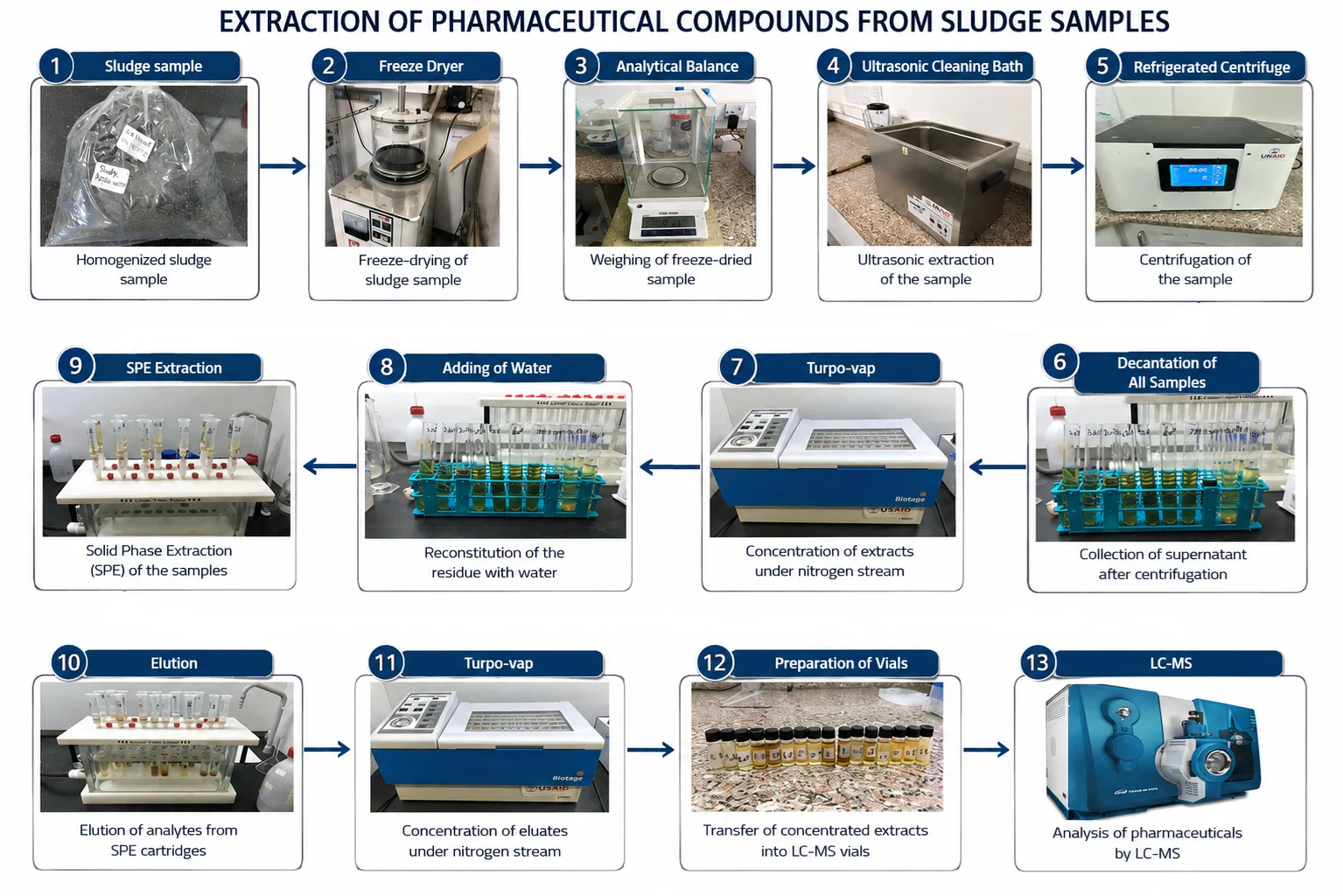
Behind every figure produced by Sludge2Energy there is a long laboratory process.
At the Royal Scientific Society (RSS) in Jordan, researchers are analysing sewage sludge and biochar — the carbon-rich material obtained by heating sludge with little or no oxygen — to detect traces of pharmaceuticals. The medicines we take are not fully absorbed by our bodies: part of them reaches wastewater and can remain in the sludge produced by treatment plants. If that sludge is reused, we need to know exactly what it still contains.
Reaching a single reliable measurement takes a long chain of carefully controlled operations. Samples are homogenised, freeze-dried and weighed, then treated with ultrasonic extraction to release the target compounds. After centrifugation and collection of the supernatant, the extracts are concentrated under a nitrogen stream, reconstituted and purified through solid-phase extraction — a technique that isolates the compounds of interest from everything else. The analytes are then eluted, concentrated once more and transferred into vials for the final analysis by liquid chromatography coupled to mass spectrometry (LC-MS), an instrument able to identify substances present in extremely small quantities.
The resulting data will make it possible to assess the quality of sludge and biochar and to inform recommendations on their safe reuse. It is a concrete contribution to the project’s ambition: turning a waste stream that Mediterranean countries struggle to manage into a resource, without transferring risks from water to soil!
 Next Med