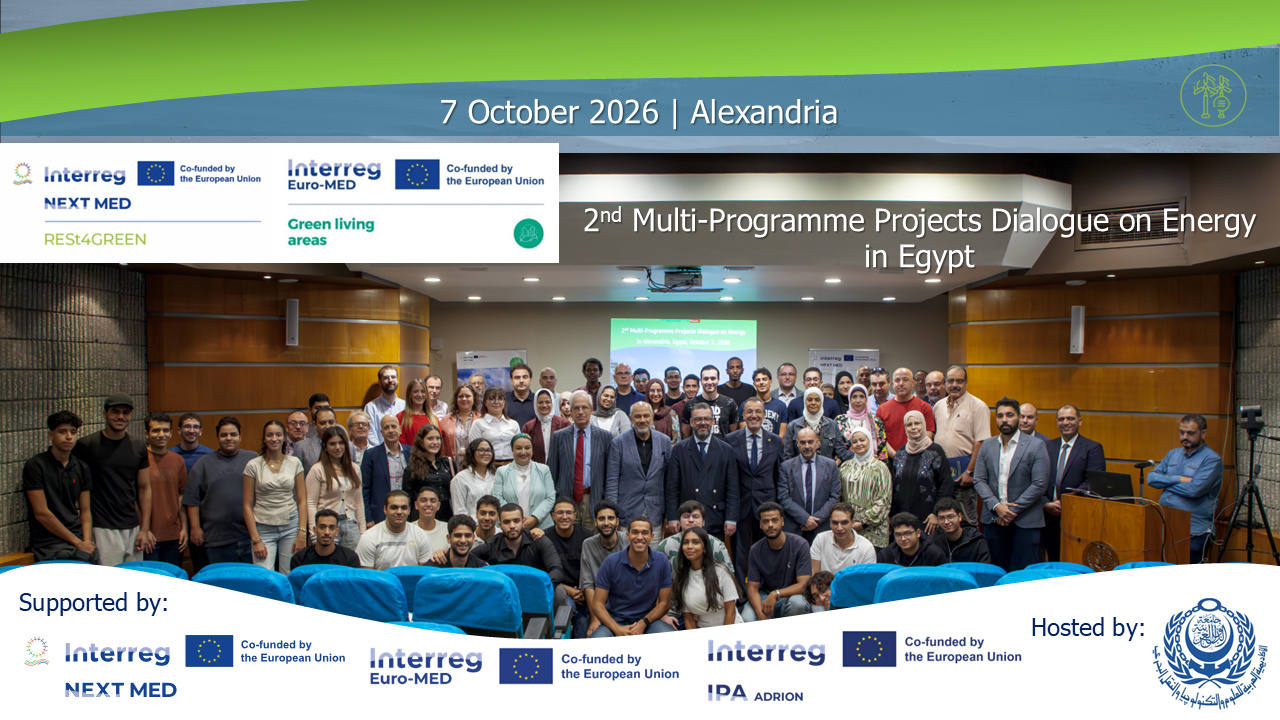
Opening
The Dialogue was opened by Prof. Yasser Gaber Dessouky (Dean of Scientific Research and Innovation, AASTMT), Prof. Akram Soliman Elselmy (Dean of the College of Engineering and Technology, AASTMT) and Prof. Em. Yorgos Stephanedes (University of Patras).
H.E. Vasileios Zarmpalis, Consul General of Greece in Alexandria, gave the keynote on behalf of the Ambassador of Greece. He highlighted the long-standing friendship and cooperation between Greece and Egypt, and the importance of preserving and strengthening these ties. Welcoming an event held on a university campus with students taking part, he underlined the value of exploring new opportunities, making the most of everyone’s skills and moving forward together through cooperation towards a shared future. Prof. Mostafa Ahmed Abdelgeliel (AASTMT) moderated the opening sessions.
From Tunis to Alexandria
- Sophie Scarveli (Interreg Euro-MED Programme) presented the Interreg Euro-MED Academy and invited everyone to the Mid-Term Event in Marseille on 25–26 November.
- Dr Marina Kouta (University of Patras – RESt4GREEN, Dialogue4LivingAreas, LOGREENER) shared the results and legacy of the Tunis Dialogue.
- Dr Amina Lamouchi (ECOPARK – RESt4GREEN) presented the outcomes of Tunis and next steps, including the Green Building cluster.
The Dialogue has grown from a project initiative in Tunis into a shared format connecting programmes and both shores. Its results are already reaching the Covenant of Mayors, EU Sustainable Energy Week and, next, the MED Talks in Marseille.
Egypt’s energy and climate transition
- Rehab Ali Sadeq & Eng. Marwa Atef (Ministry of Investment and Foreign Trade of Egypt) on global carbon markets and GOEIC’s Environmental Verification and Validation Unit.
- Dr Mohamed Elhussieny (AASTMT – GREENMEDPORTS) on greening Mediterranean ports.
- Dimitris Kokosioulis (Circle the Med Forum – INFIRE) on Greece–Egypt energy cooperation for climate resilience.
- Andreas Kazantzidis (University of Patras, ISES – HYMENSO) on solar energy in a changing climate.
The session placed Egypt at the heart of the discussion. From carbon markets, greener ports, Greece–Egypt cooperation and solar data, the speakers showed that the transition depends on strong grids, good data and partnerships across the Mediterranean.
Technical Sessions: From Project Results to Policy Change (moderated by Dr Marina Kouta)
- Bernard Massabo (Nice Côte d’Azur Metropolis – Dialogue4LivingAreas) on a Mediterranean policy dialogue for a better quality of life.
- Hrvoje Maras (REGEA – Community4LivingAreas, INFIRE, SMAFIN Expanded) on the Ecosystemic Transition hUb and on turning roundtables into national financing hubs.
- Massimo Ianniciello (Terre di Siena Lab – ProcuraMED) on green public procurement as a driver of innovation.
- Josep Maria Granollers (ICAEN) on energy efficiency in buildings, from past EU projects.
- Mostafa Ahmed Abdelgeliel (AASTMT – RESt4GREEN) on the AASTMT pilot: solar PV, smart monitoring and energy efficiency.
- Nahla Zakzouk (AASTMT – GREENOLIVE) on solar thermal storage for industry.
- Thelma Salem Redwan (ASEZA – RESt4GREEN, GREENMEDPORTS) on energy efficiency in Aqaba.
- Dr Mohamed El Khayat (former Executive Chairman, NREA) on Egypt’s and the region’s energy transition priorities.
- Em. Yorgos Stephanedes (University of Patras – URWAN, IDRON) on the water–energy nexus.
- Zivko Kokolanski (Ss. Cyril and Methodius University, Skopje – GOTOTWIN) on digital twins and renewable energy.
- Dr Julije Domac (REGEA, FEDARENE – PVMax, NEWLIGHT) on turning fragmented projects into investable pipelines.
The technical sessions turned the spotlight on what projects have already been achieved, and on how to take it further. On governance, Bernard Massabo showed how the Institutional Policy Dialogue and the EUCLID Policy Hub bring tested policy instruments to Mediterranean decision-makers. Hrvoje Maras presented the Ecosystemic Transition hUb, which helps local authorities find and adopt proven green-transition solutions.
On financing, Hrvoje Maras explained how project roundtables are becoming permanent national energy-efficiency financing hubs. Massimo Ianniciello showed how green public procurement and life-cycle costing can turn public spending into a driver of innovation.
On knowledge transfer, Josep Maria Granollers shared lessons from more than a decade of EU projects on energy efficiency in buildings. Prof. Mostafa Abdelgeliel presented the AASTMT pilot, which combines solar PV, smart monitoring and energy efficiency. Prof. Nahla Zakzouk and Thelma Salem Redwan brought experience from solar thermal storage for industry and from energy efficiency in Aqaba. Dr Mohamed El Khayat set out Egypt’s and the region’s energy transition priorities.
Finally, on policy uptake, Prof. Yorgos Stephanedes linked water and energy in practical territorial action. Prof. Zivko Kokolanski made the case for a common policy framework for digital twins and renewables. Dr Julije Domac showed how fragmented projects can become investable pipelines. Together, the speakers painted a clear picture: Mediterranean projects have the tools, the pilots and the know-how. What they need now is a bridge to policy and investment.
Looking ahead to 2028–2034
In a dialogue moderated by Dr Marina Kouta, Sophie Scarveli and Dr Julije Domac discussed the future of Interreg and EU–Southern Mediterranean partnerships.
Interreg is here to stay, and so are its results
Sophie Scarveli opened with good news: Interreg is expected to continue after 2027, with about €10 billion foreseen. Water and energy together with climate are likely to be the top priorities for the next period. She then explained how the programme makes sure project results live on after the projects end. The governance projects of the Green Living Areas Mission, e.g., Dialogue4LivingAreas and Community4LivingAreas, bring together the results of many thematic projects and help them reach policy. One example is the Local Energy Transition Integrated Support Framework of LOGREENER, now proposed to the Covenant of Mayors. Through mentoring, a city that has developed a solution can help another city adopt it, even a city that was never part of the programme. Over the next two years, the governance projects will meet regional and local authorities on both shores to understand their needs and match them with ready-to-use solutions.
To make this knowledge easy to find and use, the programme has created the Interreg Euro-MED Academy. It offers a Results Library of peer-reviewed outputs and a training platform to help apply them. The next milestone is the Interreg Euro-MED Mid-Term Event in Marseille on 25–26 November 2026, with a solutions “village” and the 4th MED Talks, where the Dialogue has been invited.
From cooperation to investments
Dr. Julije Domac picked up where Sophie left off: if the solutions exist, what is still missing? In his view, Europe has built an excellent system for making policy and now needs one just as strong for delivering it. As he noted, “We already know what to build and how to build it, and increasingly how to finance it.” The missing link is the capacity to turn policies into project pipelines and pipelines into real investments. His own region shows it can be done: the ELENA projects NEWLIGHT and PVMax mobilised more than €64 million by grouping small projects and preparing them for investment.
This is why, he argued, success should be measured not by the funds used, but by the change in KPIs and the investment triggered. It also means planning the next period together with the Southern neighbours. “If we want to play on a global scale, we should play with our friends, partners and neighbours.”
Networks are the bridge that makes this possible. FEDARENE brings together more than 100 regional energy and climate agencies and helps them share and transfer solutions. Julije will carry these messages to the European Commissioners in Brussels, together with the key results of the Alexandria Dialogue.
“We share more than one sea; we share one energy future together.” – Dr Julije Domac
 Next Med