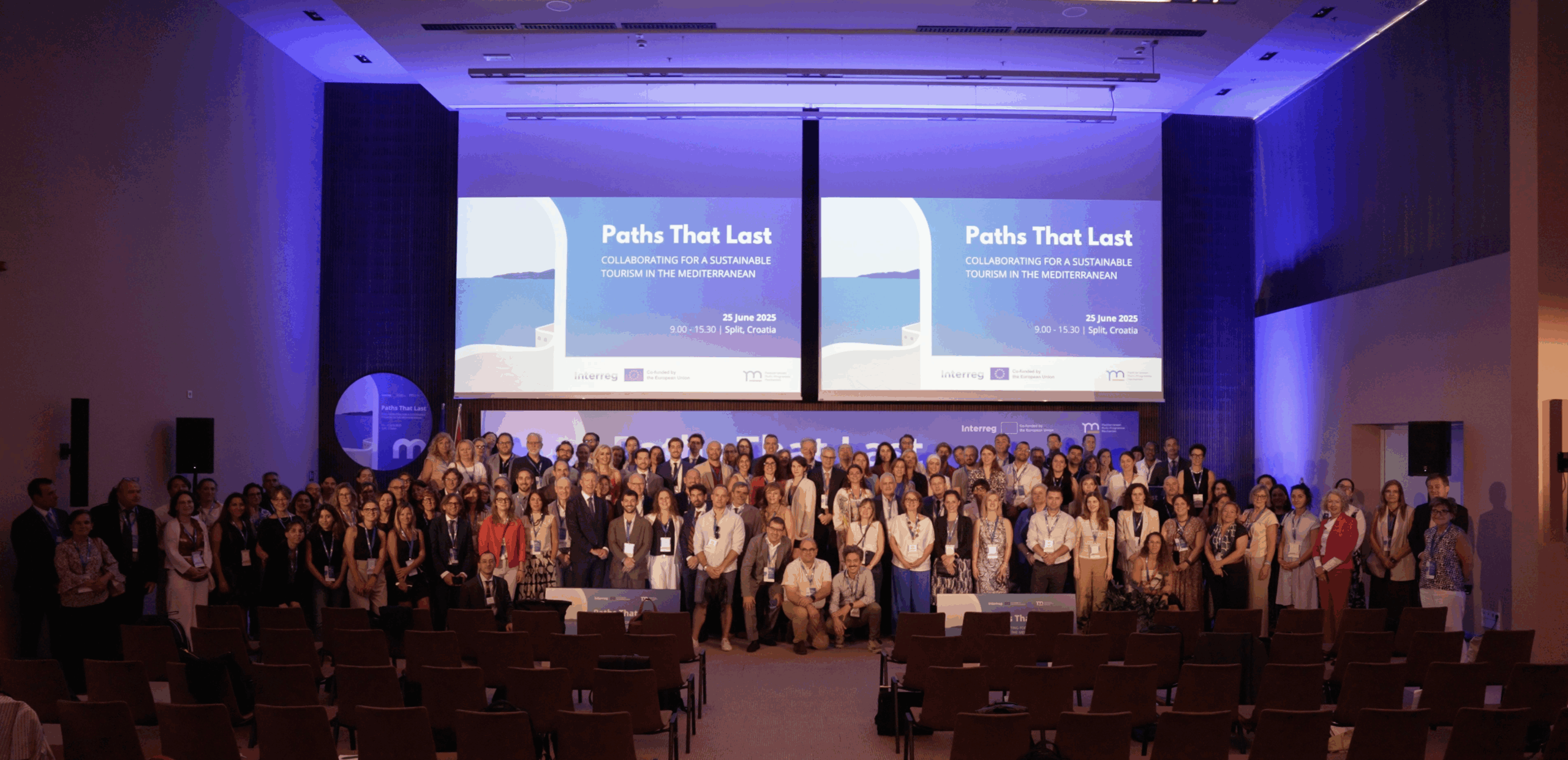
On 25 and 26 of June 2025, the Croatian city of Split hosted “Paths That Last – Collaborating for a Sustainable Tourism in the Mediterranean”, a landmark event bringing together over 340 participants from 9 Interreg programmes. Organised under the Mediterranean Multi-Programme Mechanism, the event was a major success in terms of both participation and outcomes, offering a dynamic space to capitalise on achievements and co-develop a shared vision for the future of sustainable tourism in the region.
The gathering united key actors and projects from 8 Interreg programmes (Euro-MED, Greece-Cyprus, South-Adriatic, Italy-Croatia, Italy-France Maritime, Italy-Malta, Italy-Tunisia, and NEXT MED), showcasing the power of coordinated cooperation across borders. The event marked the result of an unprecedented endeavor by these 7 Interreg Programmes to join forces and work closely together to achieve real synergies for the benefit of Mediterranean partners. Beyond the formal sessions, ‘Paths That Last’ event offered a unique opportunity to network at the Mediterranean level, laying the groundwork for future collaborations within Interreg projects and partnerships.
The two-day event opened with welcome remarks by Croatian officials and Ms. Dubravka Šuica, European Commissioner for the Mediterranean. In a video-message, she highlighted the importance of tourism for the European economy. “To harness the potential of tourism, we will present a new European Tourism Strategy in early 2026, defining a long-term vision for tourism that is environmentally-sustainable, digital and inclusive”, she added.
The meeting kicked off with a roundtable focusing on the achievements of Mediterranean Multi-Programme Mechanism, where representatives of the participating Interreg programmes discussed their collaborative efforts under the 2024/2025 Action Plan. The discussion reflected how joint governance and shared priorities are creating tangible results across the Mediterranean basin.
The session “Powering Synergies: Capitalisation & Mainstreaming” featured expert perspectives from Interreg Europe, Central Europe, and Interact/TESIM. Speakers emphasized the importance of aligning project outcomes with national and regional policies to maximise their long-term impact, reach, and integration.
The panel “Beyond 2027: building a sustainable future of Cooperation” brought a forward-thinking lens, highlighting the importance of youth involvement in future cooperation. Young repreentive and Interreg Volunteer Youth alumni offered creative ideas on how better take into account the youth expectations and perspectives in future Interreg programming, in a dynamic exchange with Jean-Pierre HALKIN, Head of Unit for “Interreg, Cross-Border Cooperation, Internal Borders” at the European Commission’s Directorate-General for Regional and Urban Policy.
An afternoon session explored sustainable tourism strategies beyond Interreg, with high-level insights from the Union for the Mediterranean, the European Commission (DG MARE), and the EU Strategy for the Adriatic-Ionian Region (EUSAIR). In addition, a keynote panel shed light on the Mediterranean Strategy for Sustainable Development, with experts from UNEP/MAP and Eco-union underlining the role of policy integration and cross-sectoral cooperation in achieving tangible impact.
Workshops: From Talk to Action
At the core of the event were five thematic workshops, offering project partners a space to share practices and co-create recommendations around:
- Shared and strategic governance of the tourism offer
- The social dimension of tourism
- Tourism and green transition
- Inclusive and accessible tourism
- Innovative tourism products
The workshops were very successful and highly appreciated by Interreg partners from all over the Mediterranean, providing not only a collaborative environment but also practical tools and strategies to reinforce sustainable tourism in their territories. The strong engagement and high quality of exchanges demonstrated the value of practical, peer-driven dialogue in shaping future actions.
Final Takeaways & the Road Ahead
On 26 June, the event concluded with a session dedicated to sharing key takeaways from the workshops and presenting the Peer Learning mechanism — a platform for projects from different programmes to exchange knowledge and best practices through study visits. The mechanism is expected to be fully operational by the end of 2025 or the beginning of 2026.
Final remarks from Curzio Cervelli (Interreg Euro-MED), Jean-Pierre Halkin (DG REGIO), and Stella Arneri (Croatian Ministry of Regional Development) reaffirmed the importance of strengthened cooperation among Interreg programmes to increase synergies and enhance the impact of funded projects in the territories.
“Paths That Last” showed just how powerful collaboration across countries and programmes can be in building a smarter, greener, and more inclusive kind of tourism in the Mediterranean. With over 300 people taking part, stronger connections, and a shared sense of purpose, the region is ready to move forward together toward a more sustainable future.
Watch the summary video below to relive the highlights of the “Paths That Last” conference, where eight Interreg programmes joined forces to shape a more sustainable future for Mediterranean tourism.
 Next Med