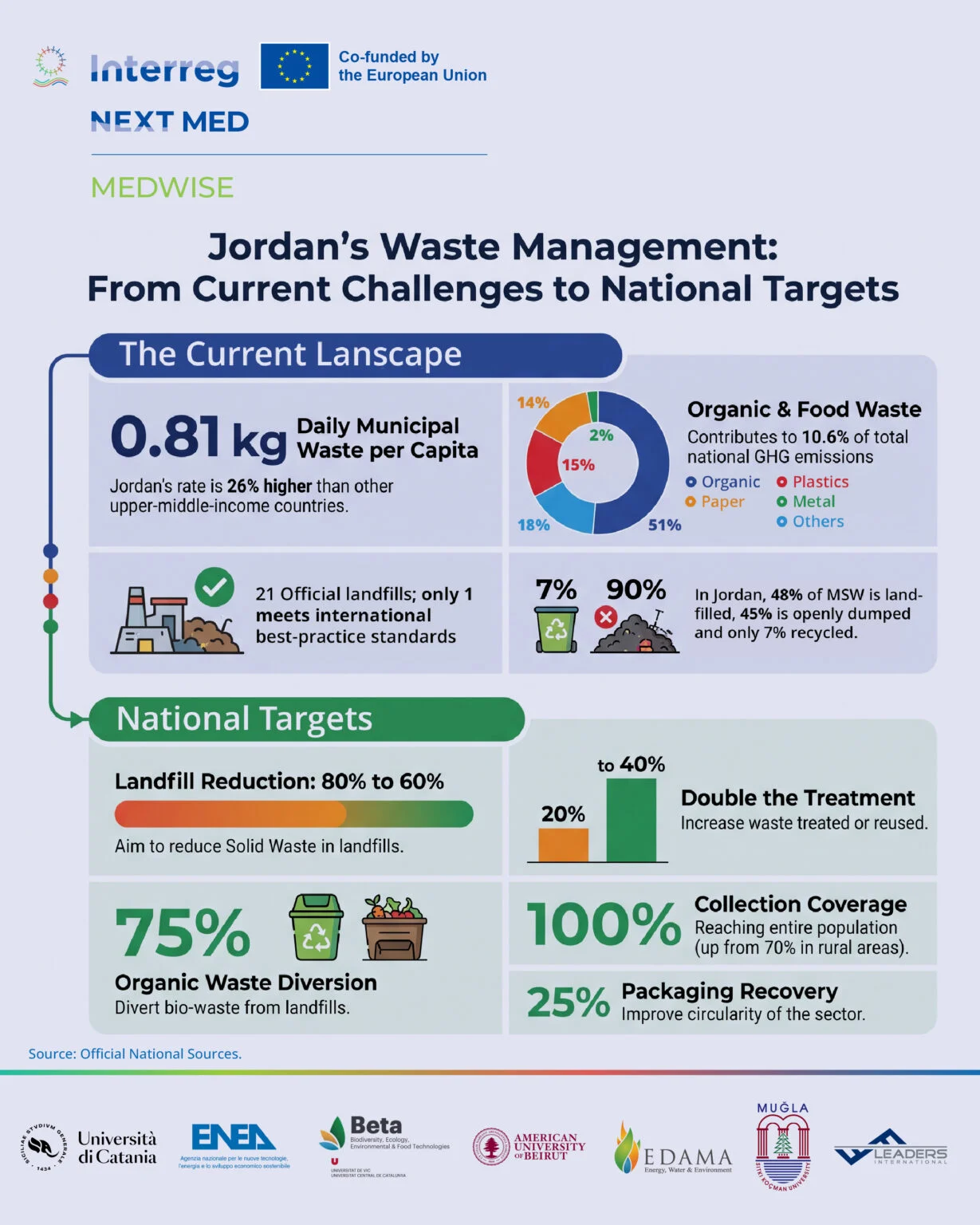
This research provides an overview of the waste management context in Jordan by presenting key facts, numbers, and figures that reflect the current waste situation in the country. It also highlights the national goals and targets for reducing waste generation and improving waste management practices across different waste streams. These efforts aim to align Jordan with the global waste and environmental agenda. Moreover, the research examines the country’s response to the growing challenges associated with increasing waste generation.
Key Facts (Current Situation):
- Jordanians produce 0.81 kg of municipal waste per capita/day — 26% higher than other upper-middle-income countries
- Municipal waste composition: 51% organic, 15% plastics, 14% paper, 2% metal.
- Over 50% of household waste is food waste
- Waste volume projected to increase 3–5% annually
Recycling & Disposal:
- Current recycling rate: 7%
- 21 official landfills; only 1 (Al Ghabawi) meets international best-practice standards
- Approximately 90% of open dumped/landfilled waste — remaining waste is openly dumped (45%) or landfilled (48%).
- Waste collection covers 90% of urban areas and 70% of rural areas
Emissions
- Waste sector = 10.6% of Jordan’s total GHG emissions (98.6% of this from methane in managed landfills).
National Targets:
- Reduce % of SW disposed in landfills: 80% → 60%
- Increase % of treated/reused SW: 20% → 40%
- Divert 75% of organic waste from landfills
- Reach 100% MSW collection coverage of the population
- Reduce bio-waste landfilled by 75%
- Recover 25% of packaging waste
Jordan faces significant challenges in waste management, with an average municipal waste generation of 0.81 kg per capita per day, which is around 26% higher than the average in other upper-middle-income countries. Municipal waste is mainly composed of organic materials (51%), followed by plastics (15%), paper (14%), and metals (2%), while food waste accounts for more than half of household waste. Waste generation is also expected to increase by around 3–5% annually. The country has 21 official landfills, but only one (Al Ghabawi landfill) meets international best-practice standards. Around 90% of waste is either landfilled or openly dumped, with approximately 48% being landfilled and 45% openly dumped. Waste collection services cover about 90% of urban areas and 70% of rural areas. The waste sector also contributes significantly to Jordan’s greenhouse gas emissions, accounting for approximately 10.6% of total national emissions, with methane from managed landfills representing around 98.6% of the sector’s emissions. Meanwhile, the overall recycling rate for all types of waste remains low, at only 7%.
Jordan has established several national targets aimed at reducing waste disposal, increasing waste recovery and reuse, and improving waste collection and treatment. These targets include reducing the proportion of solid waste disposed of in landfills from 80% to 60%, while increasing the share of treated or reused solid waste from 20% to 40%. In addition, Jordan aims to divert 75% of organic waste away from landfills and reduce the amount of bio-waste sent to landfills by 75%. The country also seeks to achieve 100% municipal solid waste (MSW) collection coverage across the population and recover 25% of packaging waste. Generally, these targets reflect Jordan’s efforts to move towards more sustainable and resource-efficient waste management practices.
Therefore, the MedWISE project contributes to addressing Jordan’s key waste management challenges and strengthening the implementation of its national targets. By promoting innovative solutions, resource recovery, and knowledge sharing, the project can support the reduction of waste sent to landfills, improve recycling and reuse, and enhance the management of organic waste. In this context, EDAMA seeks to support Jordan in facilitating the transition from conventional waste management approaches towards an integrated resource recovery framework by leveraging available resources, knowledge, partnerships, and innovative solutions to strengthen national efforts and support the achievement of the country’s waste management goals.
References:
 Next Med