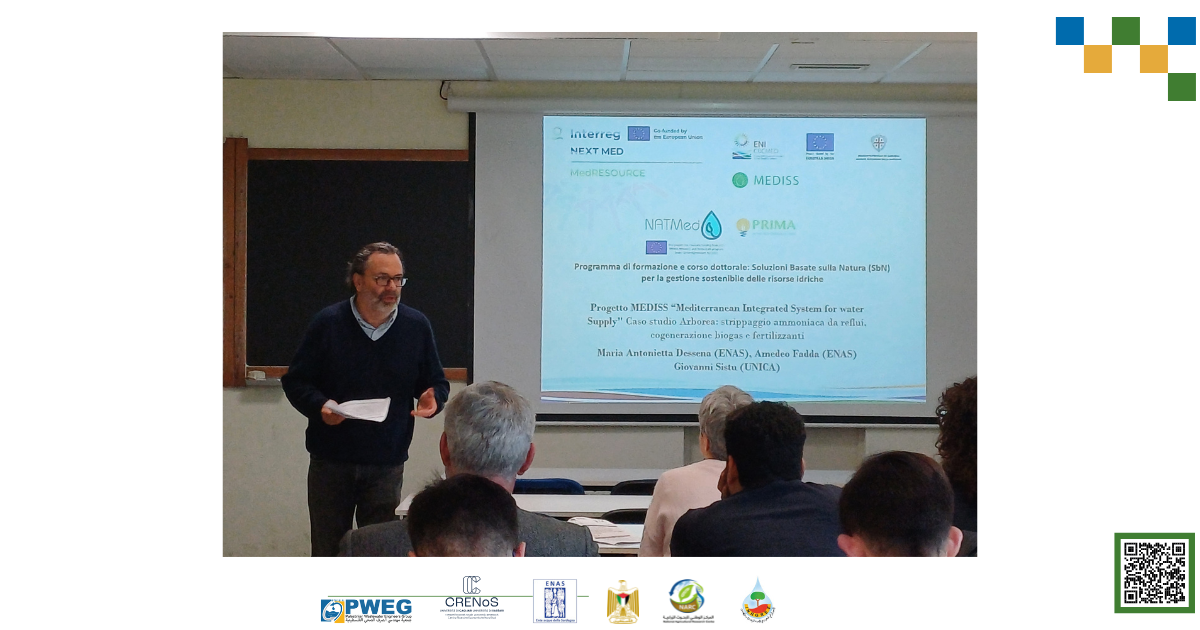
On 24 February 2026 in Cagliari, CRENoS – University of Cagliari and ENAS hosted an awareness raising and dissemination session for graduating and doctoral students within the framework of the Training Programme & Doctoral Course on Nature-Based Solutions for Sustainable Water Resource Management. The objective was to share the legacy of the previous project MEDISS (Mediterranean Integrated System for Water Supply) and show how it is feeding directly into MedRESOURCE’s Living Lab pathway, with a specific focus on the Sardinia case study in Arborea.
The event “Turning digestate into fertiliser: why Arborea is becoming a flagship Living Lab for scale-up” was presented by Professor Giovanni Sistu (CRENoS), Amedeo Fadda (ENAS) and Maria Antonietta Dessena (ENAS), and saw the participation of graduate and doctoral students along with technicians from the Sardinia Region and relevant regional agencies, as well as other technical and institutional representatives interested in circular economy solutions for nutrient recovery and sustainable sludge/digestate management.
The session highlighted what happens when a coastal, nitrate-vulnerable agricultural district—such as the Arborea area—becomes a real-world testbed for turning waste streams into useful inputs. Starting from the MEDISS experience, the speakers illustrated the logic of moving from a pilot set-up to a scalable pathway: a solution can only travel if it is proven under real constraints (Nitrate Vulnerable Zone conditions, ecosystem sensitivity and operational realities) and supported by credible monitoring and governance arrangements.
Beyond the technical dimension, the session focused on navigating the policy conditions needed to scale towards larger-scale implementation, emphasizing that scale-up depends on quality and traceability requirements, evidence on environmental outcomes (including soil and groundwater observations) and clear adoption conditions that make uptake feasible within regulatory frameworks.
The presenters emphasized how “For students and early-career researchers, Arborea offers a rare ‘full chain’ case study: a real pilot, real monitoring questions, and real governance constraints. It connects laboratory principles (chemistry, process engineering, environmental monitoring) with field-level evidence and policy discussions. If you are interested in circular economy, climate resilience, and how science becomes practical, this is a concrete Mediterranean example to learn from”.
For updates and upcoming activities, please follow MedRESOURCE on our website and official social media channels.
https://www.interregnextmed.eu/project-page/medresource/about/
https://www.facebook.com/people/Med-RESOURCE/61587075993431/
 Next Med