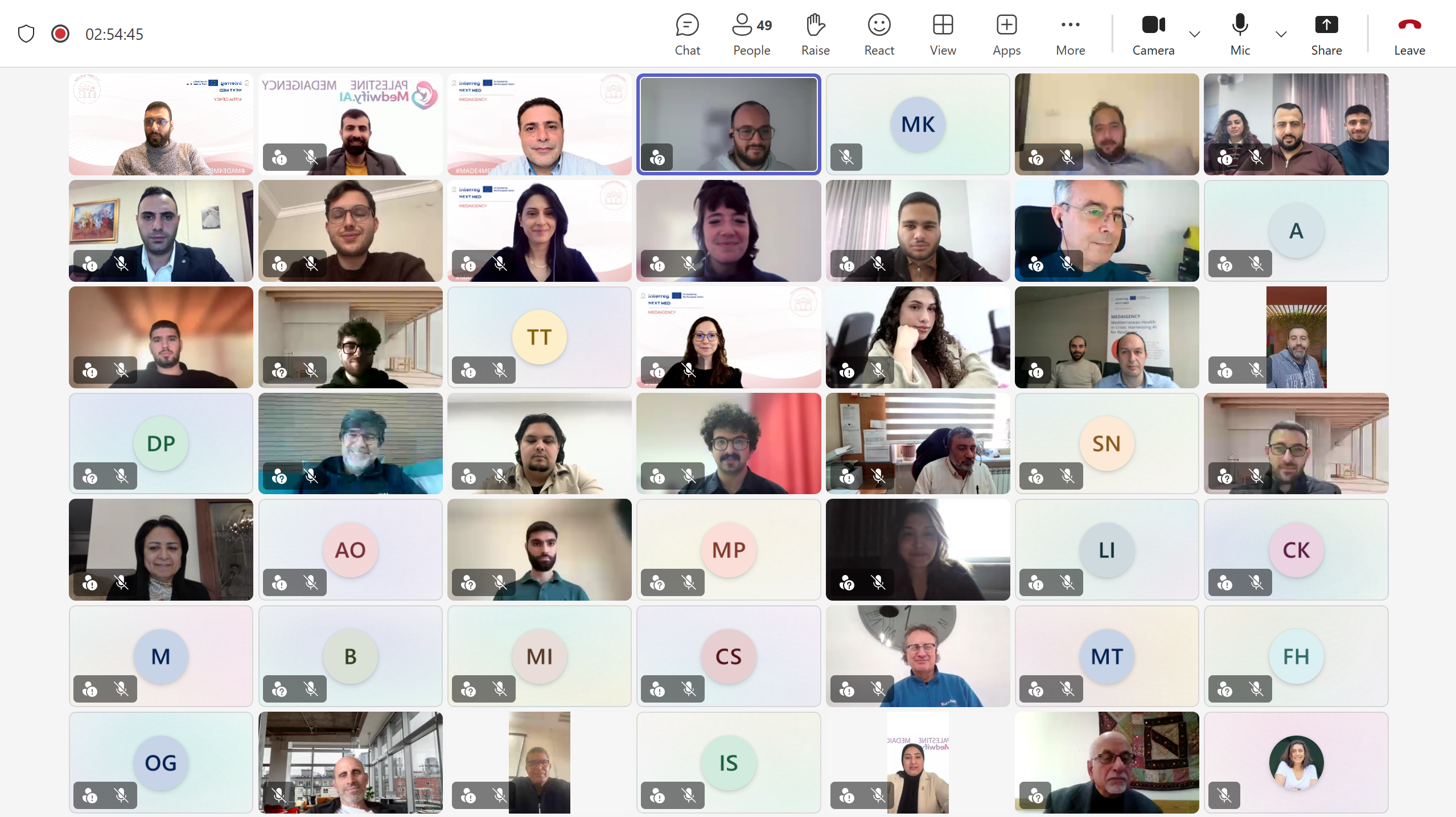
On Saturday, February 21, 2026, the most promising teams from the AI4Purpose National Hackathons gathered online for the MEDAIGENCY Transnational Hackathon, presenting innovative artificial intelligence solutions designed to strengthen emergency preparedness, response, and recovery across the Mediterranean region.
Following national competitions held in Lebanon, Italy, Türkiye, and Palestine, top teams from the professional track advanced to the Mediterranean-level event. During the transnational hackathon, they pitched their refined ideas before a panel of experts representing key institutions in public health, technology, and crisis management.
A Transnational Jury of Mediterranean Experts
The competition was evaluated by a distinguished jury composed of experts from participating countries:
- Lebanon – Ms. Wahida Ghalayini, Manager of the Public Health Emergency Operations Center (PHEOC), Ministry of Public Health
- Italy – Mr. Giovanni Giacco, Chief Technology Officer, Latitudo40
- Palestine – Mr. Haidar Abu Kteish, Former Director of the Palestinian Medical Relief Society (PMRS)
- Türkiye – Prof. Aytuğ Onan, Computer Engineering Department, İzmir Yüksek Teknoloji University
Drawing on their experience in health systems, technology, and emergency response, jury members evaluated the proposed solutions based on their innovation, feasibility, scalability, and potential impact on crisis management systems.
AI-Powered Solutions for Smarter Crisis Management
During the hackathon, participating teams presented a wide range of AI-powered concepts aimed at improving how institutions prepare for, respond to, and recover from emergencies.
Several solutions focused on enhancing situational awareness and decision-making for emergency authorities. Some teams proposed digital platforms capable of integrating satellite imagery, environmental data, and geospatial information to generate real-time risk maps and operational insights. These tools could help authorities identify vulnerable areas, anticipate disaster impacts, and prioritize interventions more effectively.
Other proposals explored the use of predictive models and simulations to strengthen disaster preparedness. By analyzing historical data and environmental indicators, AI models can estimate the probability and potential impact of disasters across regions and timeframes. These insights can support institutions in planning emergency responses, allocating resources, and reducing the consequences of crises before they occur.
Improving communication and coordination during emergencies was another key theme. Several concepts introduced intelligent platforms capable of processing emergency reports, classifying incidents by urgency, and directing them to the appropriate response units. Such systems could help reduce pressure on emergency hotlines while ensuring that critical cases receive rapid attention.
Some teams also focused on supporting frontline responders and healthcare professionals through digital tools and training environments. Proposed solutions included immersive platforms using virtual and augmented reality that allow responders to simulate crisis scenarios and strengthen preparedness through interactive training.
Environmental monitoring and early warning systems were also explored. By combining real-time environmental data with predictive analytics, AI-powered platforms could detect emerging risks and generate localized alerts, helping authorities better anticipate and respond to critical events.
Together, these concepts demonstrate how artificial intelligence can transform complex data into actionable insights that improve coordination and support faster decision-making during crises.
From Hackathon Ideas to Real-World Solutions
The transnational hackathon represents an important milestone within the MEDAIGENCY innovation process. Rather than ending with the competition, promising concepts identified during the event may contribute to the project’s next steps in identifying and adapting AI technologies that address real needs in emergency health systems.
Through collaborative initiatives such as the AI4Purpose Hackathons, MEDAIGENCY brings together innovators, researchers, policymakers, and emergency practitioners to co-create solutions capable of strengthening resilience across Mediterranean communities.
The initiative highlights the value of cross-border collaboration in tackling complex challenges that affect the region, from climate-related emergencies to health system disruptions.
Winning Teams Across the Mediterranean
Following the pitching session, the jury selected the top teams from each participating country:
Lebanon: 1st Place: Beyond Binary | 2nd Place: Tech4Good
Italy: 1st Place: Eurosoft | 2nd Place: Infocube
Türkiye: 1st Place: Venüs Yazılım | 1st Place (tie): Afetlink | 3rd Place: İbniSinaVerse
Palestine: 1st Place: TMT | 2nd Place: Health+| 3rd Place: Palwell
These teams demonstrated how artificial intelligence can contribute to solving complex challenges faced by emergency and health systems across the region.
 Next Med