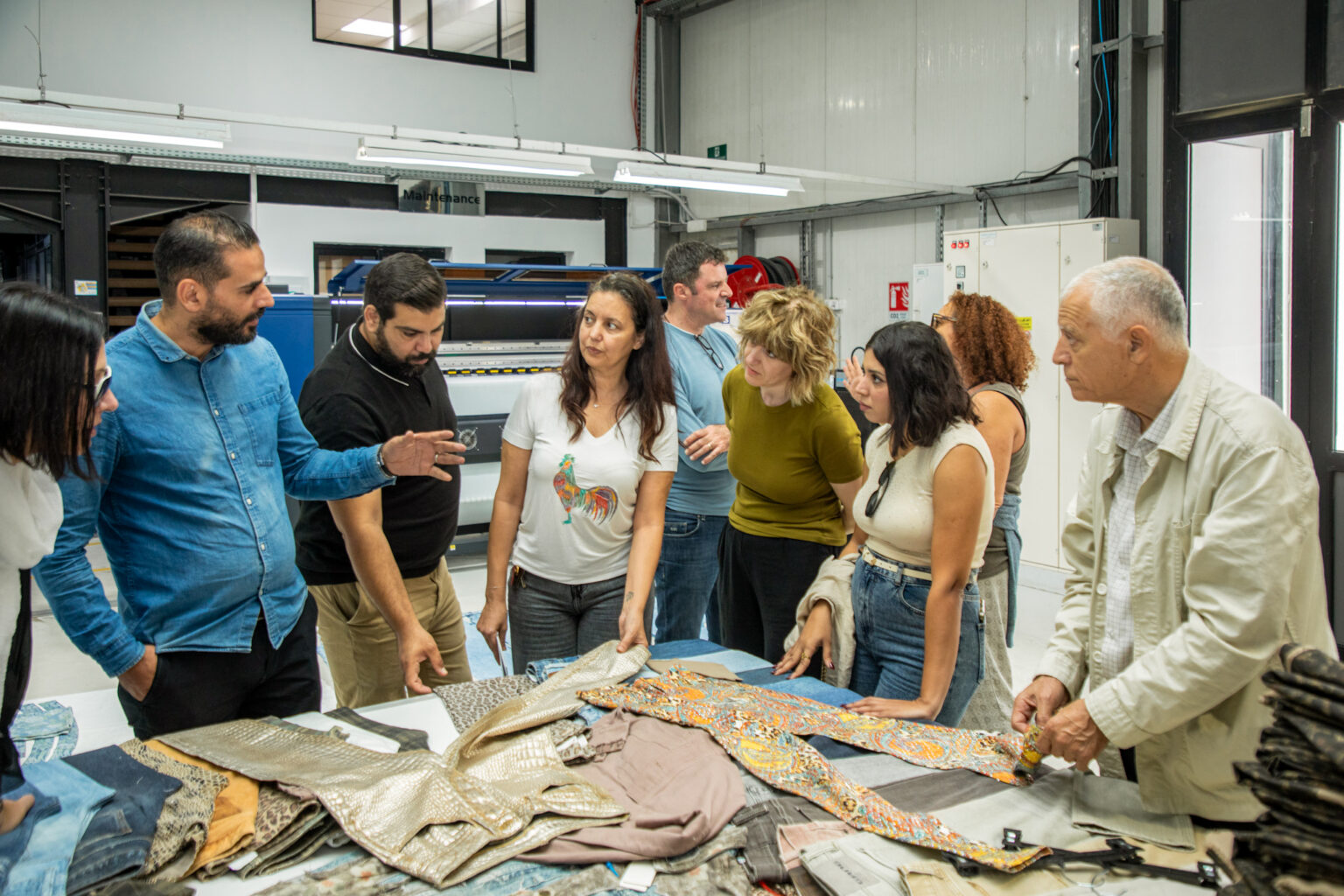
MEDinCHAMBERS advances circular textiles in Tunisia through its Living Lab and study visits

Three days of industrial study visits, knowledge sharing and co-creation in Tunisia highlight how MEDinCHAMBERS is supporting the circular transition of the Mediterranean textile sector.

Publication Date
23/11/2026
Reading Time
4 minutes

MEDinCHAMBERS advances circular textiles in Tunisia through its Living Lab and study visits

From 22 to 24 October 2026, MEDinCHAMBERS brought together project partners, industry professionals and local stakeholders in Tunisia. Over three days, participants shared knowledge, visited industrial facilities and explored new opportunities for cooperation.

The programme showed how circular textiles in Tunisia are becoming a reality through innovation and sustainable industrial practices. Moreover, it strengthened cooperation between Mediterranean partners and supported the exchange of practical solutions.

MEDinCHAMBERS is co-funded by the European Union through the Interreg NEXT MED programme. The project aims to improve cross-border governance in the textile, clothing, leather and footwear (TCLF) sectors. It involves partners from Italy, Greece, Spain, Tunisia, Egypt and Türkiye.

In particular, the project helps companies adopt circular, energy-efficient and digital practices. It also supports their alignment with European sustainability objectives, including the EU Strategy for Sustainable and Circular Textiles.

Tunisia participates through the Tuniso-Italian Chamber of Commerce and Industry (CTICI), a full project partner. CTICI connects Tunisian companies, technical centres and institutions with their European and Mediterranean counterparts.

Day 1 – Exploring circular textile practices in Sousse

On 22 October, the MEDinCHAMBERS delegation attended the INTERTEX international trade fair in Sousse. Ten delegation members explored the exhibition, discovered industry trends and met textile professionals.

The participants also gathered for a light lunch at the CTICI booth.

Later, the delegation visited the SITEX Group’s textile recycling plant in Sousse. Company representatives introduced the facility and guided visitors through the recycling process.

First, participants observed how the plant shreds used fabrics. Next, they followed the transformation process through to the production of new thread.

This visit provided a practical example of textile waste recovery. It also demonstrated how companies can turn waste into valuable raw materials.

As a result, participants gained a clearer understanding of the circular economy practices promoted by MEDinCHAMBERS.

Day 2 – Learning and co-creating solutions at the Living Lab in Monastir

On 23 October, CTICI hosted the MEDinCHAMBERS Living Lab at the MFC Pole of Technology in Monastir. The event brought together 40 participants for training, knowledge sharing and collaborative activities.

Denise Salustri, General Secretary of CTICI, opened the event with a welcome address. Afterwards, Riadh Ben Aziz, Director of the MFC Pole of Technology, introduced the host organisation.

Project partners then shared the results of their focus groups. Egyptian partner Wael Gamaleldin also contributed to the session online.

Sharing knowledge and digital tools

The programme continued with presentations on several MEDinCHAMBERS activities and tools.

First, Fadia Khraiset (CRIB) shared insights from the bootcamp. Next, Tunisian expert Fadhel Gassab introduced the Knowledge Hub and the Digital Detector.

Tiziana Campisi (CUEIM) then presented the Environmental, Social and Governance (ESG) learning platform.

In addition, expert Souha Bejaoui led an interactive training session on the Digital Product Passport (DPP).

These sessions helped participants explore tools and approaches that support the digital and sustainable transition of the textile sector.

Turning knowledge into collaborative action

In the afternoon, the Living Lab focused on teamwork and co-creation.

Organisers arranged participants at tables according to their partner countries. Each table also included local stakeholders from Tunisian companies, technical centres and institutions.

This approach encouraged dialogue between Mediterranean project partners and Tunisian industry representatives. Moreover, it allowed participants to compare different experiences and identify shared needs.

Interactive games and co-creation sessions supported the discussions. Participants also explored a wall of best practices created by the attendees.

They then contributed to the Digital Detector by sharing their specific needs.

Finally, start-ups presented their pitches. The day concluded with remarks on the project’s next steps and a group photograph.

Day 3 – Discovering sustainable water management at SARTEX

On 24 October, the delegation visited the SARTEX Group’s wastewater treatment facility in Ksar Hellal.

The visit began in the colour laboratory. Here, company representatives explained the challenges of achieving precise shades in textile dyeing.

They also demonstrated how specialised machines measure colours and reproduce them accurately.

Reducing water and energy consumption

Next, participants explored the dyeing unit and learned about SARTEX’s resource-saving practices.

The company recovers heat from process water and reuses it in other facilities. In addition, it has reduced water consumption through a circular fabric-wetting process.

Instead of fully immersing fabrics, this process wets them in a continuous cycle.

These solutions demonstrate how textile manufacturers can improve resource efficiency while reducing water and energy consumption.

How SARTEX treats and recycles wastewater

The delegation then visited the wastewater treatment and recycling plant.

First, the facility collects wastewater from industrial workshops and removes sand. The water then enters an equalisation tank, where the process regulates pH and adds oxygen.

Next, microorganisms clean the water through biological treatment. Afterwards, the water enters a settling tank, where gravity separates sludge from clarified water.

The facility recycles the dried sludge into flooring materials.

Meanwhile, the water undergoes sand filtration and reverse osmosis. According to the process presented during the visit, these treatments make the water drinkable.

The facility also tests all tanks twice daily.

Overall, the visit showed participants how industrial facilities can recover resources and close water loops through recycling.

Strengthening cooperation for a circular Mediterranean textile sector

Over three days, MEDinCHAMBERS combined international networking, industrial study visits, training and collaborative learning.

The visits to SITEX and SARTEX demonstrated the practical application of circular economy principles. In particular, participants observed textile recycling, energy recovery and water-saving solutions already in use in Tunisia.

Meanwhile, the Living Lab created opportunities for partners, experts, start-ups and local stakeholders to exchange knowledge. It also helped them identify shared needs, co-create solutions and shape the project’s next steps.

Together, these activities reinforced the value of cross-border cooperation. They also highlighted the contribution of CTICI and its Tunisian partners to a more sustainable Mediterranean textile sector.

Circularity is no longer just a promise in the Tunisian textile industry: it is already at work on the factory floor.

Last Update

23/11/2026