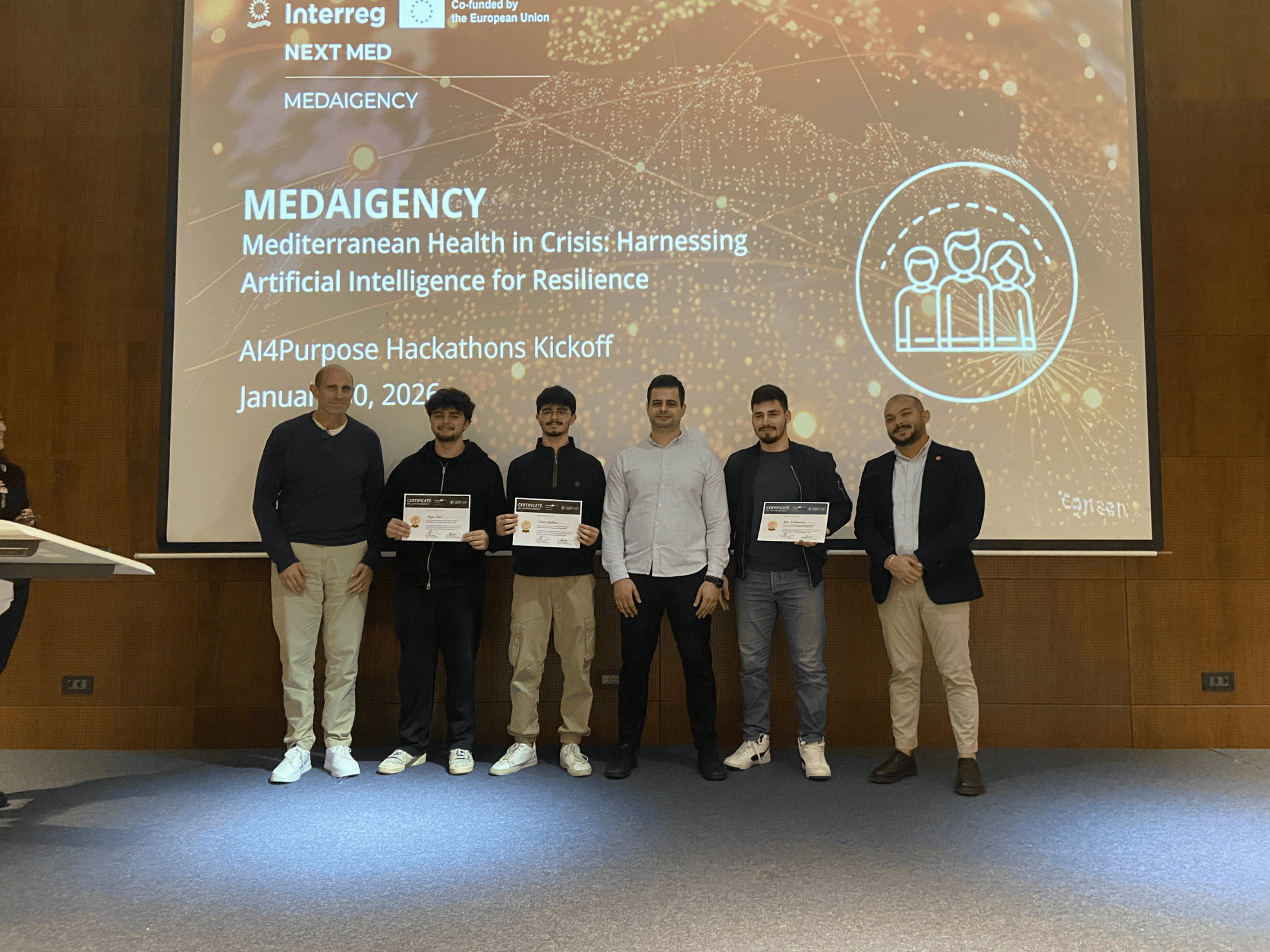
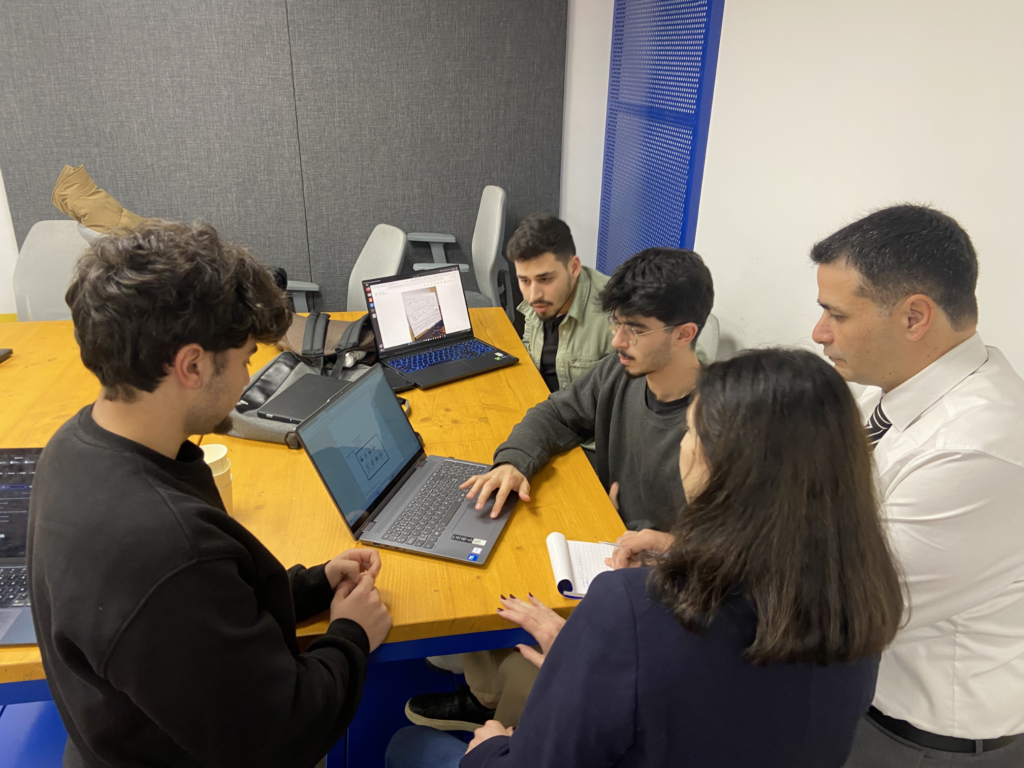
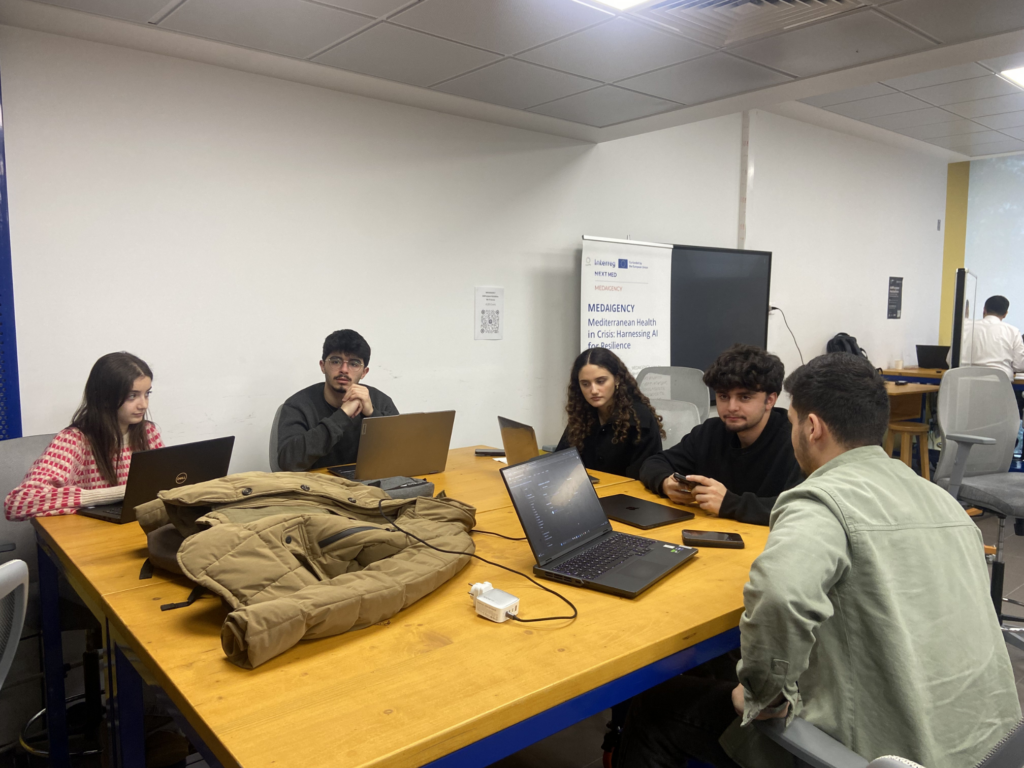
How can artificial intelligence help us respond faster and more effectively to health emergencies? This question was at the heart of the AI4Purpose National Hackathons organized by the MEDAIGENCY project.
Bringing together talents from across the Mediterranean, these hackathons sparked innovative solutions grounded in real-world needs and local experiences.
In this interview, we hear from a team of Computer Engineering students from the American University of Beirut, who share their journey and present their AI-driven solution to improve emergency response coordination.
Interview with AUB Student Team – Computer Engineering Students
About Your Team
We are second-year students at the American University of Beirut studying Computer Engineering (EECE/CCE). Our team members are William Chalhoub, Hadi Al Shmaissani, Rayen Tabet, and Celena Saadeh. As a team, we have been developing our skills in programming and systems through our coursework. Each of us brings a different perspective, but we all share a common interest in areas like software systems, data, and AI.
How did you first hear about the AI4Purpose Hackathon, and what motivated you to participate?
We first learned about the AI4Purpose Hackathon through academic and student networks, and we were interested right away because it focuses on using AI in real-life situations.
What motivated us most was the idea of improving emergency response systems. In situations like medical emergencies, fires, or disasters, even small delays can make a big difference. We wanted to explore how better coordination and data can help send the right resources faster and more efficiently.
This topic is important to us because, as Lebanese students, we have been through a lot in the past few years. Even though people often know how to react during crises, the systems themselves are not always organized or efficient, and AI is not really used. We believe that using it could improve communication, make coordination easier, and help responses happen faster.
Your AI Solution
What problem or challenge does your solution address?
Our solution tackles the critical delays and inefficiencies inherent in traditional emergency medical triage. During high-stress situations, manually assessing incident severity and dispatching the appropriate medical resources often creates dangerous bottlenecks. Our system addresses this by ensuring immediate, accurate categorization of emergencies as soon as they are reported.
Who are the intended users or beneficiaries?
The primary beneficiaries are patients requiring urgent medical attention, as well as the emergency dispatchers and first responders who rely on rapid, accurate data to do their jobs effectively.
How does AI contribute to solving this problem?
Our team developed an AI-Driven Emergency Response Coordinator to automate the emergency triage process. The AI models ingest real-time emergency data, evaluate the medical severity of each case, and instantly coordinate the logistics of deploying the right resources. By leveraging machine learning and automated workflows (incorporating tools like Python and n8n), the AI acts as an intelligent, rapid-response dispatcher that scales effortlessly during high-demand events.
What makes your solution innovative or impactful?
The innovation lies in removing human bottlenecks from the initial triage phase to accelerate deployment. By replacing manual sorting with a dynamic, automated workflow, the system drastically reduces response times and optimizes the allocation of scarce medical resources. This ensures that critical care is prioritized efficiently, maximizing the overall impact of emergency personnel.
Future Development of the Idea
How do you plan to further develop or apply your solution following the hackathon?
Following the hackathon, we plan to transform our prototype into a real-time, deployable emergency dispatch platform by adding a database, multi-user support, and live system deployment. We will also improve communication between dispatchers and stations, along with system reliability and security.
The solution can be applied in real-world emergency services such as hospitals, fire departments, and civil defense to optimize response times and coordination.
A key future improvement is integrating AI to detect the type of fire (e.g., electrical, chemical, residential) and automatically notify stations with the appropriate equipment and response strategy.
Collaboration with stakeholders, institutions, and the MEDAIGENCY project will help validate the system, access real data, and support deployment in real emergency environments.
Mediterranean Perspective
How has participating in a Mediterranean-level competition influenced your perspective or the development of your solution?
As soon as we realized how many different countries were involved in this competition, it clicked for us right away: we had to completely shift our perspective from a local mindset to a global one.
In the beginning, we looked around and saw all these different teams from across the Mediterranean, and each country was focusing on a specific, high-impact disaster that affected them uniquely. Seeing that, we realized we shouldn’t just build a highly localized tool. Instead, we decided to pivot and build a common solution, something versatile enough to respond to the major, widespread disasters that can strike any of our countries, like devastating wildfires or earthquakes.
That transnational approach really shaped our whole architecture. But I’d say the biggest takeaway came from interacting with the international mentors and the jury. Their insights helped us a massive amount. In fact, based on their feedback, we actually went back and reframed our core idea right at the end to make sure our solution rigidly addressed data privacy and AI ethics in crisis.
We would like to warmly thank Mr. Ayman Rahmeh, MEDAIGENCY Communications Manager at the American University of Beirut, for facilitating this series of interviews.
 Next Med