The green transition works only when participation is real, produces visible results and generates trust.
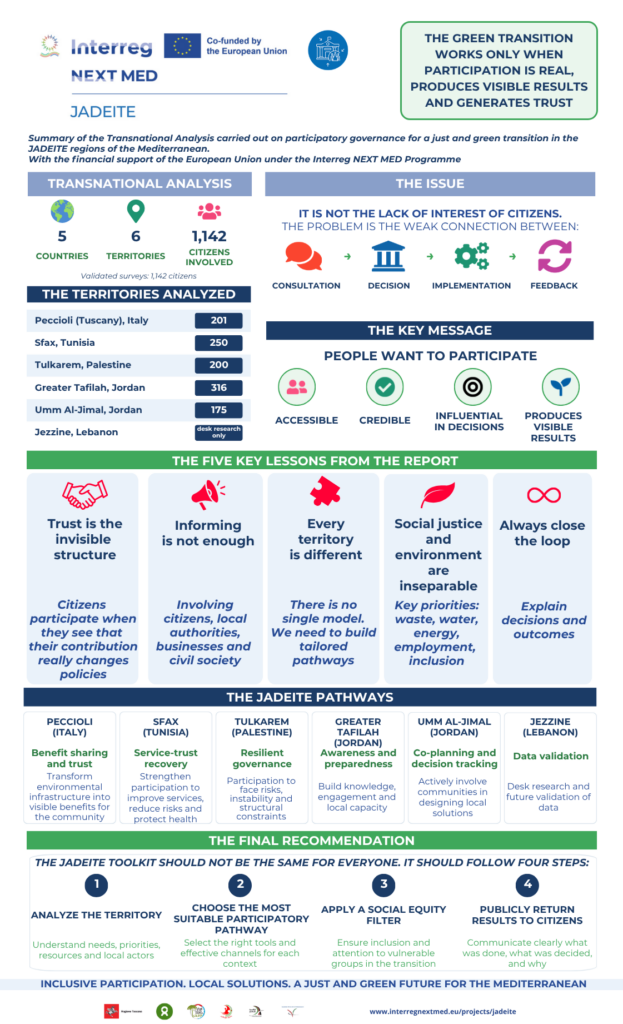
This is the key finding of the Transnational Analysis on participatory governance for a just and green transition in the JADEITE regions of the Mediterranean, carried out with the financial support of the European Union under the Interreg NEXT MED Programme.
An analysis across 5 countries and 6 territories
The study involved 1,142 citizens through validated surveys, distributed across six territories in five countries:
- Peccioli (Tuscany, Italy) with 201 respondents,
- Sfax (Tunisia) with 250,
- Tulkarem (Palestine) with 200,
- Greater Tafilah (Jordan) with 316,
- Umm Al-Jimal (Jordan) with 175,
- Jezzine (Lebanon), analyzed through desk research.
The problem is not a lack of interest
The data shows that citizens are not lacking interest in green transition issues. The real problem lies in the weak connection along the participatory chain: consultation, decision, implementation and feedback fail to communicate effectively with one another.
What citizens are really asking for
The key message emerging from the analysis is simple: people want to participate, but only when the process is accessible, credible, genuinely influential in decisions, and capable of producing visible results.
The five lessons from the report
The report identifies five key lessons.
- Trust is the invisible structure underpinning participation: citizens engage when they see their contribution actually changing policies.
- Informing is not enough: it’s essential to actively involve citizens, local authorities, businesses and civil society.
- Every territory is different, and there is no single model: tailored pathways are needed.
- Social justice and the environment are inseparable, with shared priorities on waste, water, energy, employment and inclusion.
- Finally, it’s always necessary to close the loop, explaining decisions and outcomes back to citizens.
Tailored pathways for each territory
Based on the analysis, JADEITE has defined a specific pathway for each territory:
- Peccioli focuses on benefit sharing and trust;
- Sfax on service-trust recovery;
- Tulkarem on resilient governance in the face of risk and instability;
- Greater Tafilah on awareness and preparedness;
- Umm Al-Jimal on co-planning and decision tracking;
- Jezzine on data validation.
The final recommendation
The JADEITE toolkit should not be the same for everyone, but should follow four steps: analyze the territory, choose the most suitable participatory pathway, apply a social equity filter to protect vulnerable groups, and publicly return results to citizens.
Inclusive participation. Local solutions. A just and green future for the Mediterranean.
Explore the key findings in the infographic below.
 Next Med