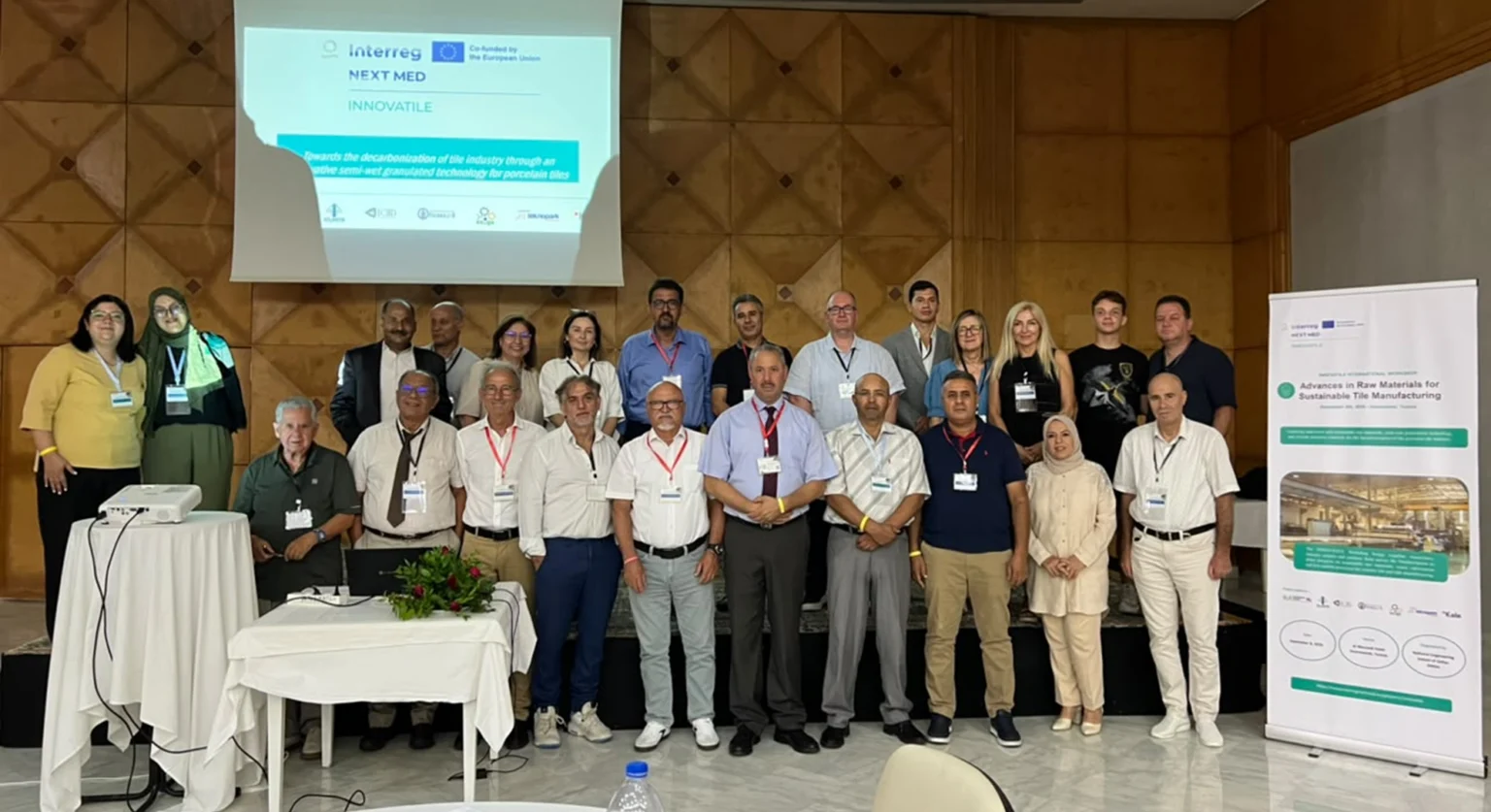
The National Engineering School of Gafsa (ENIGA), University of Gafsa, Tunisian partner of INNOVATILE hosted the INNOVATILE International Workshop 2026: Advances in Raw Materials for Sustainable Tile Manufacturing on September 8, 2026, at Al Mouradi Hotel in Hammamet.
It brought together researchers, industrial professionals, innovation organizations and public authorities to examine solutions for reducing the environmental impact of ceramic tile manufacturing.
Targeting major reductions in energy and resource consumption
The innovative process being developed by the project aims to achieve significant environmental improvements, including an anticipated 30–35% reduction in energy demand and greenhouse gas emissions and a 10–20% reduction in water and raw material consumption.
Another important objective is to increase the use of secondary raw materials, industrial waste and by-products in ceramic production, thereby supporting circular-economy principles.
The project is also investigating alternative raw materials and fluxing agents that could reduce dependence on critical resources such as feldspar.
Following validation of the technology, the project foresees pilot implementation with an industrial end user, with the possibility of replication in another country. Environmental analysis will assess the performance of the new process in comparison with conventional manufacturing approaches.
International expertise comes to Tunisia
The September workshop provided a platform for international experts to share research findings and industrial perspectives on sustainable ceramic manufacturing. Technical sessions addressed topics including Tunisian clay resources, alternative fluxing agents, Central Anatolian syenites and methods for predicting ceramic sintering behavior.
The programme also featured a high-level round table entitled Challenges and Innovative Solutions for a Sustainable and Decarbonized Tile Industry.
The discussion brought together representatives of academia, industry and public institutions to consider how research, industrial innovation and public policy can work together to accelerate the transition towards a more sustainable and decarbonized ceramic sector.
Strengthening Mediterranean cooperation
As part of the project, partners are also establishing the HypocarbonTileTech network, which will serve as a platform for cooperation across the Mediterranean ceramic tile value chain.
The network will focus on decarbonization, renewable energy, waste management, secondary raw materials and resource efficiency, while encouraging collaboration between researchers, companies, students and policymakers.
For Tunisia, the initiative provides an opportunity to strengthen the country’s participation in European and Mediterranean research and innovation networks while contributing local scientific and industrial expertise to the development of more sustainable manufacturing technologies.
 Next Med