Growing Upwards: Resource-Efficient Vertical Farming. PROTECHMED explores sensor-enabled farming to optimise water, energy, and land use.
The University of Thessaly’s ThermoPharma Box Pilot is exploring how sensor-enabled vertical farming, hydroponic cultivation and controlled environment agriculture can optimise water, nutrients, energy and land while supporting more resilient, year-round horticultural production in the Mediterranean.
Publication Date 01/09/2026
Reading Time 5minutes
Across the Mediterranean, horticultural producers face an increasingly difficult challenge: maintaining reliable production while coping with water scarcity, limited agricultural land, rising energy costs and a changing climate.
Through the PROTECHMED project, the University of Thessaly is exploring how controlled environment agriculture, hydroponic cultivation and data-supported crop management can contribute to more efficient use of water, nutrients, energy and land.
“Vertical farming gives us an opportunity to produce more food with far less water and land. By combining controlled environment agriculture with sensors and automation, we aim to develop a practical model that responds to the Mediterranean’s growing resource and climate pressures.”
— Alexandros Papachatzis, University of Thessaly
Located at the University’s Gaiopolis Campus in Larissa, Greece, the ThermoPharma Box Pilot serves as a research and innovation platform for developing and testing resource-efficient approaches to horticultural production.
A compact system for high-density production
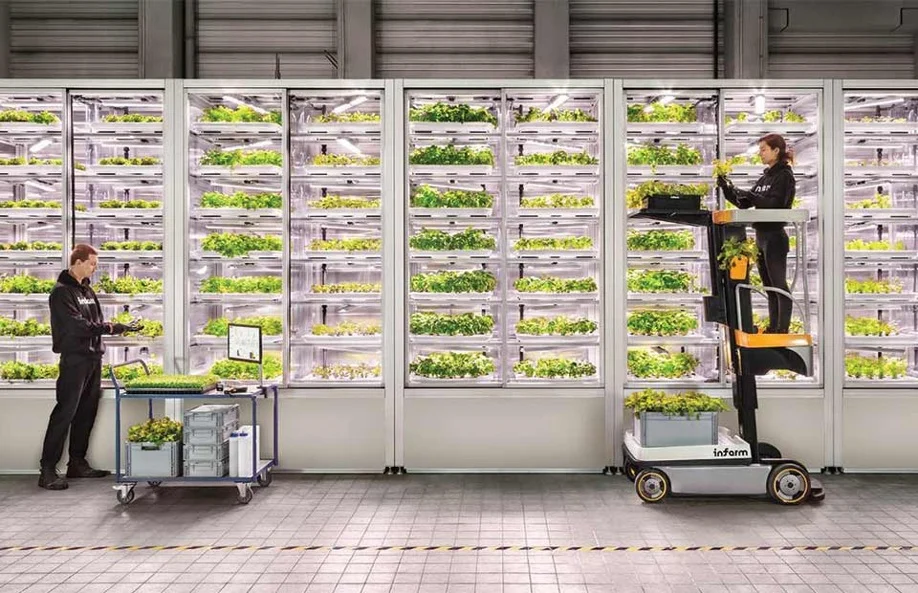
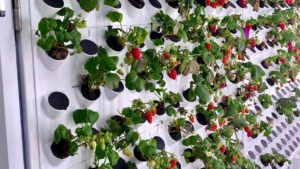
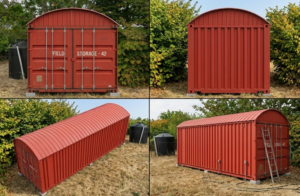
The existing prototype consists of a modular insulated cultivation tunnel measuring approximately 7 metres by 2.5 metres by 2.3 metres. Inside, a ten-level, stacked hydroponic cultivation system supports the soil-free production of leafy greens, herbs and vegetables.
The current infrastructure is described as an experimental horizontal farming prototype organised across ten cultivation levels. Through the PROTECHMED Pilot Action, the University of Thessaly will develop this infrastructure into a more advanced, sensor-enabled vertical-farming model supported by automation and Decision Support Systems.
Cultivation across multiple levels offers the potential to achieve greater production density within a smaller land footprint. This makes the model relevant to the University’s planned assessment of scalable urban agriculture applications.
The infrastructure already includes a closed-loop irrigation and nutrient circulation system, water recovery and recirculation components, and a controlled environment chamber for temperature, humidity and carbon dioxide. The current prototype also uses natural daylight, depending on weather conditions.
Instead of allowing water and nutrients to be lost after application, the system recovers and recirculates them. High water-use efficiency has already been achieved, although the wider expected savings will need to be measured and validated during the Pilot Action.
From controlled cultivation to data-supported management
A major area for improvement will be the integration of sensors for real-time crop monitoring. These will generate data on crop and environmental conditions, supporting closer management of the controlled cultivation environment.
The system is also planned to incorporate LED lighting optimised for plant-growth spectra. This will provide artificial lighting for indoor cultivation and reduce dependence on available daylight. Future improvements also include automated ventilation and regulation of carbon dioxide, humidity, temperature and airflow.
The planned aeroponic system will use micro-droplet misting to deliver water and nutrients to the root zone. Root-zone oxygenation, continuous water recycling and sterilisation, and targeted nutrient dosing are intended to improve nutrient and water-use efficiency.
Advanced Decision Support Systems will bring together data from the cultivation environment and support climate, irrigation, fertigation and nutrient management. These tools can contribute to data-driven optimisation of crop management, yield and resource use.
The intention is not to replace researchers’ or growers’ knowledge. Instead, digital tools can support more informed management by turning real-time monitoring data into practical decision support.
Resource efficiency under Mediterranean conditions
The expected impacts of the ThermoPharma Box are particularly relevant to a region facing increasing pressure on water and land resources.
The Pilot Action is targeting water savings of more than 90% compared with conventional systems, together with a potential reduction of up to approximately 90% in nutrient use. High-density cultivation could also reduce land requirements by approximately 80–90%.
These figures are expected impact targets rather than demonstrated results. The Pilot Action will provide an opportunity to test, measure and document the performance of the improved system.
The future controlled environment is also intended to support pesticide-free production and year-round cultivation independent of external climatic conditions. Its compact and modular design has strong potential for scaling as an urban agriculture and food-security model.
Energy use remains an important part of the pilot’s development. Lighting, cooling and other environmental controls require energy, and energy-efficiency optimisation is therefore one of the areas that the University intends to address.
The objective is to examine how water, nutrients, energy, land and growing conditions can be managed as parts of one integrated production system.
Research perspective
“The Sicily Camp showed us that resource efficiency cannot be addressed through one technology alone. Sensors, irrigation, nutrient management, lighting and climate control must function as one integrated system. Our Pilot Action will examine how data and Decision Support Systems can help coordinate these elements under controlled production conditions.”
— Dorothea Kasiteropoulou, University of Thessaly
The PROTECHMED Transnational Exchange in Sicily brought together researchers, growers, SMEs and technology providers from Italy, Greece, Malta, Tunisia, Lebanon and Türkiye.
Through field visits, demonstrations, workshops and co-design sessions, participants explored environmental sensors, IoT platforms, hydroponic and aeroponic systems, agrivoltaics, precision irrigation, smart glasses and Decision Support Systems.
For the University of Thessaly, the exchange highlighted the importance of approaching resource efficiency as an integrated challenge. Sensors, irrigation, nutrient delivery, lighting, climate control and data analysis must work together if controlled environment agriculture is to achieve its intended results.
The Sicily Camp also reflected PROTECHMED’s Living Lab and co-design philosophy. Researchers, companies and growers jointly considered how emerging technologies could respond to practical production challenges. This exchange of experience will inform the development of Pilot Actions across the participating Mediterranean territories.
Looking Ahead
The next stage will focus on improving the ThermoPharma Box through sensor integration, LED-assisted cultivation, aeroponic root management, greater automation and advanced decision support.
The University will also assess the scalability of the system for urban agriculture applications. Its planned future configuration is a fully controlled indoor cultivation system capable of supporting high-density, year-round production.
“Through the Pilot Action, we expect to move from an experimental cultivation prototype towards a more integrated, data-driven system. By testing sensors, automation and Decision Support Systems together, we aim to demonstrate how controlled environment agriculture can improve resource efficiency and support the transition of Mediterranean horticulture.”
— Dorothea Kasiteropoulou, University of Thessaly
By sharing the pilot’s experience and results across the PROTECHMED partnership, the University of Thessaly will contribute to wider Mediterranean cooperation on climate resilience, digitalisation and resource-efficient horticulture.
For a region in which water, land and climatic stability can no longer be taken for granted, growing upwards may become an important part of a more resilient and technologically enabled horticultural future.
Last Update
01/09/2026
The Interreg NEXT MED website uses technical, analytics and third-party cookies. By continuing to browse, you accept the use of cookies. Privacy Policy
 Next Med