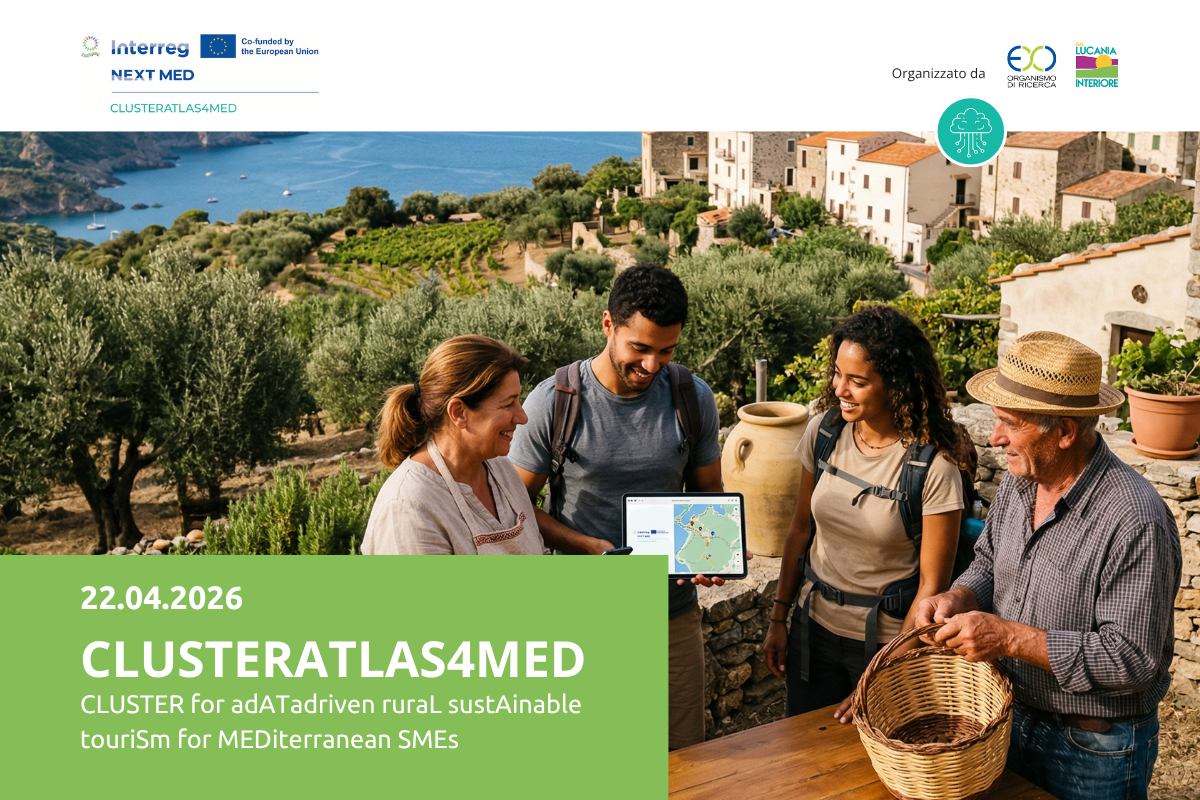
CLUSTERATLAS4MED is moving forward across the Mediterranean, and stakeholders engagement is now taking centre stage.
In recent weeks, our project has stepped up activities in different partner countries, bringing together the people and organisations who will help shape its most important results. From public institutions and local SMEs to incubators, consultants, educators and tourism professionals, these meetings are creating the connections needed to turn the shared vision standing beneath our project into practical action.
At the heart of this process is a simple idea: building a more digital, sustainable and resilient model of rural tourism requires collaboration from the start. That is why stakeholders engagement is not just a supporting activity within CLUSTERATLAS4MED. It is one of the main ways through which the project is taking shape on the ground.
The journey began in Tunisia, where partner Chambre de Commerce et d’industrie du Cap Bon launched the first stakeholder meeting in January, followed by a second session on 10 April in Hammamet. These meetings brought together a broad range of local actors and offered an important opportunity to discuss the challenges and opportunities facing rural tourism today. The exchange confirmed the importance of involving stakeholders from the earliest stages of the project, so that the solutions we develop are rooted in real needs, local knowledge and concrete territorial priorities.
Discussions in Tunisia highlighted several key themes that are central to the project: strengthening support for local entrepreneurship, investing in skills, improving coordination among ecosystem actors, and making better use of data to inform policy and investment decisions. Special attention was also given to the upcoming Rural Living Labs, which will serve as open spaces for co-creation, experimentation and innovation in rural tourism services.
The process then continued in Italy, and more specifically in Basilicata, where lead partner EXO held the first local stakeholder meeting on 25 March at GAL Lucusin Genzano di Lucania. This was an important moment for dialogue with local actors on the future of inland areas and on the role that CLUSTERATLAS4MED can play in unlocking new opportunities for rural territories. More than a presentation, the meeting helped open a shared reflection on how to connect local potential with a broader Mediterranean perspective, while reinforcing the role of co-design in the project’s approach.
This pathway is now set to continue with two further meetings scheduled for 22 and 27 April, respectively at GAL Lucania Interiore and GAL Percorsi. These next steps will help widen the involvement of local SMEs and strengthen the participatory processes through which the project aims to generate meaningful and lasting impact.
The engagement journey now moves to Spain, where partner AnySolution will host a stakeholder meeting on 24 April in Mallorca, at Parc Bit. The event will bring together actors from the Balearic tourism ecosystem and will provide another important opportunity to share the project’s objectives, deepen dialogue with local stakeholders and prepare the next co-creation activities.
As part of our strong commitment to fostering an increasingly competitive and sustainable rural tourism sector across the Mediterranean basin, similar initiatives will also be rolled out across all the other territories and partner countries involved in the project – including Malta, Greece, Egypt and Türkiye – further broadening stakeholder participation and reinforcing the shared Mediterranean dimension of CLUSTERATLAS4MED.
Taken together, these meetings tell an important story. They show CLUSTERATLAS4MED not simply as a project working across different countries, but as a growing Mediterranean community of actors committed to shaping a new future for rural tourism. A future in which innovation is shared, local realities are valued, and digitalisation becomes a tool to support more sustainable development.
As this engagement process continues, one thing is already clear: the strength of CLUSTERATLAS4MED lies in its ability to connect territories, perspectives and expertise. And it is through this growing network of stakeholders that we are building the foundations of a trans-Mediterranean hub-and-spoke cluster for the digitalisation of rural tourism, together with a broader strategy for promoting more sustainable rural tourism across the Mediterranean.
 Next Med