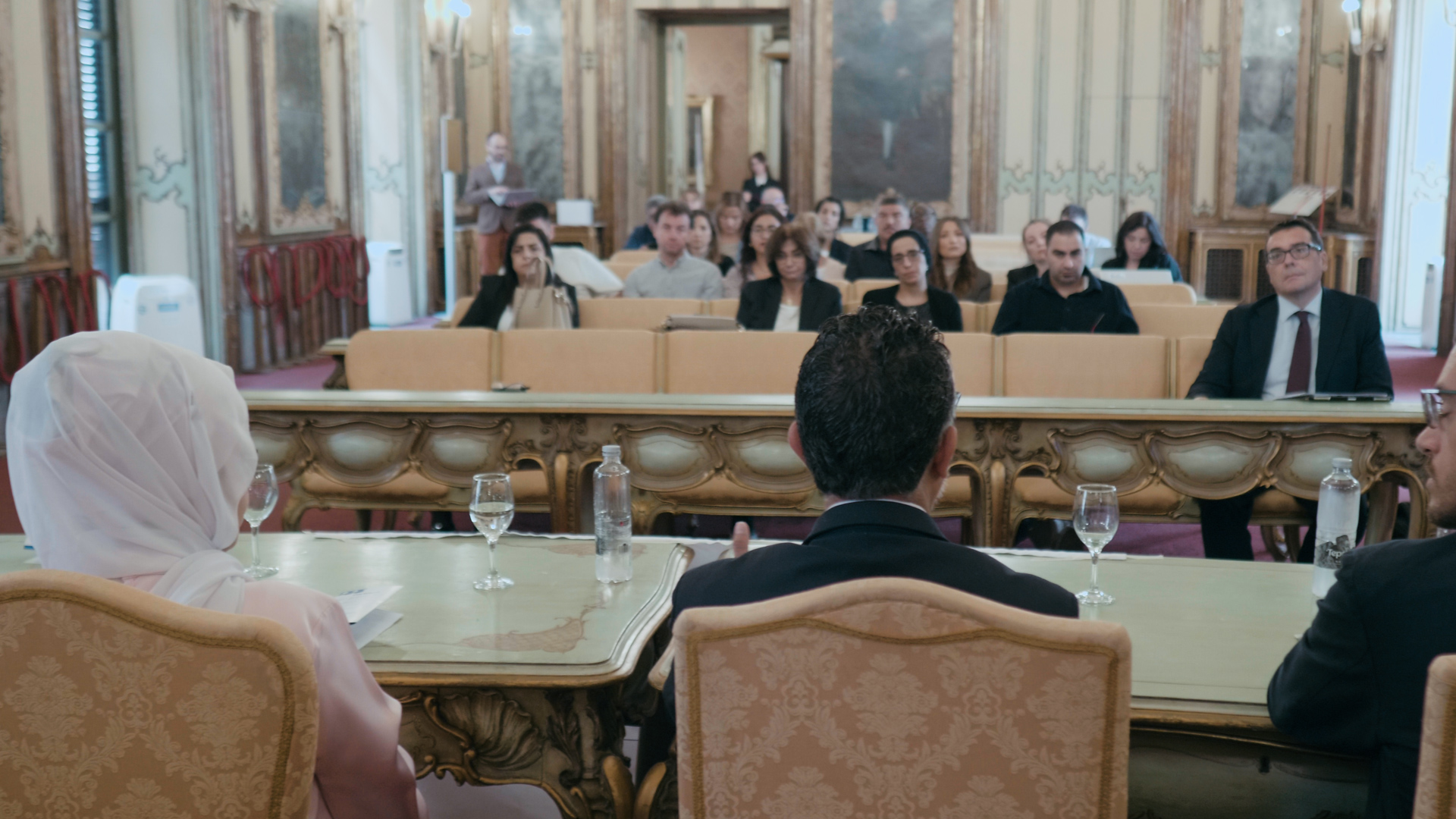
A press conference to launch CLOSER – Connecting Local Proximity Networks Sustaining Participatory Governance was held on Thursday 30 October at the Sala Martorana of Palazzo Comitini in Palermo. The project, coordinated by the Centro per lo Sviluppo Creativo Danilo Dolci – ETS and funded by the Interreg NEXT MED Programme, aims to strengthen social services in peripheral and underserved Mediterranean areas through models of participatory governance.
The initiative brings together partners from Italy, Spain, Greece, Palestine, Jordan and Lebanon, united by the ambition to structurally bridge the gap between institutions and inhabitants and to promote long‑lasting social cohesion policies.
The transnational partnership, led by Centro per lo Sviluppo Creativo Danilo Dolci – ETS, brings together organisations with extensive experience in the social and cooperation sectors: EUROTraining (Greece), the University of Alicante (Spain), JUHOUD for Community and Rural Development (Palestine), ARDD – Arab Renaissance for Democracy and Development (Jordan), and Moukhtara Municipality (Lebanon).
The event was opened by City Councillor Fabrizio Ferrandelli, representing the Metropolitan Mayor Roberto Lagalla. Councillor Ferrandelli emphasised the Municipality of Palermo’s commitment to actively collaborating with the project to develop services based on the real needs of residents, fostering continuous dialogue between the administration and local communities.
Alberto Biondo, coordinator at the Centro per lo Sviluppo Creativo Danilo Dolci – ETS, highlighted how CLOSER represents the culmination of a long journey of cooperation rooted in Danilo Dolci’s methodology:
“This project is the result of a collective journey in line with the legacy of Danilo Dolci, who always prioritised bottom-up participation, listening to needs, and the construction of new futures. CLOSER brings to the Mediterranean scale the success of local experiences such as those in the neighbourhoods of Kalsa and Albergheria – with the projects Dappertutto, CASA Ballarò, Fuori Tema – where we managed to connect communities and educational spaces to build a widespread community welfare system. Participation, as Dolci wrote, is the ‘power-duty to choose how to exist’: with CLOSER, we want to make this right a reality, creating a space where every person can decide and contribute to the life of their community.”
The technical presentation was delivered by Antonella Alessi, project coordinator for Centro Danilo Dolci, who underlined that CLOSER was created to respond to urgent needs, as depopulation in rural areas and the growing distance between policy‑makers and residents:
“No real and sustainable change can occur without the direct involvement of all stakeholders; change can never be imposed from above. Through CLOSER, we will activate ‘proximity networks’ capable of managing public affairs by including inhabitants in every phase: from needs analysis to co-design and service monitoring. Through transnational training and pilot projects in six different territories, we will test a model where social services finally respond to the desires and needs of those who use them daily.”
Mario Alvano, Secretary General of ANCI Sicilia (Association of Italian Municipalities), confirmed the support of the association, defining CLOSER as a fundamental opportunity for revitalisation and cooperation, especially for small municipalities that can enhance the effectiveness of their local welfare through these networks.
The international dimension was further explored by the partners in attendance:
- Malak Suleiman, project manager at the Arab Renaissance for Democracy and Development (Jordan), explained that participatory governance in Jordan is affected by the absence of institutionalised accountability systems and fragmentation within civil society: “CLOSER will foster the creation of cross-border proximity networks that will serve as platforms for exchanging knowledge and expertise. We will work on a strategic model to institutionalise citizen participation and ensure that services truly respond to the needs of the local context, thus ensuring long-term sustainability.”
- Mughannam Ghannam, General Manager of JUHOUD for Community and Rural Development (Palestine), described the project as an extraordinary opportunity to promote civic engagement: “We believe CLOSER will bring real added value to our country. By exchanging best practices among the six Mediterranean partners, we will be able to enhance the participation of grassroots organisations, local authorities, and the community, tangibly improving active citizenship practices for the future.”
With the establishment of local networks and the start of stakeholder mapping, CLOSER now enters its operational phase, aiming to empower local actors as protagonists of inclusive, transparent, and effective solutions, contributing measurably to the well-being and social cohesion of the most disadvantaged areas of the Mediterranean.
 Next Med