From Planning to Field Response to Recovery: Meet the AI Solutions Taking Shape through MEDAIGENCY
From disaster simulations and emergency coordination to public guidance and healthcare support, discover the solutions taking shape through MEDAIGENCY across Lebanon, Palestine, Türkiye and Italy. Developed around local needs, they explore how AI can support preparedness, response and recovery, with stakeholder engagement and responsible use guiding their path towards piloting and adoption.
Publication Date 18/11/2026
Reading Time 6minutes
Across Lebanon, Palestine, Türkiye and Italy, MEDAIGENCY is bringing together technical teams and health and emergency actors to develop solutions that address practical challenges before, during and after a crisis. These range from simulating disaster scenarios and coordinating emergency fleets to helping people find assistance and supporting continuity of healthcare.
The solutions respond to different local realities, while addressing challenges shared across the Mediterranean: fragmented information, pressure on limited resources, disrupted communications and the need to make timely decisions under uncertainty. Together, they illustrate how AI can support preparedness, response and recovery when developed around the needs of the people and the organizations expected to use it.
Lebanon: Connecting Preparedness, Information and Emergency Operations
At the American University of Beirut, five solutions bring together complementary capabilities for disaster planning, public guidance, damage assessment and operational coordination.
Sentinel Twin combine scenario-based impact assessment with a digital model of the institutions and infrastructure involved in emergency response. The solution allows planners to explore “what-if” scenarios, estimate potential human and infrastructure impacts, and examine how available response capacities could meet emerging needs. It can help identify pressures on hospitals, consider evacuation routes and assess gaps in resources or coordination. Reconstructing past incidents also offers opportunities to learn from previous decisions. Its purpose is to support planning for possible events.
Situational Assessment & Response Agent focuses on the information needs of people affected by emergencies. The public-facing chatbot is designed to help users understand a developing situation and access relevant guidance, emergency contacts and services such as shelters or medical assistance. By bringing together available alerts, service directories and trusted local information, this tool aims to make guidance more relevant to a person’s location and needs. Uncertain or life-critical requests are escalated for human review.
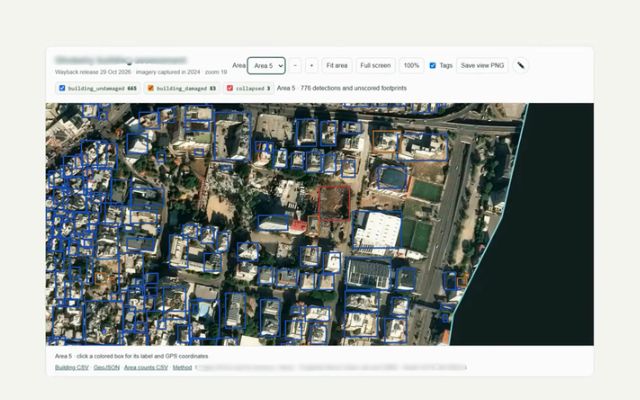
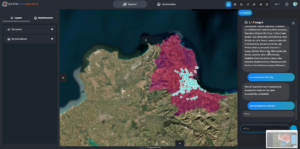
AI-Powered Post-Disaster Damage Assessment supports responders in understanding the extent and location of damage after an emergency. It uses AI to analyse imagery, identify damage to buildings and roads, and produce maps that can inform rescue priorities and early recovery planning. The solution aims to reduce the time and exposure involved in extensive manual assessments. Confidence scores help flag uncertain detections for further verification, while development includes adapting the models to regional building types and urban environments.
Buildings Damage Assessment Summary
Cross-Organizational Communication in Disaster Response addresses the difficulty of exchanging operational information across institutions with different systems and procedures. Each participating organization is represented by an AI agent connected to its information and sharing policies. These agents help prepare and exchange relevant updates on resources, incident conditions and operational constraints, while applying rules on what may be shared externally. The aim is to support a more coordinated response while preserving organizational control over information.
AI for Fire Incident Triage and Fleet Tracker bring citizen reporting and field coordination into one combined solution. The reporting component guides people through a structured WhatsApp conversation to gather incident details and prepare a report for dispatchers, including location and nearby hazards. The fleet component supports the assignment and monitoring of response units through a live map, vehicle status information and route guidance. Together, they are intended to connect the first report of an incident with the coordination of the response, with operators retaining final approval over dispatch decisions.
Türkiye: Supporting Tactical Decisions and Resource Logistics
At İzmir Kâtip Çelebi University, two solutions focus on helping emergency actors interpret operational information and coordinate resources.
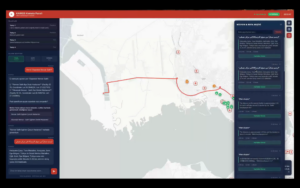
AI Response & Operations System helps incident commanders turn field requests into practical, map-based decisions. Users can submit requests in everyday language, allowing the system to query spatial and resource data, support the assessment of urgency and propose routes or resource assignments. This makes geospatial information more accessible to teams without specialist mapping expertise. Proposed actions are submitted to the incident commander for approval, keeping tactical decisions under human control.
AI Response & Operations System – User Dashboard
Disaster Resilience & Resource Logistics brings together risk analysis, routing and logistics support across preparedness, response and recovery. Combining seismic and structural analysis with route planning and resource optimization, it is intended to help emergency actors assess vulnerabilities and organize the movement of resources. An operational dashboard brings these functions together to support coordination as conditions change.
Palestine: Supporting Accessible Response and Continuity of Care
At Birzeit University, four solutions address emergency navigation, health resource coordination, children’s psychological support and shared crisis information. Their designs respond to settings where access, connectivity and essential services can be severely disrupted.
ICN — The Autonomous Sentinel Navigator is a wearable guidance and distress-signaling solution designed with particular attention to people who may face additional barriers during evacuation, including people with visual impairments or limited mobility. It combines sensor information, locally processed AI, voice prompts and tactile guidance to support navigation and alert rescuers to people needing assistance. Its design includes operation during internet outages, although positioning accuracy and rescue connectivity depend on the supporting equipment and infrastructure available.
PHS-Sentinel focuses on connecting fragmented health information to support the coordination of scarce resources. The platform brings together information from hospitals, clinics and blood banks, with a particular emphasis on monitoring blood availability and connecting needs with supplies and consenting donors. Its purpose is to help health authorities and emergency teams identify emerging shortages and coordinate action across facilities. Clinical and dispatch decisions remain with human professionals, and implementation depends on data-sharing arrangements and clear protections for personal information.
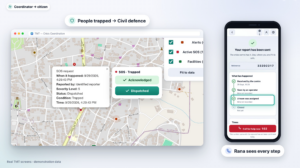
Crisis Intelligence & Coordination Platform brings citizen reports, agency information, hospital resources and map-based updates into a shared view of an emergency. Its public portal supports guided reporting and access to crisis information, while its coordination dashboard helps responders review and prioritize alerts. AI assists with tasks such as identifying duplicate reports, assessing their relevance and organizing incoming information. The platform aims to improve shared situational awareness across agencies, supported by human oversight and agreed arrangements for exchanging data.
TMT Coordinator-Citizen Report
SENSE explores how AI can support the identification of psychological support needs among children affected by crises. Through drawing and voice-based interactions, it is designed to provide initial support and help professionals identify children who may require further attention. The approach includes local processing of sensitive information and a dashboard to support professional review. Any AI-generated assessment requires clinical oversight and continued validation, with referral pathways essential to connecting identified needs with appropriate care.
Italy: Linking Environmental Intelligence with Field Capabilities
The solutions presented by the Italian teams connect geospatial analysis with practical support for emergency operations.
EarthDataInsights, developed by Latitudo 40, is an operational geospatial intelligence platform being enhanced through MEDAIGENCY with dedicated emergency-related capabilities. It uses satellite imagery and other environmental datasets to help users understand hazards, exposure and territorial vulnerabilities. Planned enhancements address heat risk, flooding and seismic risk, supporting authorities in monitoring conditions and considering future scenarios. The platform translates complex environmental information into accessible maps and indicators for preparedness and response planning.
EarthDataInsights Demo Dashboard
OneReact-AI, presented by Latitudo 40, So.Re.Sa. and Eurosoft, brings communications and analytical capabilities into a portable unit for field deployment. It combines resilient communications, geospatial intelligence, field devices, drone mapping and telemedicine capabilities to support operations where infrastructure has been disrupted. AI-assisted analysis of imagery can help teams assess hazards and damage, while communication and geolocation functions support coordination. Its use requires trained personnel and integration with existing emergency procedures.
Preparing for Practical Use Across the Mediterranean
Across this portfolio, effective adoption involves more than making technology available. Organizations need reliable and regularly updated data, suitable infrastructure, trained staff and clear procedures for reviewing recommendations and acting on them. Solutions that handle personal or sensitive information also require appropriate safeguards and agreed rules for its use.
MEDAIGENCY’s engagement with health and emergency stakeholders helps connect development with these operational realities. Discussions with potential adopting organizations are intended to clarify needs, identify suitable settings for piloting and establish the conditions required for practical use.
By combining technical development with stakeholder engagement, capacity building and ethical guidance, MEDAIGENCY is working towards solutions that can support the people responsible for managing emergencies—and the communities they serve. Cooperation across countries creates opportunities to learn from different experiences and explore wider adoption across the Mediterranean, while adapting each solution to local needs and conditions.
Last Update
18/11/2026
The Interreg NEXT MED website uses technical, analytics and third-party cookies. By continuing to browse, you accept the use of cookies. Privacy Policy
 Next Med