STORM at AUB: Storing Summer Heat to Warm Bliss Hall in Winter
Can summer heat help warm a historic building in winter? AUB’s STORM pilot at Bliss Hall explores this possibility, with simulations suggesting the system could meet nearly half the building’s annual heating needs.
Publication Date 16/11/2026
Reading Time 5minutes
Contributed by Dr. Imad El Chiti – American University of Beirut
Can solar heat captured during the warm months help heat a historic university building in winter? At the American University of Beirut (AUB), this question is at the center of an ambitious demonstration project that combines solar thermal collectors, underground heat storage, and heat-pump technology to rethink how buildings can meet their seasonal heating needs.
As part of its contribution, AUB is designing and constructing a solar-assisted borehole thermal energy storage (SA-BTES) pilot on its Beirut campus, with Bliss Hall selected as the demonstration building.
A historic building with a contemporary energy challenge
Bliss Hall is among AUB’s earliest and most recognizable buildings and is regarded as Beirut’s first reinforced-concrete building. Its historic significance gives the pilot a distinctive setting: rather than applying renewable technologies only to new construction, the project explores how an established building can benefit from a modern low-carbon heating strategy while retaining its existing internal heating infrastructure.
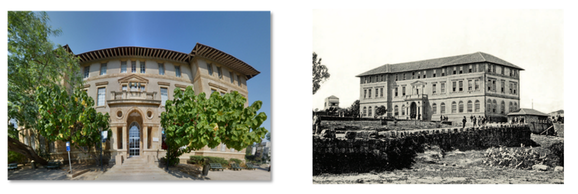
Figure 1. Bliss Hall today (left) and circa 1900 (right).
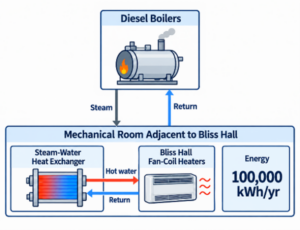
Today, space heating at Bliss Hall depends on a central diesel-fired steam system. Steam generated at boilers elsewhere on campus travels through long, above-ground distribution pipes before reaching a mechanical room adjacent to Bliss Hall. There, a steam-to-water heat exchanger transfers energy to the circulating water serving the building’s fan-coil units. Although the steam network is insulated, transporting heat over several hundred meters introduces opportunities for distribution losses before the energy reaches its destination.
The building’s useful annual space-heating requirement is estimated at about 100,000 kWh. The STORM pilot is intended to supply approximately half of that demand—around 50,000 kWh per year—through a local renewable-assisted system. This is a projected contribution, not a measured reduction in fuel consumption: the actual diesel savings will depend on operating conditions, system efficiency, and the extent to which the pilot displaces heat from the existing steam supply.
The challenge with solar heat is not simply collecting it; it is matching its availability to when it is needed. Solar thermal energy is abundant during warmer months, while the greatest space-heating demand arises in winter. Short-term hot-water tanks can bridge fluctuations over hours or days, but storing useful quantities of heat across seasons requires a much larger thermal reservoir. The STORM pilot addresses this mismatch by using the ground itself as a storage medium.
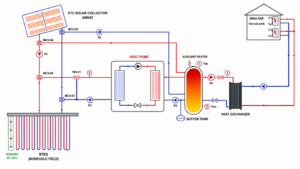
The proposed system links approximately 100 m² of evacuated-tube solar thermal collectors to a borehole thermal energy storage field comprising 21 boreholes, each roughly 25 m deep. A circulating heat-transfer fluid transports solar energy to closed-loop pipes installed in the boreholes. Heat passes through the pipe walls and grout into the surrounding geological formation, progressively raising the temperature of a volume of ground. The ground, rather than a conventional tank, stores the accumulated energy for recovery later in the year.
This approach does not eliminate thermal losses: some stored heat inevitably migrates outward into the surrounding ground. Its effectiveness therefore depends on the storage-field geometry, subsurface thermal properties, operating temperatures, and the balance between annual charging and extraction. The purpose of the pilot is to evaluate how these interacting factors perform in a real campus application.
Figure 3. Schematic of the solar-assisted borehole thermal energy storage system.
From summer charging to winter heating
During the charging season, the control system circulates solar-heated fluid through the borehole field. Heat is introduced near the central boreholes and transferred outward through the field. Over successive sunny periods, the subsurface gradually accumulates energy that can remain available after solar input declines.
In winter, the process is reversed. Cooler circulating fluid enters the outer part of the field, picks up stored heat as it flows through the ground heat exchangers, and returns from the central boreholes at an elevated temperature. The heated fluid from the borehole field is then delivered to a water-to-water heat pump raising its temperature to magnitudes necessary for space heating. The project simulations indicate delivery temperatures of approximately 60–62 °C after this temperature upgrade, suitable for transferring heat through a heat exchanger to the building’s existing circulating-water network.
A thermal buffer tank helps decouple heat production from instantaneous building demand. On sunny winter days, the solar collectors may also contribute heat directly to the buffer system, supplementing energy recovered from the ground. Pumps, temperature sensors, flow meters, and motorized valves coordinate these modes and protect equipment against unsuitable operating temperatures. Together, these components make the pilot an integrated thermal-management system rather than a stand-alone solar installation.
What the simulations suggest
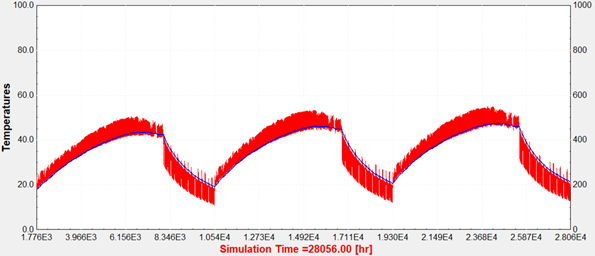
TRNSYS simulations were used to examine the behavior of the borehole field over three annual charging-and-discharging cycles. The results show a clear seasonal pattern: storage temperatures rise during the solar-charging months and fall as heat is recovered for winter operation. Importantly, the simulated peak temperatures increase from approximately 44 °C in the first year to 46 °C in the second and 48 °C in the third. This progressive rise suggests that the field has not yet reached an identical year-to-year thermal cycle within the simulated period and that some of the injected heat remains in the ground from one year to the next.
The trend is promising, but higher peak temperature alone does not establish long-term performance. The pilot will need to assess recoverable heat, seasonal thermal losses, heat-pump efficiency, delivered temperatures, and overall system reliability under actual operating conditions. Monitoring is therefore essential to determine whether model predictions translate into sustained useful energy delivery.
Figure 4. Simulated borehole-field temperatures across three annual operating cycles.
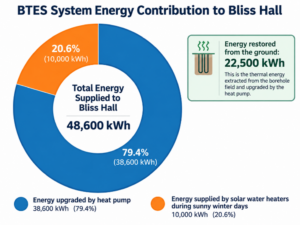
The simulated annual energy contribution helps clarify the role of each subsystem. Approximately 22,500 kWh of heat is recovered from the ground. Following heat-pump upgrading, this pathway provides around 38,600 kWh of useful heat, while direct solar contribution during sunny winter periods adds an estimated 10,000 kWh. The combined delivery to Bliss Hall is thus approximately 48,600 kWh annually—close to half of the building’s estimated 100,000 kWh space-heating requirement..
Figure 5. Simulated annual heat delivered to Bliss Hall from the heat-pump-assisted and direct winter-solar pathways.
Beyond a single building
The broader significance of the STORM pilot lies in demonstrating a way to shift renewable thermal energy across time, not merely across space. By collecting heat when solar resources are strong, storing a portion of it below ground, and recovering it when winter demand rises, the system could reduce the amount of heat that must be supplied by conventional diesel-based infrastructure. It also illustrates a possible retrofit pathway for buildings whose existing terminal heating systems are to be retained.
Bliss Hall provides a demanding and meaningful test case: a historic building, an established steam network, and a substantial seasonal heating load. The pilot’s ultimate value will come from measured evidence—how much heat is stored and recovered, how effectively the heat pump operates, and how reliably the integrated controls respond throughout the year. If the results support the design projections, the experience could inform future efforts to deploy seasonal thermal storage at AUB and in other buildings facing similar heating and decarbonization challenges.
Last Update
16/11/2026
The Interreg NEXT MED website uses technical, analytics and third-party cookies. By continuing to browse, you accept the use of cookies. Privacy Policy
 Next Med