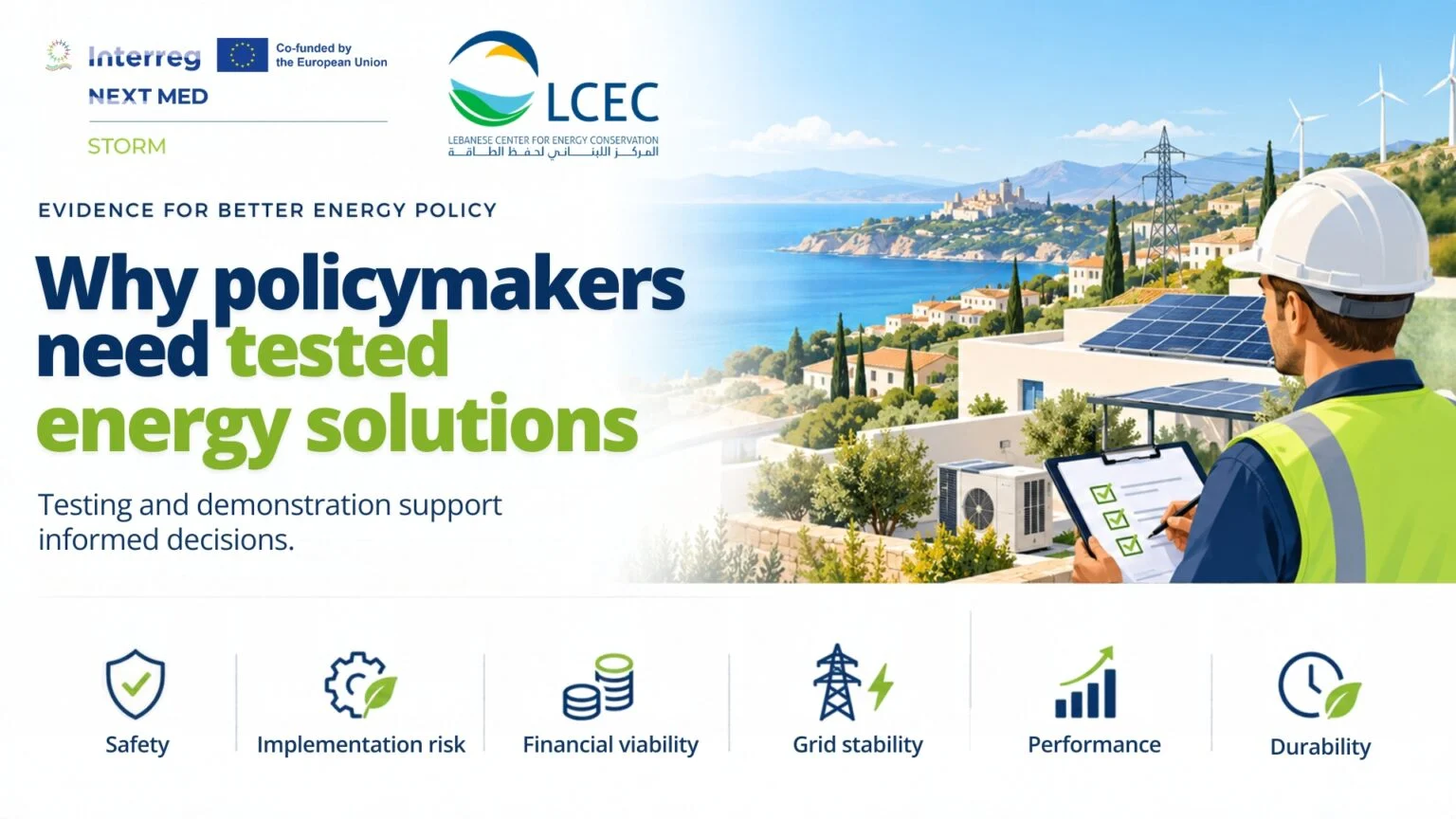
STORM: Why Policymakers Need Tested Energy Solutions?
How can policymakers make informed choices about emerging energy technologies? Testing and real-world demonstrations provide essential evidence on safety, performance and durability, helping reduce implementation risks, protect long-term investment and support wider adoption.
Publication Date 13/10/2026
Reading Time 3minutes
As countries accelerate the energy transition, governments are making decisions that will shape energy systems for decades. The International Energy Agency (IEA) expects global energy investment to reach about USD 3.4 trillion in 2026, 5% more than in 2025. At this scale, selecting technologies that are safe, reliable and suited to real operating conditions is essential. Testing does not eliminate every risk or stand in the way of innovation. It provides evidence that a solution can perform as expected before it is introduced on a large scale.
Improving safety
Safety must come first when introducing new energy technologies. Energy systems may involve high voltages, extreme temperatures, pressurized equipment or combustible materials. International standards turn this principle into practical requirements.
The International Electrotechnical Commission (IEC) specifies general safety requirements and considerations for electrical energy storage (EES) systems connected to the electrical grid. The international safety standard IEC 62933-5-1:2024, for example, requires grid-connected energy storage systems to identify hazards, assess risks and introduce suitable safeguards. Other standards set performance, testing and safety requirements for connecting distributed energy resources to electricity networks. Compliance and independent verification give policymakers stronger evidence that foreseeable safety and compatibility risks have been addressed.
Reducing implementation risks
A technology that works well as a prototype may behave differently when expanded, connected to existing infrastructure or exposed to commercial operating conditions. The IEA identifies full-scale demonstration as the stage at which a technology proves it can work commercially and begins to reduce risk for investors. This step matters because energy projects are particularly vulnerable to overruns: an analysis of 401 power generation and transmission projects in 57 countries found that construction costs were underestimated in around three out of four cases. Testing helps expose problems earlier, when corrections are less disruptive and costly.
Protecting long-term investment
Energy infrastructure is a long-term investment for governments, utilities, businesses and financial institutions. Uncertainty about output, maintenance, operating costs and asset life can raise financing costs. In an IEA analysis of utility-scale solar projects across China, Europe, India and the United States, stronger policy frameworks and greater technological maturity helped reduce financing costs by 15-30% between 2015 and 2019. The cost of capital can represent 20-50% of the levelized cost of electricity from utility-scale solar PV. Verified performance therefore supports stronger financial planning and helps prevent low upfront prices from becoming higher long-term costs.
Supporting a stable electricity grid
As electricity systems include more renewable generation, storage and electric vehicles, equipment must remain stable during disturbances and interact correctly with the wider grid. In North America, regulators identified approximately 11 events involving losses of at least 500 MW from inverter-based resources between January 2020 and June 2023. These included a 1,711 MW loss during the 2022 Odessa disturbance and a 921 MW solar PV loss in Southwest Utah in 2023.
These events do not show that renewable technologies are inherently unreliable. They show why equipment settings and grid behavior must be validated. Testing should confirm that systems respond correctly to changes in voltage and frequency, remain connected when required and avoid turning a local fault into a wider disruption.
Confirming real-world efficiency and reliability
Performance in the field can differ from laboratory ratings or manufacturer specifications. Weather, dust, installation quality and local operating conditions all affect energy output. The IEA Photovoltaic Power Systems Programme estimates that dust, snow and other forms of soiling reduce global solar PV production by around 3-5% each year, causing approximately EUR 3-5 billion in economic losses. Because these effects vary significantly by location, policymakers need independently measured data on actual energy yield, availability and reliability, rather than nameplate efficiency alone.
Testing durability
Energy infrastructure must operate for many years while facing heat, humidity, dust, mechanical stress and changing weather conditions. Qualification testing can reveal failure points before equipment is deployed widely. For solar modules, international standards uses an extended thermal-cycling test based on showing that 95% of the represented modules can withstand the equivalent of 500 temperature cycles with less than 5% loss in maximum power. Such tests cannot guarantee an exact service life, but they help policymakers compare expected durability and lifecycle costs, reducing the risk of premature replacement or declining output.
Conclusion
Choosing tested energy solutions does not mean choosing caution over innovation. It means managing risk in proportion to the scale and consequences of deployment. Policymakers can support emerging solutions through pilots, full-scale demonstrations and controlled early use, while requiring appropriate safety certification, grid-conformance testing, independent performance data and durability evidence before wider rollout. Proper validation can accelerate adoption by giving governments, utilities and investors credible evidence that new infrastructure can deliver safe, reliable and financially sustainable results over the long term.
Read the full article
For the detailed evidence, real-world examples and full list of references, read the complete article on LinkedIn: Click here.
Last Update
13/10/2026
The Interreg NEXT MED website uses technical, analytics and third-party cookies. By continuing to browse, you accept the use of cookies. Privacy Policy
 Next Med