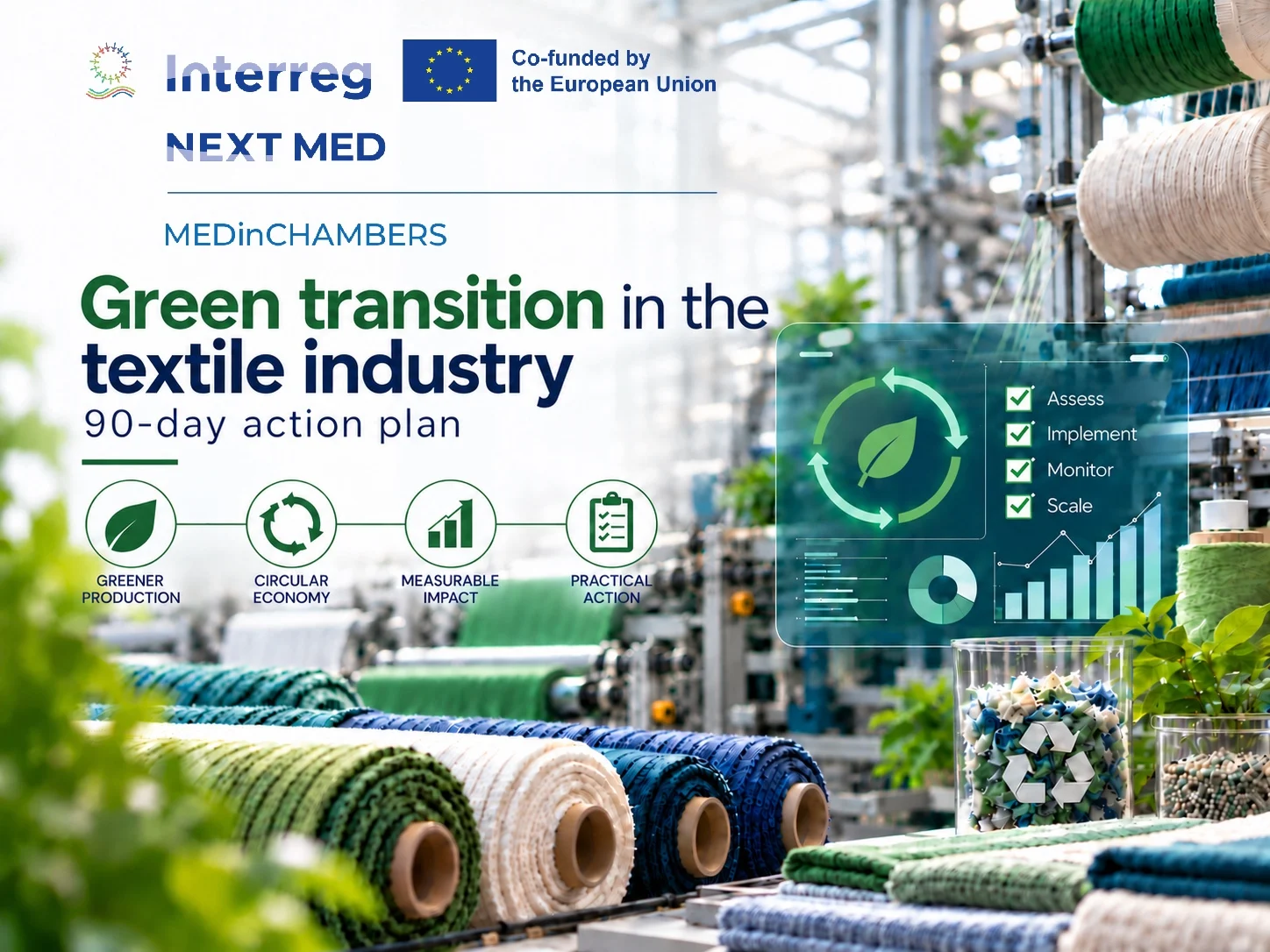
MEDinCHAMBERS Equips 87 Participants with Practical Tools for a 90-Day Green Transition Action Plan

A practical MEDinCHAMBERS training programme helps companies turn environmental data, EU compliance and risk mapping into measurable green transition actions.

Publication Date
09/10/2026
Reading Time
4 minutes

Between June and August 2026, the Italian Chamber of Commerce and Industry in Türkiye–Izmir delivered a Green Transition Specialist Training Programme within the MEDinCHAMBERS project framework of the Interreg NEXT MED Programme.

The green transition training involved 87 participants from around 53 companies and institutions. Its goal was to help businesses and business-support organisations turn sustainability challenges into practical tools, reliable data and measurable actions.

Participants learned how to identify environmental risks, assess compliance gaps, organise sustainability data and interpret carbon information. They then brought these elements together in a practical 90-day green transition action plan.

87 participants from companies and institutions across Türkiye

The programme attracted participants from several Turkish cities and regions. Around 45% of participants came from İzmir, while 29% were from Denizli. Together, these two areas accounted for approximately 74% of total participation.

Istanbul represented around 7% of participants and Manisa approximately 4%. Ankara, Muğla and Bursa were also represented on a smaller scale. Around 12% could not be clearly assigned to a province because they participated as individuals, freelancers, or through organisations without a specified location.

The professional backgrounds were also diverse. The textile and apparel sector represented the largest group, with 28.95% of participants. Chambers and business organisations accounted for 15.79%, while public institutions, universities and research organisations represented 11.84%. Freelancers accounted for 3.95%. Other participants worked in sectors including sustainability, industry, energy, chemicals and packaging.

This diverse participation helped connect companies with the organisations, institutions and professionals that can support their transition towards more sustainable business models.

Green transition training focused on practical tools

The programme was designed to answer a practical question: how can companies turn green transition goals into actions they can manage and measure?

Rather than focusing only on theory, participants worked on six connected outputs:

  • a value chain risk map;
  • a compliance checklist;
  • a Do No Significant Harm (DNSH) risk matrix;
  • a Life Cycle Assessment (LCA) and Material Flow Analysis (MFA) data map;
  • carbon data interpretation;
  • a measurable 90-day green transition action plan.

Together, these outputs formed the basis of a company’s first structured green transition file. Through the exercises, participants identified where environmental pressures were concentrated within their activities. They also assessed which information was already available and where important gaps remained.

As a result, sustainability became more than a general ambition. Participants could connect environmental performance with data management, compliance requirements and business decisions.

What did participants learn?

One of the main lessons was clear: green transition is not a one-time project. Instead, companies need to manage it as a continuous process based on measurable and verifiable data.

During the training, participants identified several recurring environmental pressure points. These included energy and carbon, waste and scrap, water and wastewater, chemical use and supplier data. However, recognising a risk is only the first step. Companies also need to know who is responsible for the relevant data, how that data is measured, how often it is updated and which evidence can support it.

The exercises showed that participants could generally identify their most important environmental risks. At the same time, they highlighted gaps in data visibility, supplier verification, data ownership and the definition of Key Performance Indicators (KPIs). Another important lesson concerned data quality. Participants learned to question and interpret environmental information rather than simply calculate indicators.

Reliable decisions require companies to understand where data comes from, which units are used, which period it covers and which activities or processes are included.

From environmental risks to a 90-day action plan

The final stage of the programme transformed the previous exercises into a practical 90-day action plan.

Participants were encouraged to choose a small number of realistic actions rather than create long lists of general sustainability commitments. Each action needed a clear owner, timeframe, required resources and measurable KPI. This approach makes the green transition easier to manage. A broad objective such as reducing resource consumption can become a specific action linked to a responsible person, deadline and indicator.

For example, companies can monitor measures such as energy consumption per unit of production, water use per tonne or waste generated during a specific process.

The 90-day structure also supports continuous improvement. Once companies complete their first actions, they can review the results, identify new priorities and start another cycle. This approach is particularly relevant for small and medium-sized enterprises (SMEs), which often need practical and accessible tools to manage complex sustainability challenges.

Strengthening green transition capacity through MEDinCHAMBERS

The Green Transition Specialist Training Programme was developed and delivered by the Italian Chamber of Commerce and Industry in Türkiye–Izmir as part of its activities within MEDinCHAMBERS.

This distinction is important. The companies and institutions were the beneficiaries of the training, while the Chamber implemented the activity within the wider project framework. MEDinCHAMBERS works to strengthen the green transition capacity of Mediterranean textile, clothing, leather and footwear value chains. It does so by supporting cooperation between Chambers of Commerce, companies, institutions and other business-support actors.

In this context, the training translated the project’s objectives into a concrete capacity-building activity for companies and organisations in Türkiye.

The participation of both businesses and support organisations added further value. Companies gained practical tools to manage environmental performance, while chambers, universities, institutions and other organisations strengthened their ability to support businesses through this transition.

For the 87 participants, the programme provided a clearer way to understand where to start, which data to collect and how to convert environmental priorities into measurable actions.

For MEDinCHAMBERS, the activity shows how project partners can turn Mediterranean cooperation into practical green transition support for companies and local business ecosystems.

Last Update

09/10/2026