Laboratory activities within the Sludge2Energy project are moving forward with the analysis of plant tissue samples collected during the project’s sampling campaign. The work is carried out by the project partner HMU – Hellenic Mediterranean University.
From the field to the laboratory
The samples come from three crops – cotton, corn and wheat – grown on soils where sewage sludge has been applied. To prepare them for analysis, the HMU team uses a modified QuEChERS protocol (Quick, Easy, Cheap, Effective, Rugged and Safe), a widely used method for extracting chemical residues from food and plant matrices.
How the analysis works
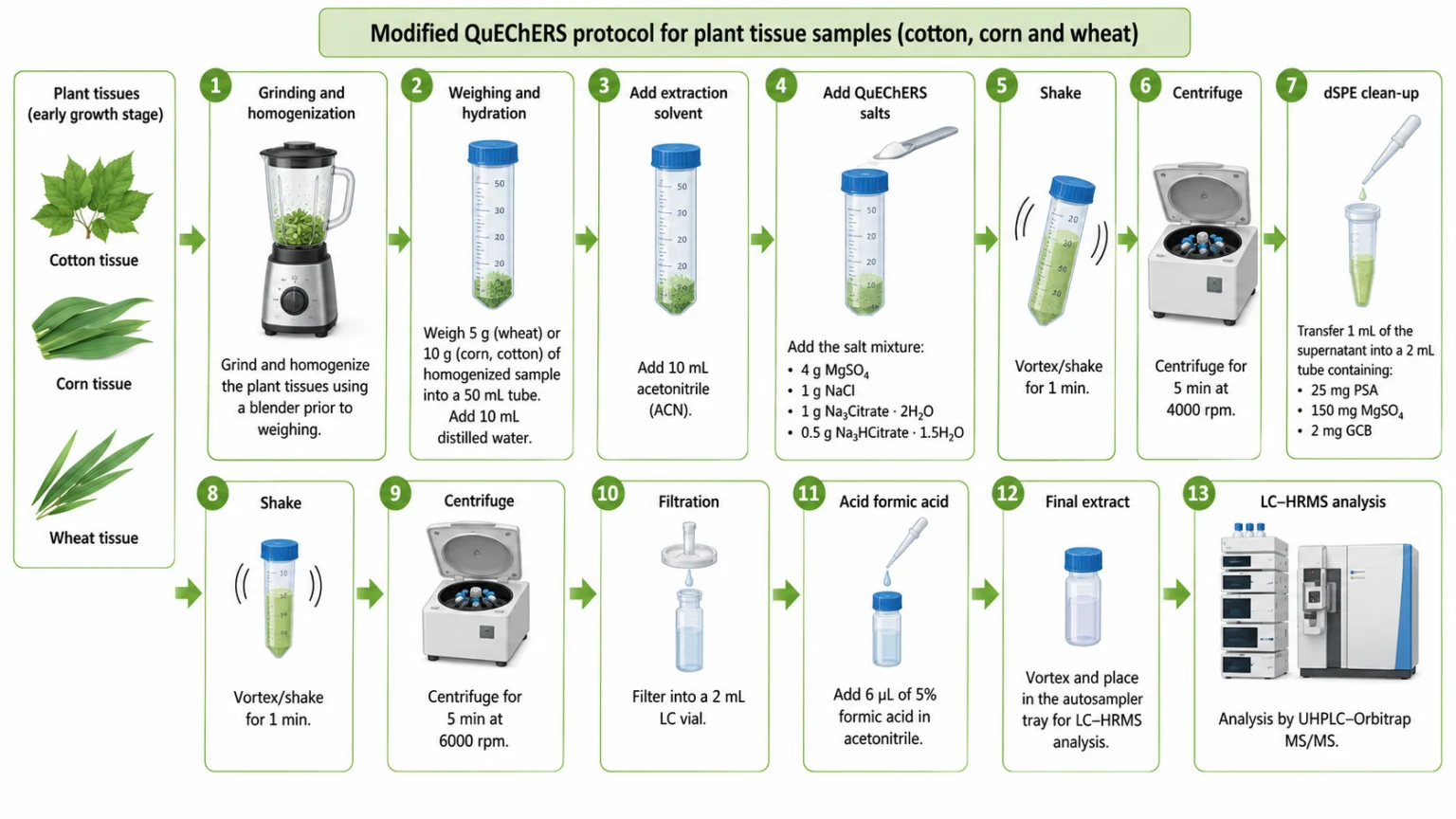
Each sample goes through a series of steps: grinding and homogenisation, hydration, extraction with acetonitrile (a solvent that separates the compounds of interest from the plant material), salt-assisted extraction, and a clean-up phase based on dispersive solid-phase extraction (dSPE), which removes interfering substances. After centrifugation and filtration, the extracts are analysed using ultra-high-performance liquid chromatography coupled with Orbitrap high-resolution tandem mass spectrometry (UHPLC–HRMS/MS), a technique able to identify and measure compounds present even at very low concentrations.
Why it matters
This approach makes it possible to investigate whether pharmaceutical compounds and other emerging contaminants are present in plant tissues and to what extent they may be taken up by crops grown on sludge-amended soils.
The results will feed into the Sludge2Energy environmental assessment, helping to better understand the potential risks linked to the reuse of sewage sludge in agriculture and supporting the development of safe and sustainable circular economy practices.
Next steps
Step by step, the project is building a complete picture: from sampling to sample preparation, from advanced chemical analysis to environmental assessment.Laboratory activities within the Sludge2Energy project are moving forward with the analysis of plant tissue samples collected during the project’s sampling campaign. The work is carried out by the project partner HMU – Hellenic Mediterranean University.
From the field to the laboratory
The samples come from three crops – cotton, corn and wheat – grown on soils where sewage sludge has been applied. To prepare them for analysis, the HMU team uses a modified QuEChERS protocol (Quick, Easy, Cheap, Effective, Rugged and Safe), a widely used method for extracting chemical residues from food and plant matrices.
How the analysis works
Each sample goes through a series of steps: grinding and homogenisation, hydration, extraction with acetonitrile (a solvent that separates the compounds of interest from the plant material), salt-assisted extraction, and a clean-up phase based on dispersive solid-phase extraction (dSPE), which removes interfering substances. After centrifugation and filtration, the extracts are analysed using ultra-high-performance liquid chromatography coupled with Orbitrap high-resolution tandem mass spectrometry (UHPLC–HRMS/MS), a technique able to identify and measure compounds present even at very low concentrations.
Why it matters
This approach makes it possible to investigate whether pharmaceutical compounds and other emerging contaminants are present in plant tissues and to what extent they may be taken up by crops grown on sludge-amended soils.
The results will feed into the Sludge2Energy environmental assessment, helping to better understand the potential risks linked to the reuse of sewage sludge in agriculture and supporting the development of safe and sustainable circular economy practices.
Next steps
Step by step, the project is building a complete picture: from sampling to sample preparation, from advanced chemical analysis to environmental assessment.
 Next Med