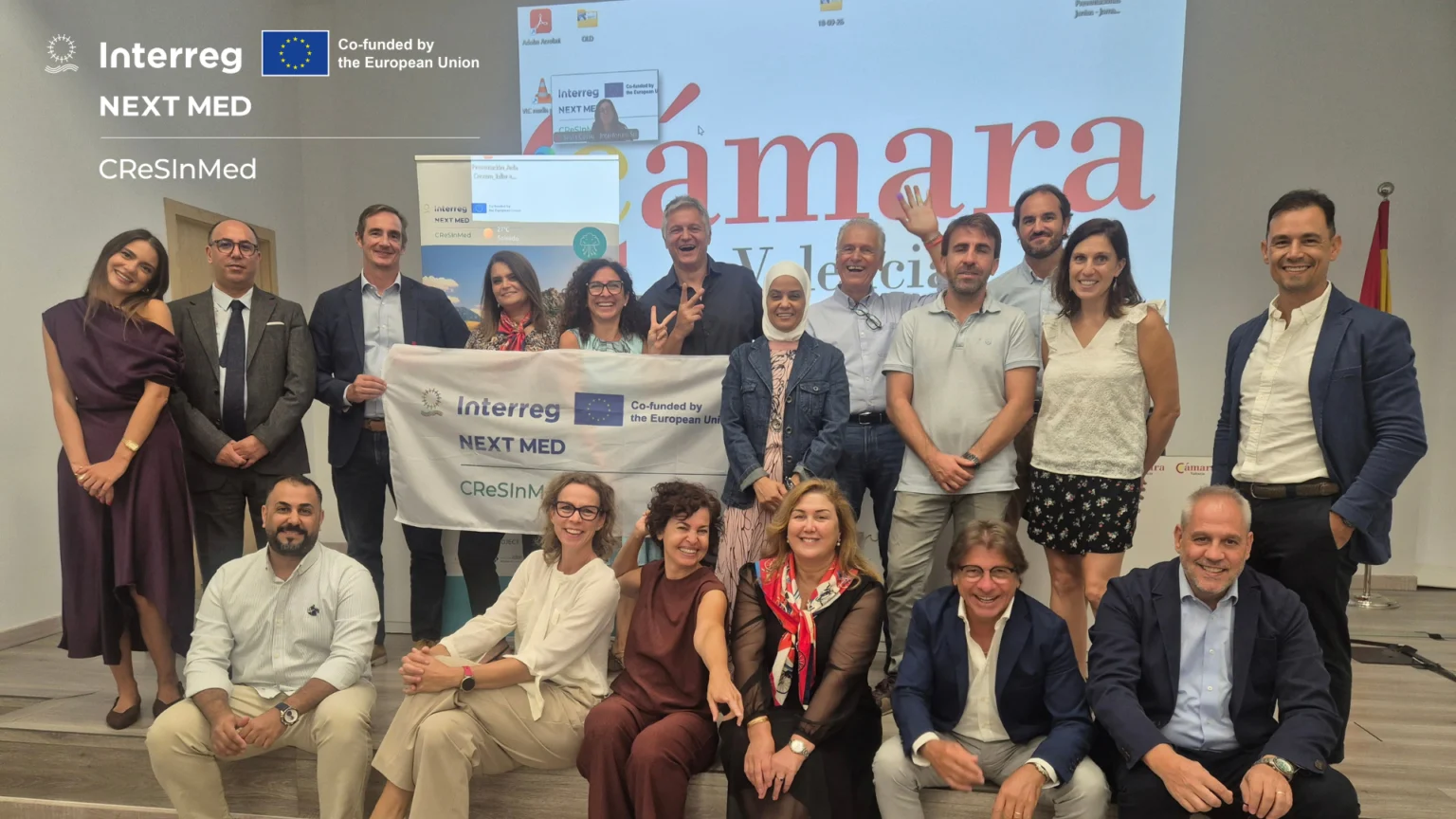
From 21 to 23 September 2026, CReSInMed partners from Italy, Greece, Türkiye, Jordan, Tunisia and Spain gathered in Valencia for the project’s 2nd Steering Committee, hosted by the Valencia Chamber of Commerce, with the Palestinian partner joining online.
The three-day meeting combined project coordination and direct engagement with the rural territory, providing an opportunity to review the progress made in the first months of CReSInMed, agree on the next steps and connect the project’s objectives with concrete rural tourism experiences.
The first day brought the partnership together at the Valencia Chamber of Commerce for a technical working session on the current state of the project and the activities ahead.
The meeting opened with welcome remarks from Alberto Rodrigo, European Projects Unit Manager at the Valencia Chamber of Commerce, Annamaria D’Angelo, CReSInMed Project Coordinator, and Vincent Ernoux, Official Coordinator of the Interreg NEXT MED Western Mediterranean Branch Office.
Partners reviewed progress across the main areas of project implementation, starting with management and coordination, including physical and financial monitoring, budget implementation and procurement procedures. The discussion then moved to communication and dissemination, capacity building and internationalisation support for rural tourism (M)SMEs.
The day concluded by agreeing on priorities, decisions and action points for the months ahead.
On 22 September, the focus shifted from project planning to discovering rural tourism first-hand.
The day began at the Valencia Chamber of Commerce with an introduction to the Valencian rural areas involved in CReSInMed and to Alto Turia, giving partners an overview of the territory, its economy, tourism profile and main challenges before experiencing it first-hand.
The partnership then travelled to the Serranía Valenciana, visiting Aras de los Olmos, Chelva and Titaguas and meeting the local businesses behind a series of complementary tourism experiences.
In Aras de los Olmos, a heritage and landscape experience hosted by Piedra y Amapola showed how local history, landscape, storytelling and poetry can transform cultural identity into an innovative tourism product.
In Chelva, API-Cultura introduced partners to beekeeping, biodiversity and honey production through an educational visitor experience combining local production and tourism.
The programme continued with a focus on local gastronomy. Les Saveurs de Marie offered a culinary journey through local flavours and traditional recipes, with dishes prepared and explained live, followed by a networking session hosted at La Tabla restaurant. The day concluded in Titaguas with a starlight experience led by Cosmofísica, combining a 3D planetarium show with telescope observation in an area recognised for its astrotourism potential
More than a field visit, Alto Turia offered CReSInMed partners a concrete example of the type of cooperation the project seeks to encourage across the Mediterranean.
Heritage interpretation, beekeeping, gastronomy and astrotourism were delivered by different local enterprises but experienced as parts of the same destination. In this way, partners could see a small rural area operating as an informal cluster: separate businesses, complementary products and one shared visitor experience.
This approach is particularly relevant to CReSInMed. Strengthening rural tourism competitiveness is not only about supporting individual businesses, but also about helping them connect their products, skills and territorial assets, develop more integrated tourism experiences and open up new opportunities for cooperation and internationalisation.
The field experience also provided practical material directly connected with the project’s work on capacity building, exchange of good practices and communication, with partners encouraged to consider which experiences and approaches could be transferred or adapted to their own territories.
The meeting concluded on 23 September, when partners returned to Valencia after the overnight stay in Aras de los Olmos.
The 2nd Steering Committee provided more than an opportunity to review project implementation. It connected the work being developed within CReSInMed with the realities of rural businesses and territories.
As CReSInMed moves into its next phase, these exchanges will feed into the project’s work to strengthen the skills, internationalisation capacity, cooperation and visibility of rural tourism (M)SMEs across the Mediterranean. From project coordination to experiences on the ground, Valencia showed how cooperation between businesses, territories and people can help build stronger rural tourism ecosystems across the Mediterranean.
 Next Med