STORM’s Jordan Pilot Brings Seasonal Thermal Energy Storage to Ajloun Forest Reserve
At Jordan’s Ajloun Forest Reserve, STORM is developing a solar-assisted heating system designed to store summer solar heat for winter use. Combining solar collectors, an underground seasonal storage tank and heat pumps, the proposed pilot will serve ten accommodation units, demonstrating how thermal energy storage can support sustainable tourism in the Mediterranean.
Set high in the forested hills of northern Jordan, Ajloun Forest Reserve combines nature conservation with eco-tourism, including 38 timber accommodation units that welcome thousands of visitors each year. The reserve has also received international recognition for its sustainable tourism approach. At present, the accommodation facilities rely on grid electricity for their energy needs. Based on 2023 electricity billing data provided for the site, annual electricity expenditure across the reserve’s 38 accommodation units was approximately €57,000. Within this wider site, the STORM pilot focuses on five selected Pistachio bungalows, comprising ten independently operated accommodation units. Managed by the Royal Society for the Conservation of Nature (RSCN) and located about 80 km north of Amman, Ajloun provides an environmentally sensitive setting where any heating solution must be both effective and unobtrusive. Under the Interreg NEXT MED STORM project, led in Jordan by the Royal Scientific Society’s National Energy Research Center, Ajloun has been selected as the Jordanian pilot site for the development and demonstration of a solar-assisted seasonal thermal energy storage system capturing summer solar energy and storing it until it is needed most during winter.
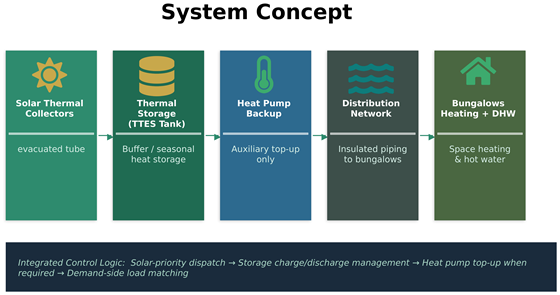
System concept: solar thermal collectors feed a seasonal storage tank, backed up by a heat pump and delivered through an insulated distribution network to the bungalows.
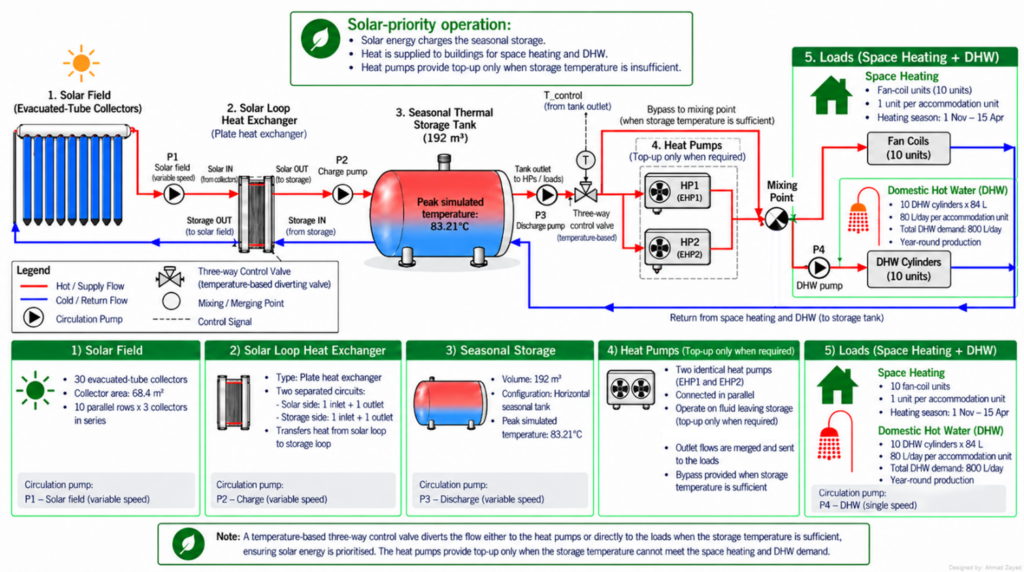
The pilot design integrates solar energy collection, seasonal thermal energy storage and auxiliary heating into a single system sized according to the estimated space-heating and domestic hot water demand of the selected pilot units. The proposed solar field comprises 30 evacuated-tube collectors, with a total collector area of 68.4 m², arranged in ten parallel rows of three collectors connected in series. The collected solar heat is transferred through a heat exchanger to a proposed 192 m³ seasonal thermal energy storage tank. The storage tank is configured horizontally and buried underground to accommodate the spatial and site constraints of the pilot location. Two identical auxiliary heat pumps, connected in parallel, with a nominal heating capacity of approximately 18 kW support the system when the solar-storage circuit cannot meet the required supply conditions. Variable-flow pumping and control are used throughout the system to optimize heat collection, storage charging and heat delivery and match the operating conditions and number of units calling for heat. The pilot focuses on five Pistachio bungalows comprising ten independently operated accommodation units, each served by one fan-coil unit and sized at approximately 5 kW according to the design load and one 84-litre domestic hot water storage tank.
Key design figures and simulation parameters of the updated Ajloun pilot.
The proposed design was evaluated using a detailed TRNSYS Simulation Studio model representing the five pilot bungalows and their ten independently controlled accommodation units. The model allows for optimizing solar-priority dispatch, storage charge and discharge management, and heat-pump top-up only when required. The seasonal storage was represented using dedicated TRNSYS storage components capable of accounting for the thermal behavior of the large-volume store and its surroundings. The auxiliary heat pumps was modelled using the available manufacturer performance data, with interpolation and modelling assumptions applied where operating points were not explicitly provided. The simulation ran over three years at a 15-minute timestep, with the collector circuit carrying a 30% water-glycol mixture and the other circuits running water. Using the third simulation year as the annual reporting basis, useful solar-collector output was 64.22 MWh, heat charged into the seasonal storage was 61.51 MWh, and heat discharged from the storage was 56.71 MWh. The combined thermal output of the two heat pumps was 104.59 MWh. The reported annual demand was 114.8 MWh for space heating and 8.6 MWh for domestic hot water, giving a combined thermal demand of 123.4 MWh for the ten pilot accommodation units. The annual demand is reported separately from the component energy flows. Space-heating control targets an indoor setpoint of 22°C with a ±2°C dead band, with heating enabled from 1 November to mid-April. The seasonal storage reached a maximum temperature of 83.21°C in the third year. Storage charging can occur throughout the year according to the control criteria; discharge for space heating is restricted to the heating season, while discharge for hot water production can occur year-round. These results illustrate the potential of the proposed storage volume and control strategy to retain useful solar heat across seasons and support winter heating alongside the auxiliary heat pumps.
System Layout of the Ajloun STORM Pilot for Space Heating and Domestic Hot Water.
As a simulation-based pilot design, the Ajloun pilot illustrates how seasonal solar thermal storage can be designed, simulated and prepared for implementation in a real eco-tourism setting. For Jordan and the wider Mediterranean, where solar resources are abundant but heating demand is sharply seasonal, the pilot offers a transferable template: measure the load, size the collectors and storage to match it, and combine stored solar heat with auxiliary heat-pump support to serve the cabins through winter and provide hot water throughout the year.
Last Update
25/09/2026
The Interreg NEXT MED website uses technical, analytics and third-party cookies. By continuing to browse, you accept the use of cookies. Privacy Policy
 Next Med