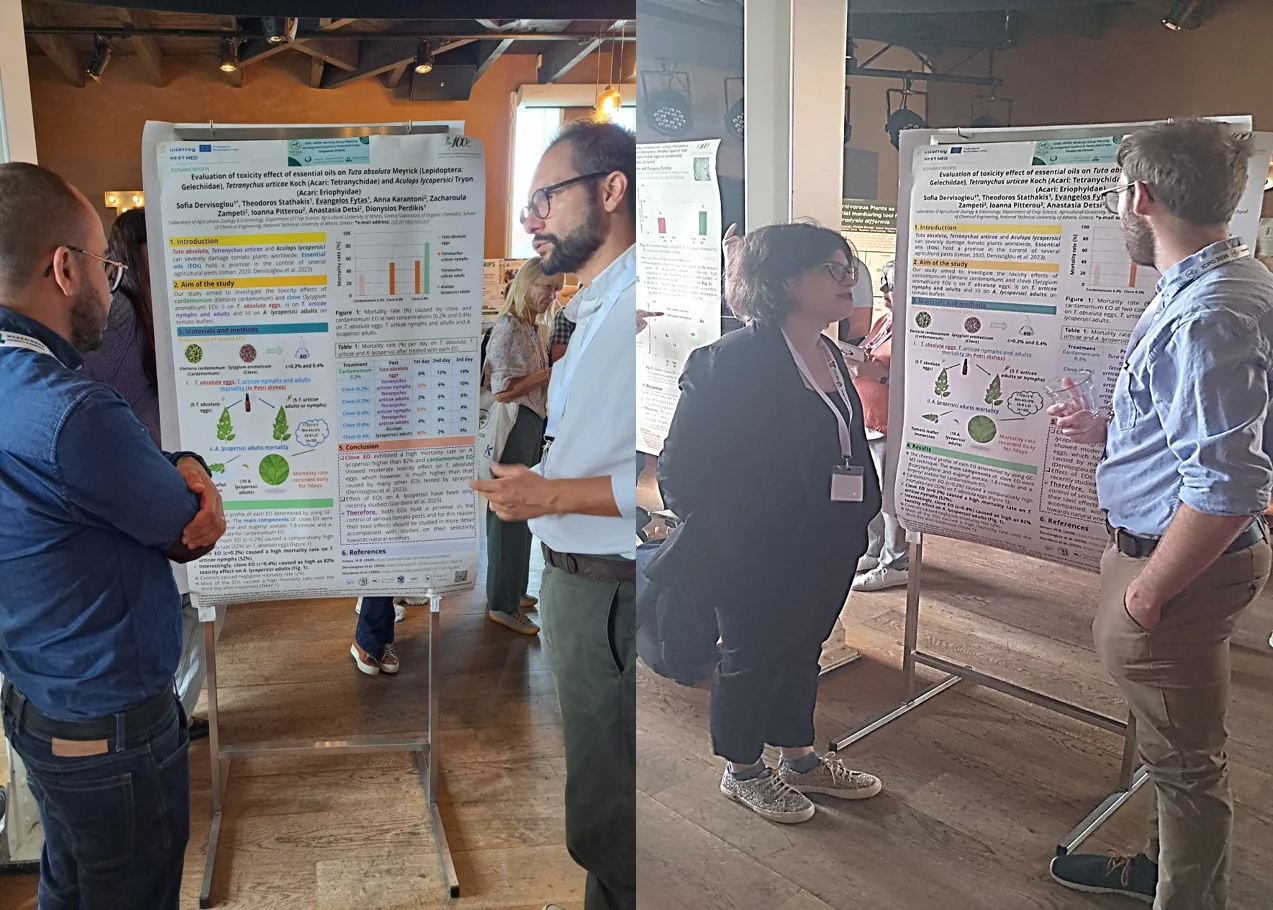
Boskoop, the Netherlands, September 2026 – Researchers from the Agricultural University of Athens (AUA) presented promising findings on the potential of selected essential oils to control three major tomato pests during the 18th Meeting of the IOBC-WPRS Working Group “Integrated Control in Protected Crops, Temperate Climate.”
The international meeting took place from 31 August to 3 September 2026 in Boskoop, the Netherlands, under the auspices of the International Organisation for Biological and Integrated Control – West Palearctic Regional Section (IOBC-WPRS) and Wageningen University & Research.
The conference brought together researchers, industry experts and practitioners to exchange knowledge and expertise on biological control and Integrated Pest Management (IPM) in greenhouse crops.
AUA was represented by Professor Dionysios Perdikis and PhD candidates Sofia Dervisoglou and Evangelos Fytas. They presented research assessing the effects of selected essential oils against three serious tomato pests: the tomato leafminer (Tuta absoluta), the two-spotted spider mite (Tetranychus urticae) and the tomato russet mite (Aculops lycopersici).
The scientific team also included Dr Theodoros Stathakis from AUA, as well as PhD candidates Anna Karantoni and Zacharoula Zampeti, Dr Ioanna Pitterou and Professor of Organic Chemistry Anastasia Detsi from the National Technical University of Athens (NTUA).
The results showed that clove essential oil caused an extremely high mortality rate in A. lycopersici, while cardamom essential oil caused a high mortality rate among T. absoluta eggs. Several researchers and representatives of small and medium-sized enterprises (SMEs) expressed strong interest in the findings, as previous knowledge of these specific effects was limited.
The participation strengthened scientific exchange, increased the visibility of EONANOBIOPS research and introduced attendees to the Interreg NEXT MED Programme and its support for sustainable agriculture across the Mediterranean.
 Next Med