STORM | American University of Beirut
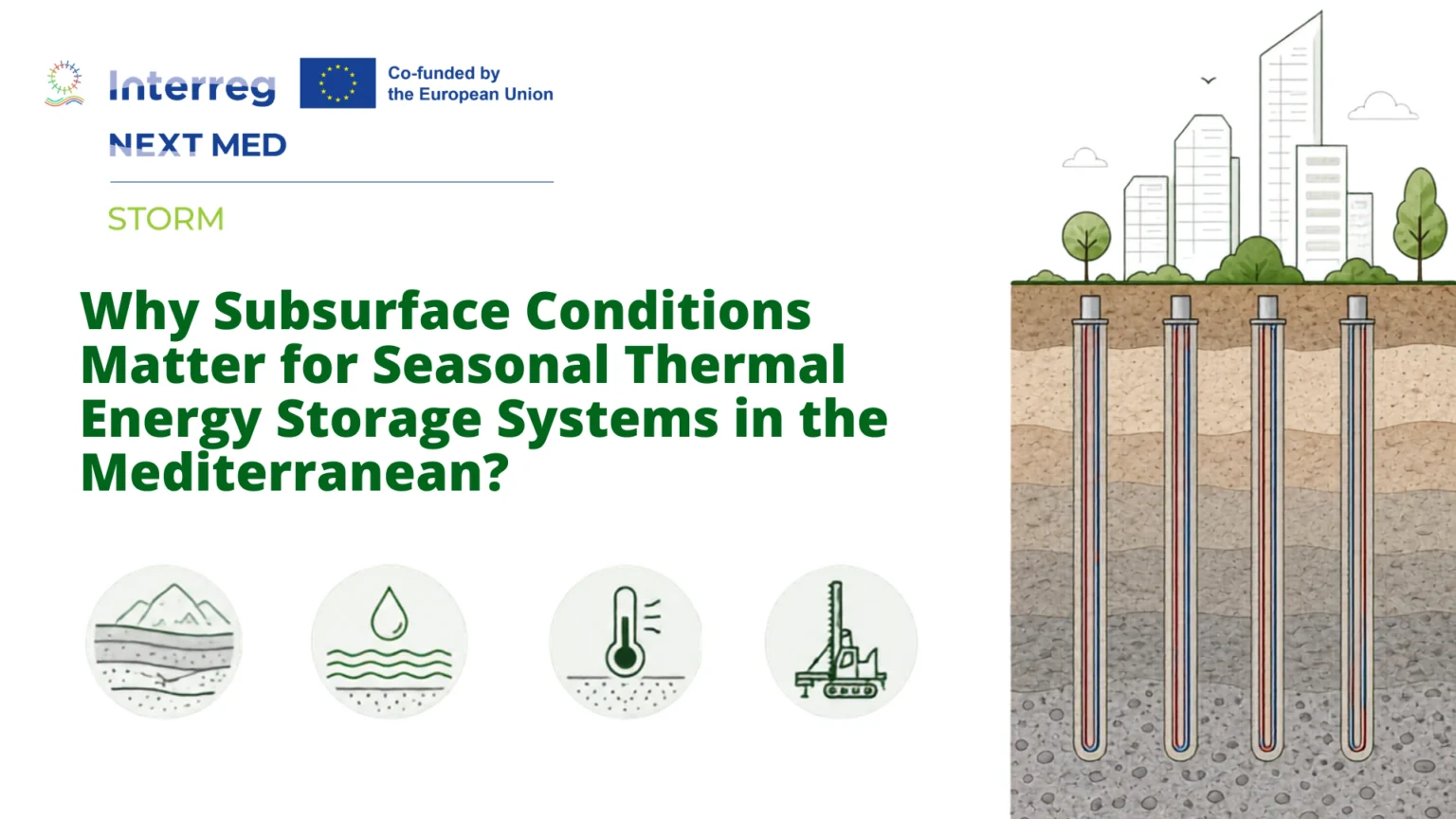
Seasonal thermal energy storage enables heat captured in summer to be used in winter, and winter cold to be retained for summer use. For underground storage systems, the subsurface is not merely the host medium for the installation since the local geology and groundwater conditions directly influence storage behavior and performance.
Why does this matter?
Heating and cooling account for a significant share of overall energy consumption. In the European Union, buildings account for around 40% of energy consumption, and roughly 80% of energy used in homes goes to heating, cooling and hot water. Seasonal energy storage can reduce the mismatch between when renewable heat or cold is available and when buildings need it. [1]
The case for seasonal thermal energy storage is especially compelling in the Mediterranean region where the combination of strong summer solar availability and the need for winter heating makes this technology attractive. If the subsurface is to be used as a medium for storing this energy, proper site selection and deep understanding of the impact of subsurface conditions on the design and performance of subsurface seasonal thermal energy storage systems becomes a necessity. A store that leaks heat into the surrounding or through moving groundwater could become inefficient and costly.\
Borehole Thermal Energy Storage (BTES) Systems
Borehole thermal energy storage (BTES) uses a field of closed-loop borehole heat exchangers to heat or cool a volume of soil and rock. Heat transfer is primarily by conduction. The preferred conditions for improved efficiency of BTES systems combine favorable thermal conductivity and volumetric heat capacity with little natural groundwater movement. IEA guidance describes typical BTES borehole depths of about 30-100 m and warns that significant groundwater movement can create unacceptable heat loss. [2]
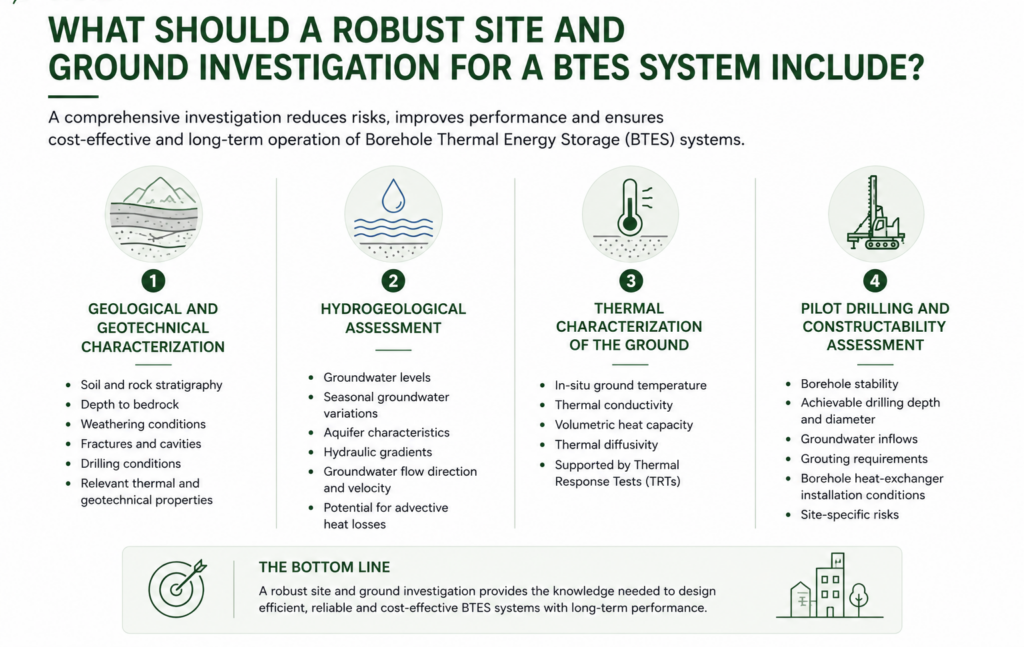
What should a robust site and ground investigation for a BTES system include?
- Geological and geotechnical characterization – establish soil and rock stratigraphy, depth to bedrock, weathering, fractures, cavities, drilling conditions, and relevant thermal/geotechnical properties.
- Hydrogeological assessment – determine groundwater levels, seasonal variations, aquifer characteristics, hydraulic gradients, groundwater flow direction and velocity, and the potential for advective heat losses.
- Thermal characterization of the ground – assess in-situ ground temperature, thermal conductivity, volumetric heat capacity and thermal diffusivity, typically supported by one or more Thermal Response Tests (TRTs).
- Pilot drilling and constructability assessment – confirm borehole stability, achievable drilling depth and diameter, groundwater inflows, grouting requirements, borehole heat-exchanger installation conditions, and any site-specific risks before finalizing the BTES layout and design.
The practical conclusion
For seasonal thermal energy storage, the key points for storage effectiveness cannot be reduced to whether the site has granite, limestone, clay or sand. The effectiveness of BTES system depends on how that formation stores heat, transmits heat, moves water, reacts chemically and can be drilled or excavated within the site’s environmental and urban constraints.
In the Mediterranean region, subsurface conditions can strongly influence the efficiency and long-term performance of BTES systems. Geological variability, groundwater flow, thermal properties, and drilling conditions must therefore be properly characterized to ensure effective heat storage, minimize thermal losses, and support reliable system design.
Sources:
[1] European Commission, Energy Performance of Buildings Directive – key facts on energy and buildings in the EU (accessed 6 August 2026).
[2] IEA Solar Heating and Cooling Programme, Task 45, Seasonal Borehole Thermal Energy Storage – Guidelines for Design & Construction (2015).
 Next Med