From environmental pressure to collaborative governance. Sfax, one of Tunisia’s largest industrial and economic hubs, faces growing environmental challenges linked to rapid urbanisation, industrial activity and waste management, and its citizens are showing strong willingness to take part in addressing them.
The survey
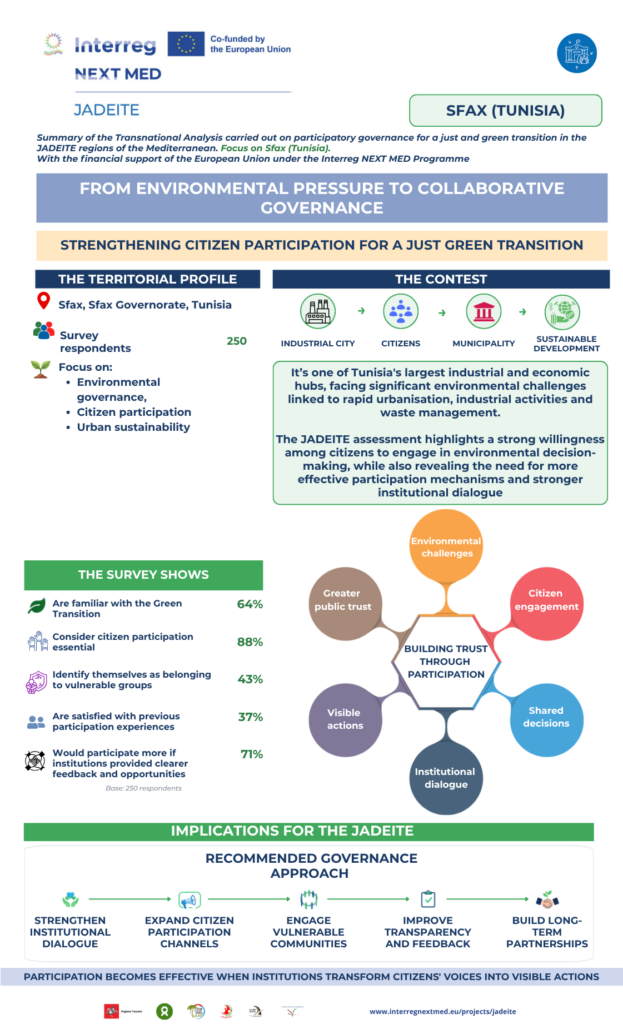
The JADEITE Transnational Analysis surveyed 250 citizens in Sfax, with a focus on environmental governance, citizen participation and urban sustainability.
What the data shows
- 64% are familiar with the Green Transition
- 88% consider citizen participation essential
- 43% identify themselves as belonging to vulnerable groups
- 37% are satisfied with previous participation experiences
- 71% would participate more if institutions provided clearer feedback and opportunities
A virtuous governance cycle
Environmental challenges drive citizen engagement. Citizen engagement leads to shared decisions. Shared decisions require institutional dialogue. Institutional dialogue produces visible actions. Visible actions build greater public trust.
The recommended approach for Sfax
Stronger institutional dialogue, expanded citizen participation channels, engagement of vulnerable communities, greater transparency and feedback, and long term partnerships.
Participation becomes effective when institutions transform citizens’ voices into visible action.
Explore the key findings in the infographic below.
 Next Med