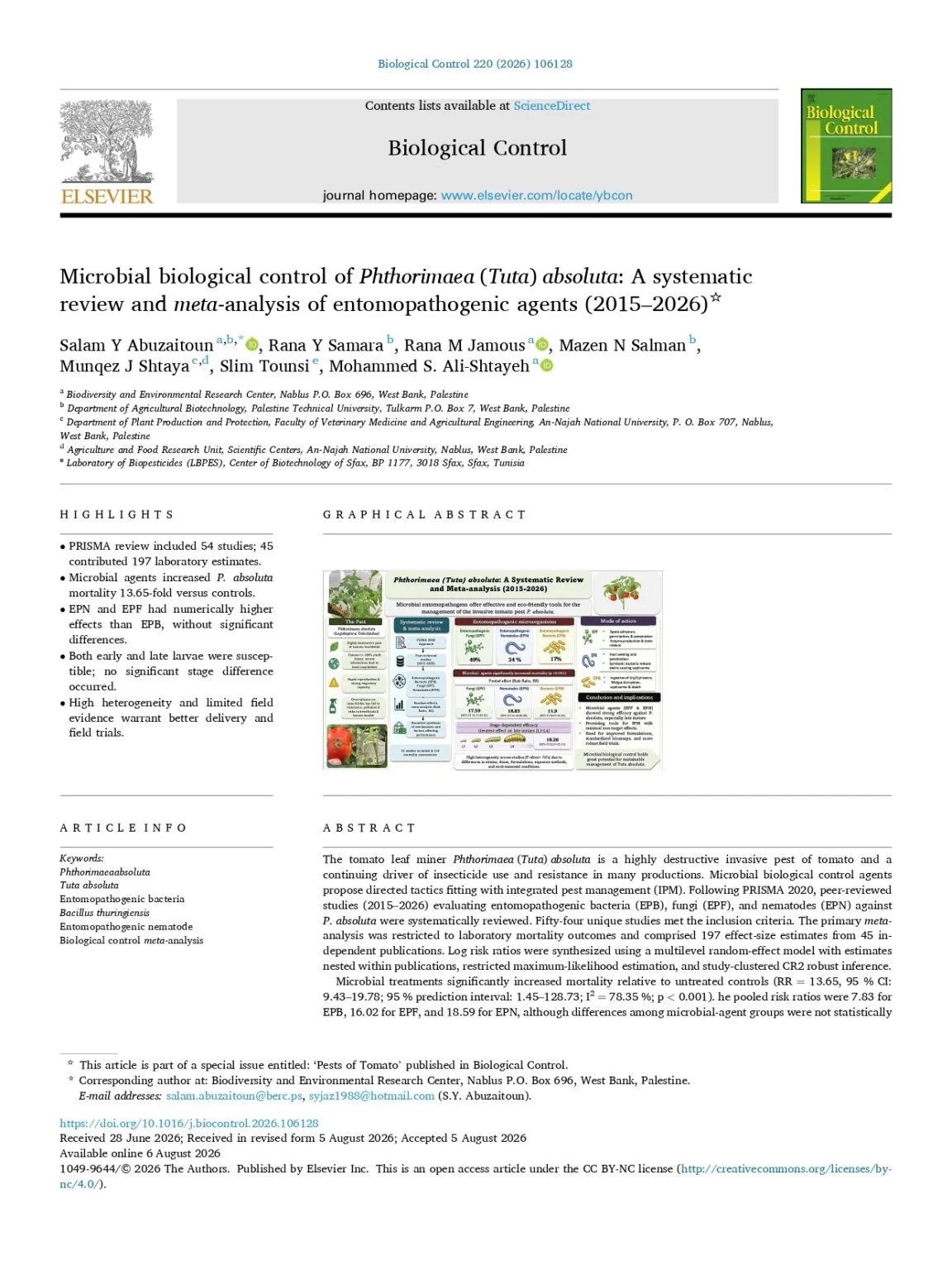
The Biodiversity and Environmental Research Center (BERC), Lead Partner of the EONANOBIOPS project, co-funded by the European Union under the Interreg NEXT MED Programme, contributed to a new scientific study entitled “Microbial Biological Control of Phthorimaea (Tuta) absoluta: A Systematic Review and Meta-analysis of Entomopathogenic Agents (2015–2026)”, in collaboration with Palestinian Technical University – Kadoorie (PTUK) and EONANOBIOPS project partners An-Najah National University (ANNU) and the Centre of Biotechnology of Sfax (CBS), Tunisia.
The research team included members of the EONANOBIOPS project team—Salam Abuzaitoun, Rana Jamous, Mohammed S. Ali-Shtayeh, Munqez Shtaya, and Slim Tounsi—representing Biodiversity and Environmental Research Center BERC, An-Najah National University (ANNU), and the Centre of Biotechnology of Sfax (CBS), Tunisia, together with Rana Samara and Mazen Salman from Palestine Technical University – Kadoorie (PTUK) as collaborating researchers. The study was published in the international, peer-reviewed scientific journal Biological Control (Impact Factor: 4.0; CiteScore: 7.1).
The tomato leafminer, Phthorimaea (Tuta) absoluta, is one of the most serious invasive pests threatening tomato production worldwide, particularly due to its high reproductive capacity and increasing resistance to insecticides. Following the PRISMA 2020 guidelines, the study systematically reviewed research published between 2015 and 2026 to evaluate the effectiveness of entomopathogenic bacteria, fungi, and nematodes as microbial biological control agents. The review included 54 studies, while the primary meta-analysis comprised 197 effect-size estimates from 45 independent publications.
Under laboratory conditions, microbial treatments significantly increased P. absoluta mortality compared with untreated controls, with a pooled risk ratio (RR) of 13.65. Entomopathogenic bacteria, fungi, and nematodes all showed strong biological control potential, with no statistically significant differences among the three groups. Both early- and late-instar larvae were susceptible to microbial treatments, while the method of exposure or application significantly influenced efficacy.
The study also highlighted substantial variability among the reviewed studies and the limited evidence currently available from greenhouse and field conditions. It therefore emphasizes the need for improved formulations and delivery methods, together with further greenhouse and field validation, to support more consistent performance under practical agricultural conditions.
The study is particularly relevant to the EONANOBIOPS project, as P. absoluta is one of the major tomato pests directly targeted by the project. The findings provide valuable scientific evidence on the efficacy of biological control agents against different developmental stages of P. absoluta and contribute to understanding their potential mechanisms of action, including infection, pathogenicity, toxicity, and other biological interactions responsible for pest mortality and suppression. In addition, the study highlights the importance of formulation, application method, dose, exposure conditions, and delivery systems in determining biopesticide performance. These aspects closely align with the objectives of EONANOBIOPS, which include identifying effective bioactive agents and essential oils, investigating their modes and mechanisms of action against P. absoluta, and developing and characterizing innovative nano-formulations to improve their stability, persistence, delivery, and biological efficacy. The findings therefore provide a useful scientific basis for selecting and evaluating candidate biopesticides and for their future integration into sustainable tomato pest management and IPM programmes.
Explore the full study here: Click here.
 Next Med