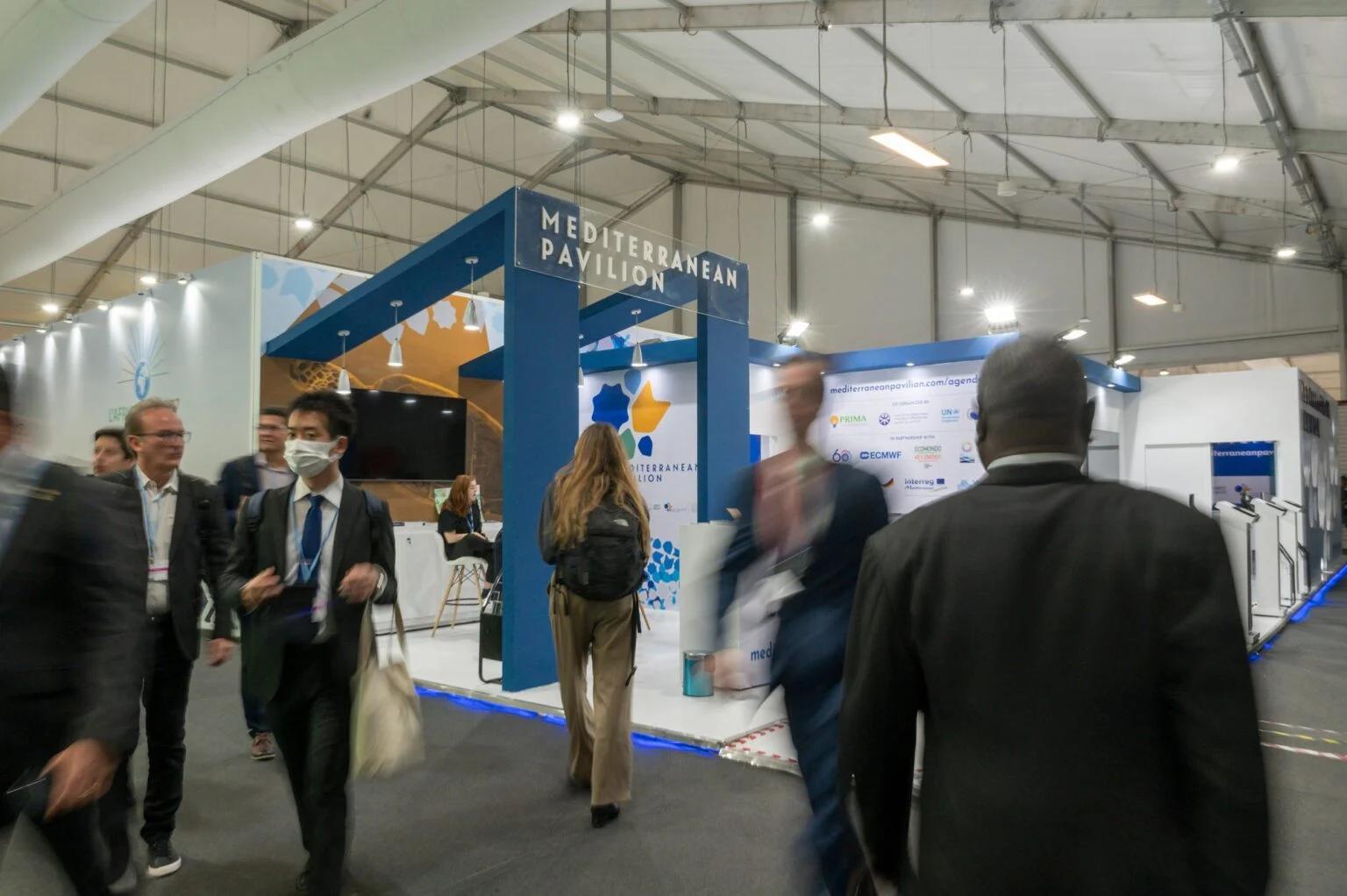
Interreg NEXT MED will join the Mediterranean Pavilion at the upcoming United Nations Climate Change Conference ‘COP31’, taking place in Antalya, Türkiye, from 9 to 20 November 2026. Located in the official Blue Zone, the Pavilion has one clear purpose: to bring a stronger and more united Mediterranean voice to the global climate negotiations at a time when climate change is accelerating rapidly across the region, with significant consequences for communities, ecosystems and economies.
Coordinated by the Union for the Mediterranean (UfM), the Pavilion will bring together a broad coalition of partners and serve as a key platform for regional engagement to advance climate action. Through panel discussions, policy dialogues and high-level sessions, the Pavilion will provide a common space for Mediterranean stakeholders to showcase solutions – ranging from renewable energy deployment and adaptation practices to sustainable food systems – that are essential in a region warming around 20% faster than the global average.
Taking place in a country participating in the Interreg NEXT MED Programme and, for the first time, on the Mediterranean shores, COP31 offers a valuable platform to help ensure that specific Mediterranean challenges are more visible within international climate negotiation processes.
Building on its participation in previous COP27, COP28 and COP29, Interreg NEXT MED’s involvement in COP31 will provide an important opportunity to highlight its efforts to strengthen regional cooperation and partnerships in response to the climate crisis. The Programme will unveil its new portfolio of 49 recently approved projects dedicated to accelerating the green transition, worth more than €120 million. These projects reflect Interreg NEXT MED’s multidisciplinary approach to climate action, addressing the green transition across multiple sectors, from water management and energy efficiency to business, innovation, education, public policy and health. They promote practical solutions across these different areas, including SME decarbonisation, climate technologies, education and skills, climate-responsive public policies, sustainable natural resource management, and stronger preparedness of health systems for climate-related risks.
In the lead-up to COP31, the Union for the Mediterranean and the Turkish COP31 Presidency have organised a series of consultations in the framework of the ‘Antalya Mediterranean Climate Dialogue’ to identify shared Mediterranean priorities ahead of the conference. The conclusions of these discussions will be consolidated into a Mediterranean Synthesis Note, to be presented in Antalya in November. The consultation process is not intended to negotiate common positions, but rather to identify shared priorities, exchange national perspectives and help build greater regional convergence ahead of COP31. Interreg NEXT MED took part in the Madrid and Rome editions of the Antalya Mediterranean Climate Dialogue consultations, sharing insights from Programme implementation across several key priorities of COP31 Presidency, including the clean energy transition, zero waste, food security, youth and education, and oceans and seas.
Stay tuned as the full line-up of Interreg NEXT MED events at COP31 will be announced on this website.
For more information on the Mediterranean Pavilion, please visit: https://ufmsecretariat.org/mediterraneanpavilion/
Held annually under the United Nations Framework Convention on Climate Change (UNFCCC), the Conferences of the Parties – commonly known as COPs – have become some of the world’s largest international gatherings and the foremost global forums for multilateral discussion and negotiation on climate change. They bring together governments from across the world at all levels, alongside international organisations, civil society, experts, businesses and global media, to negotiate climate commitments, assess progress and advance collective responses to the climate crisis.
 Next Med