Meet the People Behind MedFireWise in Spain: Learning Without Borders

For Helena Ballart and the Pau Costa Foundation, wildfire resilience is not built by one organization or one country alone. It grows through shared knowledge, collaboration and a willingness to learn from one another.

Publication Date
10/08/2026
Reading Time
3 minutes

There is something striking about the way Helena Ballart talks about wildfire prevention.

She rarely begins with fire itself. Instead, she talks about people.

Researchers exchanging ideas with firefighters. Public authorities learning from local communities. Mediterranean partners comparing experiences and discovering that, despite their different landscapes, many of their challenges are remarkably similar.

Throughout our conversation, one message kept resurfacing: no single organisation has all the answers. Building wildfire resilience begins with listening, sharing and learning together.

That philosophy lies at the heart of the Pau Costa Foundation’s contribution to MedFireWise.

More Than Wildfire Experts

The Pau Costa Foundation is an international non-profit organisation dedicated to improving wildfire management through the lens of fire ecology. Its work brings together researchers, practitioners, policymakers and communities to promote more resilient landscapes and better-informed wildfire management.

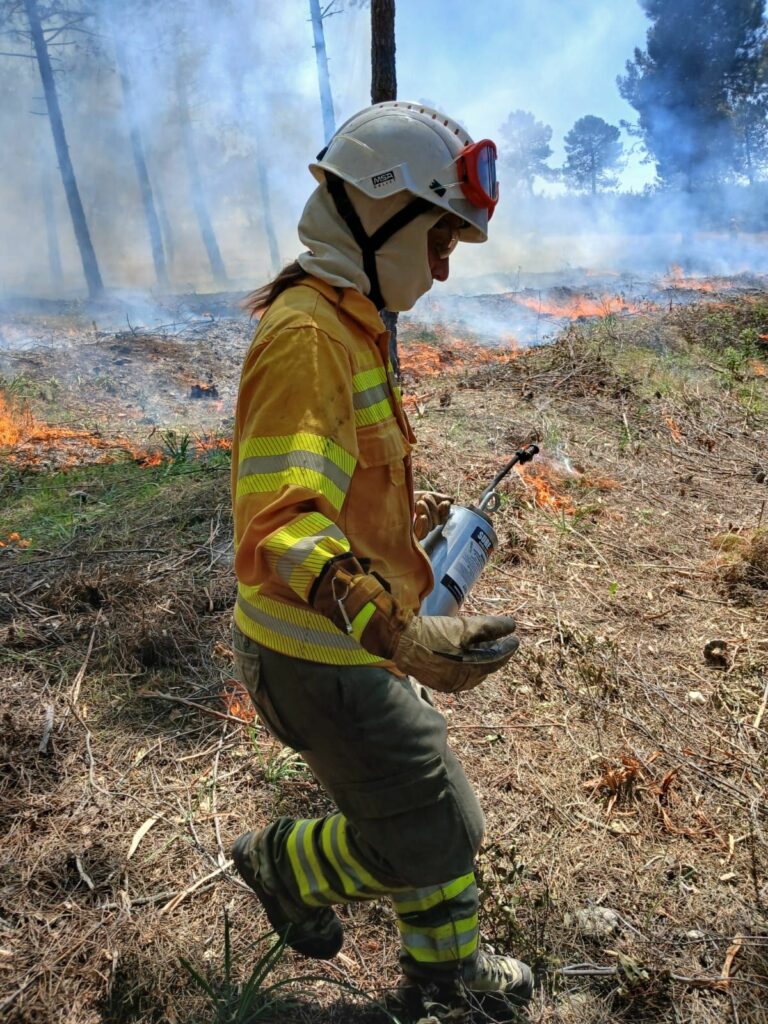
Within MedFireWise, the Foundation supports knowledge exchange, stakeholder engagement and the implementation of Nature-Based Solutions, including prescribed burning and silvopasture, helping partners adapt these approaches across different Mediterranean regions.

For Helena, however, the Foundation’s greatest strength is not simply its technical expertise.

It is its ability to connect people.

“Our team brings expertise in integrated wildfire management, fire ecology, risk governance, community engagement and knowledge transfer,” she explained. “We have experience working with fire agencies, researchers, policymakers and local communities to develop science-based approaches that can be applied in real-world wildfire prevention and preparedness.”

For her, scientific knowledge only becomes valuable when it can be understood, shared and transformed into practical action.

Every Landscape Has a Story to Tell

Like many Mediterranean countries, Spain is experiencing longer fire seasons, more frequent droughts and increasingly intense wildfires.

Climate change is only part of the story.

Rural abandonment, vegetation accumulation and the expansion of urban areas into fire-prone landscapes have all contributed to growing wildfire risk.

Rather than viewing these as isolated national challenges, Helena sees them as shared Mediterranean realities.

“Wildfires in the Mediterranean are becoming more frequent, larger and more intense due to climate change, more frequent and severe droughts and rising temperatures,” she explained. “At the same time, rural abandonment, vegetation accumulation and expanding urban development into fire-prone areas increase both wildfire risk and potential impacts on people, ecosystems and infrastructure.”

These common challenges are precisely why collaboration matters.

Different countries may experience them in different ways, but no country faces them alone.

Learning Instead of Reinventing

One of the moments that stood out most during our conversation came when Helena described what she values most about MedFireWise.

It wasn’t a particular tool. Or a methodology. Or a technology. It was an opportunity to learn.

“One of the most valuable aspects of MedFireWise has been the opportunity to learn from partners with very different backgrounds and experiences,” she said. “Each region has its own challenges and ways of managing wildfire risk, so exchanging ideas helps us see our own work from a different perspective.”

That exchange goes far beyond meetings and workshops.

Across the project, partners work together during cross-campaigns, field demonstrations and technical exchanges, testing approaches such as prescribed burning and silvopastoral practices under different environmental conditions.

Successful ideas are not simply copied from one country to another.

They are adapted.

Improved.

And reshaped according to local realities.

For Helena, this is one of the greatest strengths of Mediterranean cooperation.

“By exchanging knowledge and practical experience, we can avoid reinventing the wheel and adapt successful approaches to our own contexts.”

It is a simple sentence, yet it captures one of the project’s core ambitions: learning faster by learning together.

Building Something That Lasts

When asked what she hopes MedFireWise will achieve in the long term, Helena did not focus on project milestones or technical outputs.

Instead, she spoke about continuity.

“I hope the cooperation between partners continues beyond the project, and that the Nature-Based Solutions tested through MedFireWise keep being implemented, adapted and improved across the Mediterranean,” she said. “I also hope the knowledge and partnerships created through the project continue supporting wildfire prevention in the long term.”

For Helena, the real success of MedFireWise will not be measured when the project ends.

It will be measured years later.

In landscapes that are better prepared.

In partnerships that continue to grow.

And in professionals who keep learning from one another long after the final meeting has taken place.

Because wildfire resilience is not built by one organisation, or one country. It is built by people who are willing to share what they know.

Partner Spotlight Series

This article is part of the MedFireWise Partner Spotlight series, highlighting the people and organisations working together to strengthen wildfire resilience across the Mediterranean.

Gallery

Last Update

10/08/2026