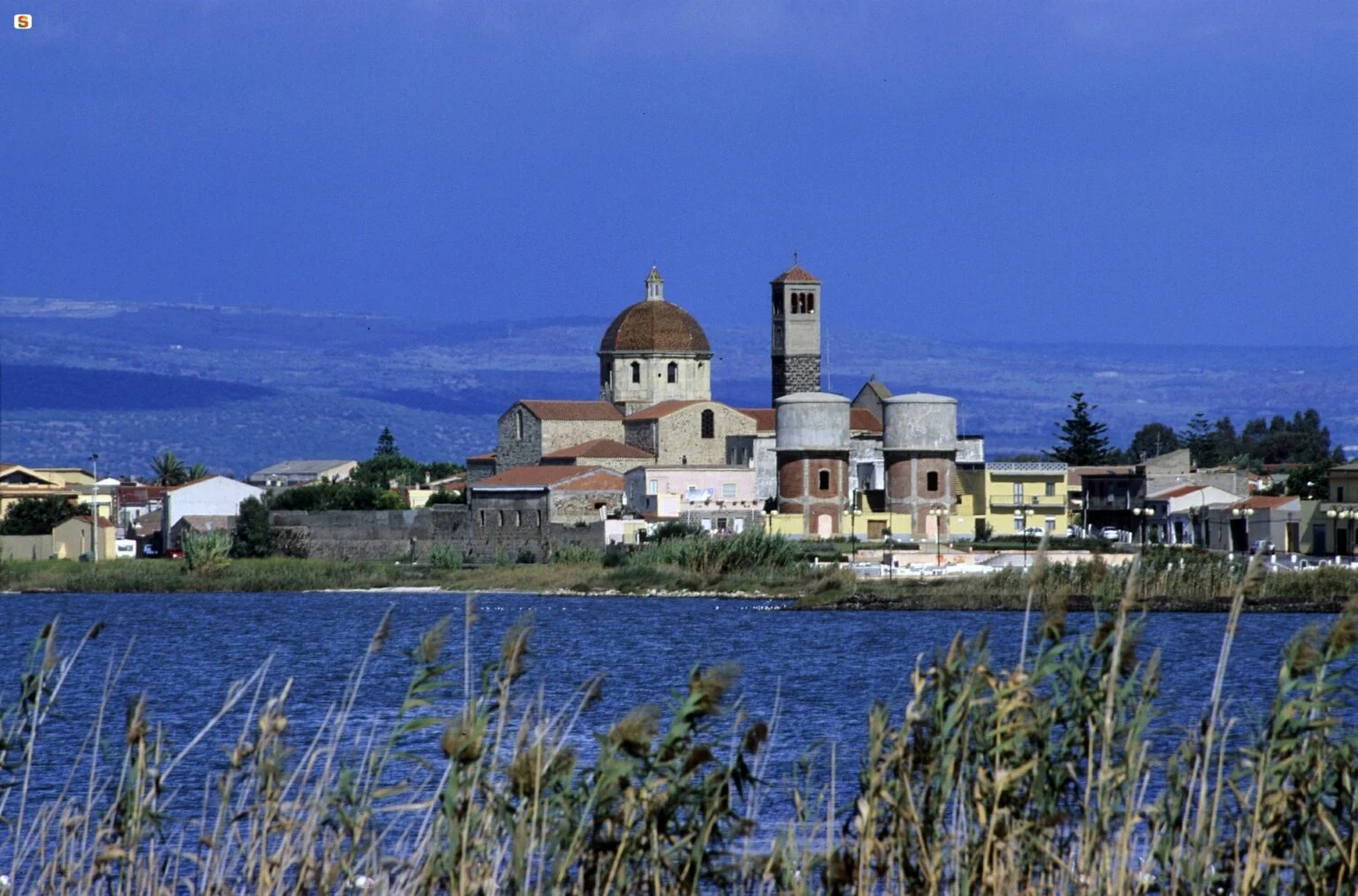
The MedRESOURCE project co-financed by Interreg NEXT MED Programme aims to strengthen integrated water resources management. In this respect, the area of Cabras in Sardinia can be regarded as a strategic laboratory for cooperation, where the effectiveness of public decision-making depends increasingly on the integration of technical knowledge, planning tools and institutional responsibility. Read the interview to Andrea Abis, Mayor of Cabras in the Gulf of Oristano, to highlight a territorial context in which broader issues of environmental sustainability, multi-level governance, institutional coordination and resilience-building emerge with particular clarity.
Mayor Abis, where should one begin when governing coastal risk?
In my view, the first step is to define the objective with absolute clarity. If the aim is to safeguard a specific asset, then action must be taken through interventions explicitly designed to protect it, that is, to slow down or counteract natural dynamics that would otherwise progressively erode or destroy it. The exact timing may be uncertain, but the direction of those dynamics is clear.
These are high-impact and high-cost interventions. And when I say high-impact, I mean that a choice has to be made: it is unrealistic to think that an asset can be preserved while the surrounding landscape remains entirely unchanged. That is simply not possible.
In some cases, therefore, it is necessary to decide clearly that a given asset must be protected. In others, it may be more appropriate to accept a different course of action: allowing natural processes to continue, choosing decommissioning, restoration, demolition, retreat or relocation in response to the natural repositioning of the coastline.
Which tools and sources do you use to update the risk scenario and translate it into planning?
Our main reference is the Inventory of Landslide Phenomena, the so-called IFI. We also rely on the classification and mapping of hydrogeological hazard and risk, which must be incorporated into the updating of the municipal urban plan as a fundamental planning layer. That is the point at which the risk scenario is updated from a programmatic perspective.
Cabras has recently updated its entire coastal hydrogeological study. In doing so, the municipality refined the regional studies and also identified localised risk situations that had not emerged in the broader regional analysis. This framework, for example, formed the basis for the approval of the PUL, the beach use plan, which is not a planning instrument in the strict urban sense, but an implementing tool for coastal management policies and therefore requires an updated hydrogeological basis.
According to you, how is awareness must be built?
In my opinion, citizens should receive interpreted information rather than direct access to raw technical data. The role of the local authority is to act both as a filter and as an amplifier of the actual condition of the territory. It is not reasonable to expect citizens to interpret highly technical datasets; these must be translated into what becomes, in practical terms, a constraint.
What citizens actually perceive is the constraint itself, namely the limitation placed on the use of parts of the territory on the basis of updated studies and mapping. What must therefore be communicated clearly is the fact that such constraints are the direct outcome of technical assessment.
Does it still make sense to continue allocating vast public resources to repairing damage caused by storm surges and marine events, when these are likely to recur with increasing frequency?
From a financial point of view, the current model is already difficult to sustain, and it will become even less sustainable in the future.
What is needed is a shared scenario, because these are not hypothetical futures. These situations are already taking place. If a coastline managed through a beach use plan includes concessions and facilities that are clearly exposed to marine weather events, what is the value of simply reaffirming the same framework? Is it reasonable to continue compensating private actors for recurring damage? Public authorities would in any case face significant difficulty in sustaining such an approach. Private actors should manage these risks through insurance mechanisms and assume responsibility for the implications of their locational choices.
The same logic should also apply to public works and infrastructure: roads, coastal access routes and port facilities. I do not agree with a policy that continues to direct large volumes of public resources towards what is, in effect, non-investment. Compensation for repeated damage is precisely the element missing from a more rational and forward-looking investment strategy. These are passive and compensatory policies, not active ones. What we need is a lucid rethinking of coastal planning, based on the tools and knowledge already available and on the clear evidence that these are not theoretical scenarios but present realities.
Is there constructive dialogue between the different institutional levels?
One of the main difficulties lies in the subjectivity of opinions. There is a legal and administrative framework, there are formal competences, but the interpretation of those competences often remains highly discretionary. The dialogue takes place among institutional actors representing public bodies, but individual discretion can still produce very different opinions, even among authorities of the same rank. Important decisions can therefore end up depending heavily on subjective judgment.
Awareness may be increasing, but too much time is still lost on formal procedures, on what I would call the “school exercise,” instead of moving directly to the substance of solutions that are often already visible. Months and years are spent developing alternatives and procedural passages when the real question is much simpler: is a given asset to be safeguarded, or is a different course of action preferable? Greater clarity on this point would save resources and, in my opinion, would also open more meaningful prospects for future action.
 Next Med