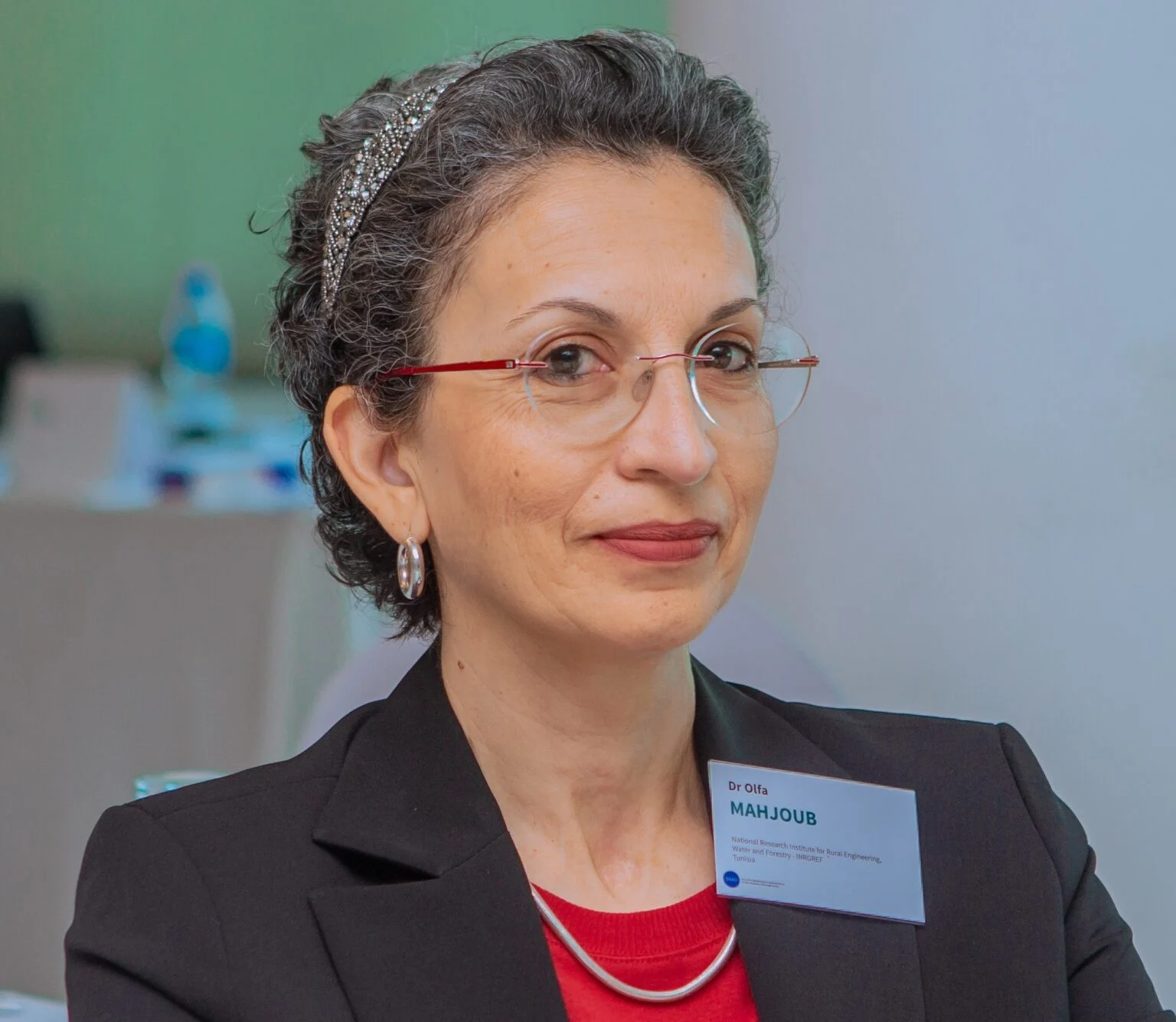
The “Mediterranean initiative to Regenerate wastewater Sludges for Optimal Use toward a Circular Economy”, funded by the Interreg NEXT MED Programme, aims to install sustainable environmental practices in agriculture. Read the interview with Dr. Olfa Mahjoub of MedRESOURCE Tunisian project partner INRGREF, to explore the potentially of providing concrete solutions for sludge management in the Mediterranean.
Could you outline your main responsibilities and objectives within the project?
Within the MedRESOURCE project, INRGREF will build partially on the outputs of the TRESOR project by testing the efficiency of sludge dewatering reed beds in treating liquid sludge collected from the WWTP SE4 in the Nabeul region. Since this treatment system operates over the long term, INRGREF will also install a small-scale composting unit—at farmer level—to valorize biosolids from the drying beds of the same treatment plant, together with the biomass generated by the reed beds.
INRGREF will monitor and evaluate the performance of both systems in producing biosolids suitable for agricultural use, both within and beyond the project’s timeline. The project will further assess the impact of the resulting compost and biosolids on selected crops and soil properties.
Project outputs will be disseminated to the farming community, relevant stakeholders, and regional and national policymakers to support evidence-based decision-making in the agricultural and environmental sectors.
Can you explain how you came to set up this network of international cooperation? And describe the company you belong to.
As a former Leading Partner of the TRESOR project, an R&D project funded under the ENI CBC Med (IEV) programme, INRGREF has joined the MEDISS project consortium to build on the outputs of both projects, advancing research and providing solutions for sludge management through the application of various innovative technologies.
INRGREF, the National Research Institute for Rural Engineering, Water, and Forestry, is a leading R&D institution and the first in Tunisia to carry out applied research on sewage sludge characterization, its agricultural use, and its impacts on soil, plants, and water resources, dating back to the early 1980s. Its experimental research units—particularly the one located in Nabeul—have been instrumental in establishing various protocols for the safe use of sewage sludge. The outputs of these research projects have strongly supported the development of Tunisia’s national standards currently in force on the use of sludge as an agricultural fertilizer, namely NT 106.20 (2002). As such, INRGREF’s research teams provide ongoing expertise and continue to support the development of institutional and regulatory frameworks, as well as national policies, on the use of reclaimed water and biosolids in agriculture.
Building on this accumulated knowledge, INRGREF established Tunisia’s first pilot plant for the natural treatment of sludge, using sludge dewatering reed beds—a constructed wetland system for treating liquid sludge to produce a natural fertilizer. This pilot was installed to explore the feasibility of this nature-based, low-cost technology for treating sludge to produce organic fertilizers, while protecting soil health and managing on-site organic waste.
What are the causes of the environmental and agricultural difficulties in your area?
In Tunisia, the centralized activated sludge process used in wastewater treatment generates large quantities of sewage sludge, which is increasingly becoming an environmental and public health concern. The 131 wastewater treatment plants (WWTPs) in operation produce around 156,000 tons/m³ annually, the majority of which is discharged in controlled landfills or stored on-site under constraining conditions. Meanwhile, less than 10% is currently used in agriculture as fertilizer. Hence, there is an urgent need to develop sustainable management solutions.
Separately, animal manure, as the organic fertilizer most commonly used by farmers, is facing two major challenges: rising costs and declining availability, making it increasingly unaffordable and inaccessible, respectively. In many agricultural areas located near WWTPs, farmers are highly willing to use sewage sludge as a low-cost, available alternative fertilizer. However, administrative and logistical procedures remain cumbersome in several regions, while social reluctance to use biosolids as fertilizer persists in others.
Solutions for treating liquid and solid sludge on-site, whether at the treatment plant or at the farm level, remain underdeveloped, requiring thorough investigation as well as targeted awareness-raising among policymakers and stakeholders.
Can you briefly describe your tasks in the project? And goals?
In Tunisia, INRGREF’s role within the project is to showcase two distinct but complementary natural sludge treatment systems. The first is a long-term treatment process involving sludge dewatering reed beds for liquid sludge. This system is designed to be sustainable and operational for at least 5 years, if not longer, mineralizing liquid sludge to produce a natural fertilizer suitable for soil amendment. The second system is a composting unit for solid sewage sludge, expected to valorize organic waste generated on-site and in the surrounding area of INRGREF’s agricultural experimental unit, producing compost at a small scale that can be adapted and adopted by farmers in the Nabeul region.
INRGREF will monitor both units in parallel over 3 to 4 semesters. The research team will also build the capacities of stakeholders in the Nabeul region and beyond, including associated partners and potential end-users. While the composting unit is expected to be operational and to produce compost within the project implementation period, the reed bed system will continue producing sludge beyond the project’s timeline. As such, monitoring efforts for the reed bed system will focus primarily on evaluating the technology’s efficiency and long-term impacts.
INRGREF will also contribute to disseminating project results in Tunisia, among partners and policymakers nationwide. It will raise awareness about the use of nature-based solutions for sludge treatment and the scale-up of composting in wastewater-irrigated areas. Through its Living Lab, INRGREF also plans to play a pivotal role in translating research results on innovative technologies into effective waste management policy.
Do you think coordination between partners will be complicated? What do you think will be the decisive aspects in making relations and coordination easier?
Coordination goes beyond technical issues, because we are human. The MedRESOURCE project builds upon existing collaborations, with strong ties already established between partners. Beyond that, it reconnects partners who were once part of a larger scientific network within the MENA region, while bridging North and South Mediterranean countries. It also brings together partners with a high level of leadership, capitalizing on the managerial expertise and good governance they have gained through previous successful projects.
The biggest challenge lies in reinforcing participatory settings throughout the project, under each partner’s specific circumstances, through a robust coordination mechanism and effective communication channels. Regular meetings, continuous exchange, and consensus-building are prerequisites for good coordination. We are confident that the project coordinators, including the Leading Partner, supported by the communication teams, have the skills needed to foster a professional and cheerful atmosphere for a successful project.
Which activity will have a greater effect than initially expected? And why do you think so?
The Living Lab is at the core of the project. As such, WP3 and WP4 are expected to have significant effects across all countries, as there is a need to raise community awareness of the innovative solutions being developed under the flagship of the Living Labs in the various partner countries, at various scales. The exchange of knowledge among partners and the lessons learned from successful case studies will have an impact that extends beyond the scientific dimension, it is fundamentally about the acceptance and adoption of these technologies in the short and medium term, and their influence on policy and decision-making on the long-term. This requires effective cooperation and coordination at the local, regional, national, and international levels. Hands-on training, participatory workshops, and field visits, combined with shared science-based outputs, will speak louder to end-users than theory alone.
Dr. Olfa Mahjoub is a senior researcher (Associate Professor) holding a PhD in Water Sciences from the University of Montpellier, France. She has been serving the INRGREF for more than 25 years. She has extensive expertise in the reuse of wastewater treatment by-products, namely reclaimed water and biosolids, in agriculture, with a particular focus on the environmental and health impacts of contaminants and the risks associated with current practices.
 Next Med