How can artificial intelligence make health emergency response faster, smarter, and more effective? This question drove the AI4Purpose National Hackathons organized by MEDAIGENCY project.
In this interview, we hear from Domenico Lombardi, co-founder of QuTec, who shares his experience and insights into Care4Heat, an AI-powered solution designed to anticipate and manage heatwave-related health risks.
Interview with Domenico Lombardi – Co-founder of QuTec
About you
I’m Domenico Lombardi, co-founder of QuTec Srl, a startup developing AI-powered solutions for enterprises. Before founding QuTec, I was a lecturer at the University of Manchester, where I led research into risk assessment of infrastructure under extreme natural and anthropogenic events. At QuTec, we’ve carried that mission forward, building data-driven AI tools to strengthen community resilience in the face of extreme events. As of February, QuTec has become part of A-Squared, an international group operating across Europe, North America, and Australia, allowing us to scale our impact and bring our solutions to a wider audience.
Your motivation to participate
We learned about the AI4Purpose Hackathon through the MEDAIGENCY project network and saw it as a perfect opportunity to apply our expertise in risk assessment to a real-world challenge close to home. Our region, Campania, faces significant exposure to hydrogeological, seismic, volcanic, and extreme weather hazards, making AI-driven crisis response not just relevant, but urgent.
AI for health emergencies sits at the heart of our mission to build more resilient communities, with a particular focus on the Global South, which is disproportionately impacted by extreme events despite contributing least to climate change. In 2023, we co-authored an opinion piece in Nature proposing a data-driven mechanism enabling climate loss-and-damage funding, the global framework through which high-emitting, wealthier nations compensate vulnerable communities for the economic and human costs of climate-related disasters they did little to cause. This makes the AI4Purpose Hackathon a natural extension of work we deeply care about.
Your AI solution
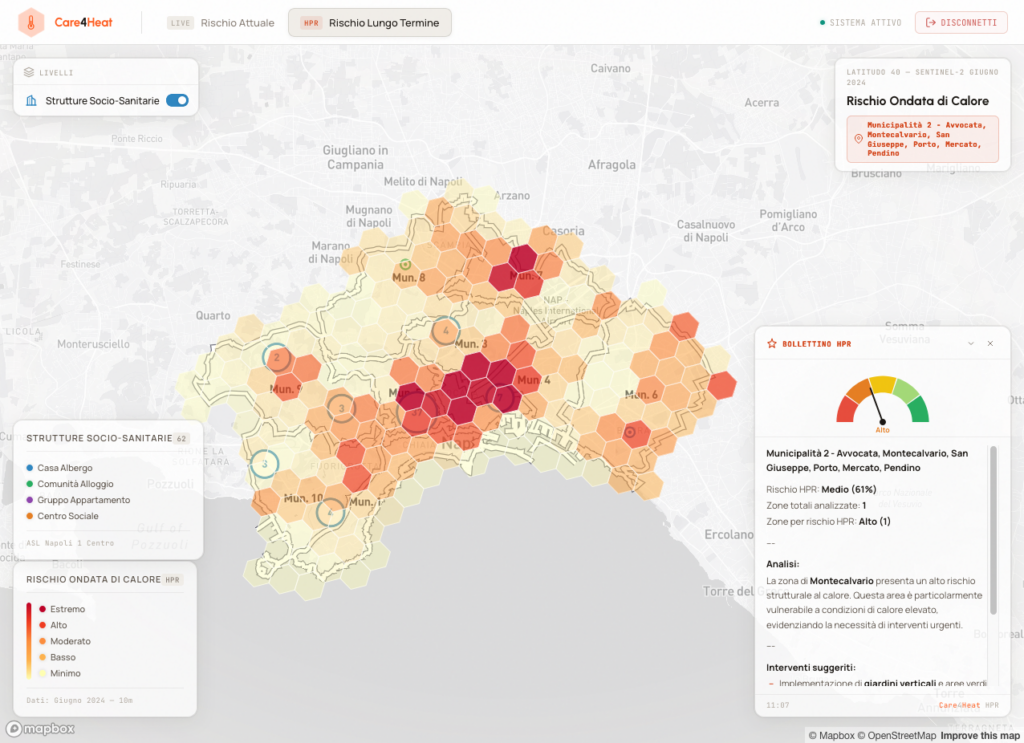
We developed Care4Heat, an AI-powered predictive platform that helps public authorities and citizens anticipate, manage, and respond to heatwaves. Extreme heat is one of the deadliest yet most underestimated climate hazards, hitting hardest the elderly, low-income communities, and those with pre-existing health conditions.
Care4Heat combines data federation and shared AI models to identify the most vulnerable population groups before heatwave strikes, enabling authorities to act early. Citizens receive smart notifications and personalised guidance through a digital assistant.
What makes Care4Heat impactful is its shift from reactive to proactive crisis management. Rather than responding after harm is done, it prevents it, making it a scalable solution for health resilience across the Mediterranean and beyond.
Future development of the idea
Our next step is to move Care4Heat from proof of concept to a fully deployed platform. We are keen to engage with public health authorities, civil protection agencies, and municipal governments across the Mediterranean to pilot the platform in real settings, starting from Campania.
We hope the MEDAIGENCY network and its partners will see the value in supporting this journey. Collaboration with key stakeholders would allow us to validate our models with real data, and scale across borders. Our ambition is for Care4Heat to become an embedded tool in regional health emergency preparedness systems.
Mediterranean perspective
Competing at Mediterranean level provided valuable perspective on the scope and relevance of our solution. Engaging with teams from across the region highlighted that, despite different national contexts, many communities share the same underlying challenges: extreme heat exposure, limited public health resources, and the need for faster, data-driven response systems.
The transnational dimension directly informed our approach. Exposure to different institutional frameworks and needs assessments from other countries pushed us to focus on adaptability in Care4Heat’s design, reinforcing the value of data federation and shared AI model hubs as the technical foundation for a scalable, cross-border crisis response platform. Feedback from mentors and jury members was particularly useful in grounding our technical approach in operational realities, helping us focus on what public authorities need to act effectively during a health emergency.
Special thanks to Mr. Ayman Rahmeh from the American University of Beirut for facilitating this series.
 Next Med