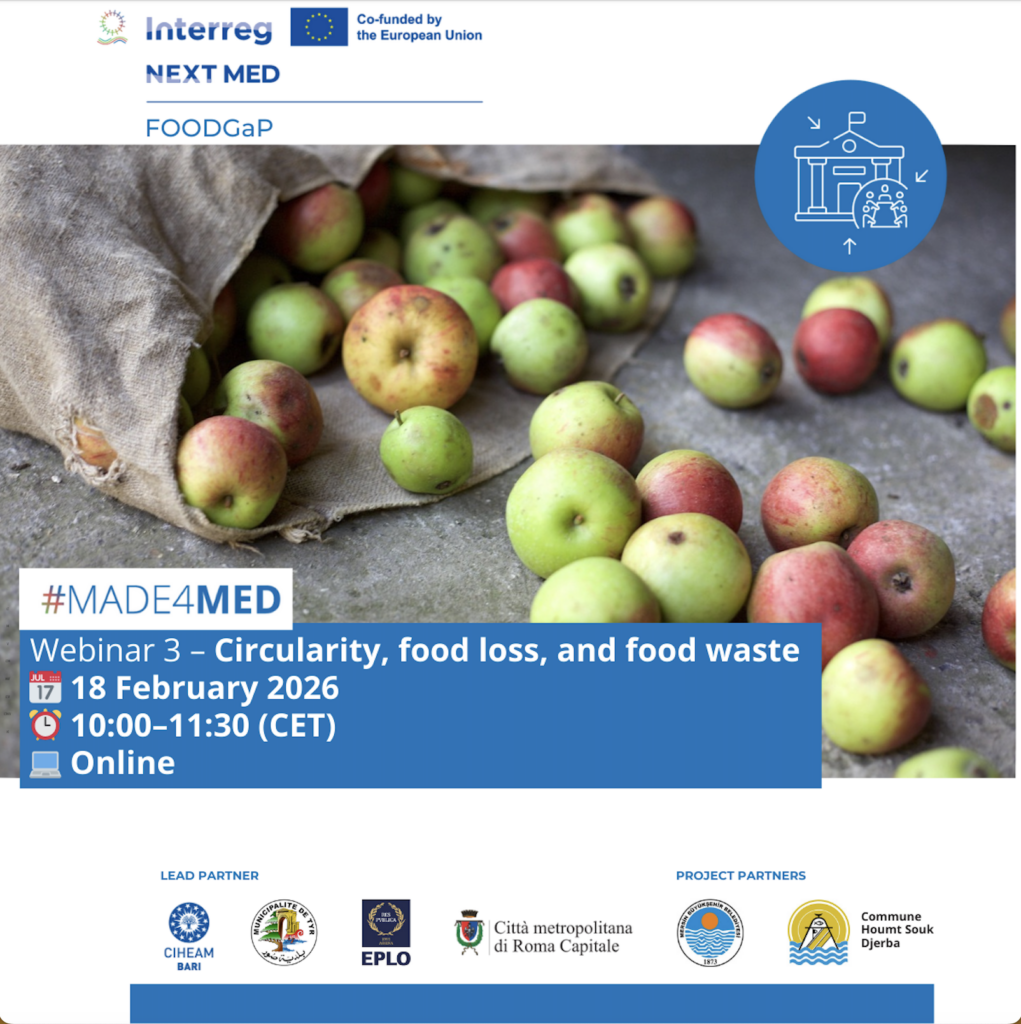
On 18 February 2026, CIHEAM Bari organised the third online webinar of the FOODGaP Capacity Building Programme, dedicated to circularity, food loss and food waste. The event gathered cities, policymakers, researchers, and practitioners to exchange knowledge and practical experiences aimed at strengthening local food governance across the Mediterranean.
The session explored how cities can move from a linear “produce–consume–discard” model to more circular and resilient food systems, highlighting solutions such as sustainable public procurement, food waste prevention, redistribution initiatives and recycling practices that increase resource efficiency while promoting social inclusion and healthy diets.
The webinar opened with a keynote by Matteo Vittuari from the University of Bologna, who presented policy pathways for sustainable and healthy urban food systems. His intervention emphasised that food systems influence multiple dimensions of urban life—from environmental sustainability to public health and social equity. Drawing on case studies from school canteens and behavioural research, he demonstrated how small adjustments in food environments, combined with regulatory frameworks, can significantly reduce food waste and promote healthier consumption patterns.
Practical examples of circular governance were then presented by Andrea Calori, President of EStà – Economia e Sostenibilità, who illustrated the experience of the Cuccagna Food Hub in Milan. Born during the COVID-19 emergency and later institutionalised within the city’s food policy framework, the initiative connects NGOs, social organisations and local institutions to recover and redistribute surplus food to vulnerable families while promoting dignity, choice and community participation.
A complementary perspective was offered by Paolo Greco, former Mayor of Caprarica di Lecce, who presented a circular economy model implemented at the municipal level. The initiative integrates organic waste management, compost production and local agricultural supply chains, while also supporting a social restaurant that provides affordable meals and strengthens community cohesion. The project demonstrates how circularity can simultaneously generate environmental, economic and social value at the local level.
Finally, Erica Locatelli from ICLEI – Local Governments for Sustainability presented European initiatives supporting cities in their circular transition. Through networks such as the Circular Cities Declaration, municipalities are encouraged to adopt integrated strategies, share best practices and monitor progress in reducing waste and resource consumption.
The discussion highlighted that circular food systems require systemic change, combining prevention strategies, regulatory frameworks, behavioural change and collaboration among public authorities, civil society and the private sector. Speakers also stressed the importance of data sharing, participatory approaches and international cooperation to scale up successful practices.
The webinar concluded with an interactive Q&A session that addressed key questions on whether policies should focus on mitigating food waste symptoms or addressing structural causes, and on how policymakers can improve knowledge exchange across regions and governance levels.
Overall, the event reaffirmed that cities play a pivotal role in driving the transition to circular food systems, translating global sustainability commitments into practical local solutions.
 Next Med