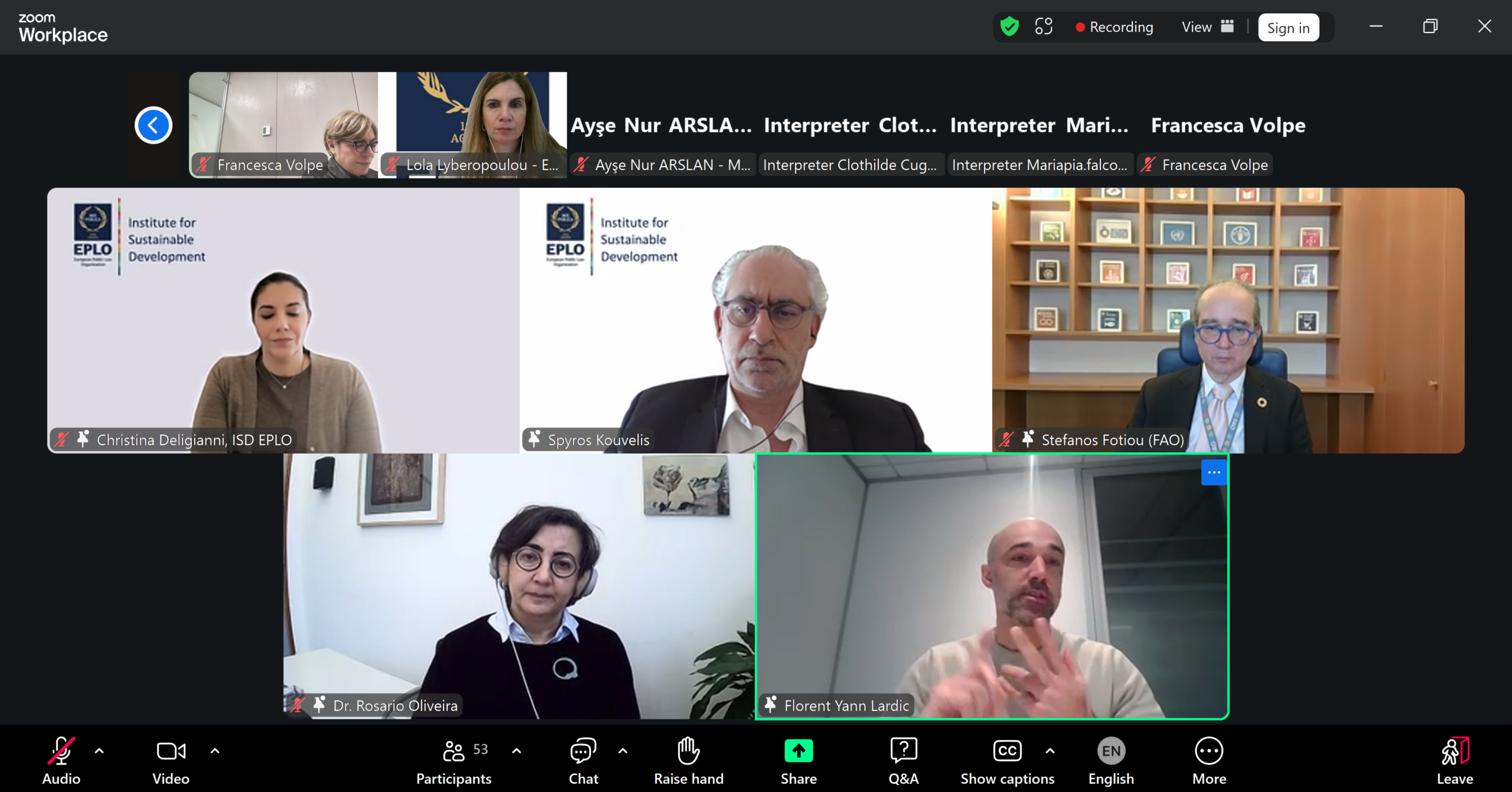
On 4 February 2026, the FOODGaP Project convened its second peer-learning webinar,Multilevel Governance, Participation and Vertical Coordination,organised by the EPLO Institute for Sustainable Development under the Capacity Building Programme (WP3). The session gathered policy experts, international organisations, and local authorities to examine how governance structures influence the effectiveness and sustainability of food policies.
The discussion confirmed a shared understanding that the success of food system strategies relies not primarily on the design of isolated measures, but on how governance systems function in practice. Across diverse territorial and institutional contexts, challenges were consistently linked to coordination gaps between governance levels, unclear mandates, fragmented participation mechanisms, and limited institutional continuity.
Opening the session, Mr. Spyros Kouvelis, Founder and Director of ISD EPLO, highlighted multilevel governance as a prerequisite for meaningful impact. Food systems intersect with urban planning, health, agriculture, environment, and social policy, making cross-sector and cross-level coordination essential. Clear allocation of roles, structured cooperation, and continuity beyond project cycles were identified as critical to ensuring lasting outcomes.
Dr. Stefanos Fotiou, Director of the FAO Office of Sustainable Development Goals and the UN Food Systems Coordination Hub, emphasised the importance of vertical coordination between global, national, regional, metropolitan, and local levels. Drawing on international experience from countries including Lebanon, Indonesia, Peru, Nepal, Serbia, and Gambia, he noted that national ambitions often falter during implementation. Effective governance, he argued, requires aligning decision-making authority, financing, and accountability across levels, while ensuring local actors are involved early in policy processes and supported with adequate resources.
Participation emerged as a central and complementary theme. Speakers underlined that stakeholder engagement only influences outcomes when it is formally connected to decision-making processes. Without institutionalised entry points and clear responsibilities, participation risks remaining consultative rather than transformative.
The metropolitan scale was presented as a crucial governance bridge. Dr. Rosrio Oliveira showcased the Lisbon Metropolitan Areas FoodLink initiative, which connects 18 municipalities alongside research institutions and civil society. Shared data systems and collaborative planning were highlighted as tools to enhance transparency, coherence, and evidence-based policy, enabling more integrated territorial approaches to food distribution, land use, and logistics.
Further insights came from the French experience of Territorial Food Projects (Projets Alimentaires Territoriaux), presented by Mr. Florent Yann Lardic. Since 2014, these initiatives have demonstrated how institutionalised participation, inter-municipal cooperation, and subsidiarity can strengthen food governance in areas such as food education, sustainability, social justice, and school meals. However, speakers also stressed that participatory processes must be supported by stable mandates and long-term resources to remain effective.
The webinar concluded with an interactive discussion facilitated by Christina Deligianni, linking food governance to the UN 2030 Agenda, the Sustainable Development Goals, and the EU Green Deal. Participants reaffirmed that food systems intersect with all SDGs, underscoring the need for integrated and coordinated governance approaches rather than sector-specific solutions.
Overall, Webinar 2 reinforced a clear message: participation, coordination, and strong governance architecture are not secondary elements, but the foundations of effective, inclusive, and resilient food policy.
The event was dedicated to the memory of Şadiye Karabudak, Project Expert from the Metropolitan City of Mersin, FOODGaP partner, for her untimely passed away
.
 Next Med