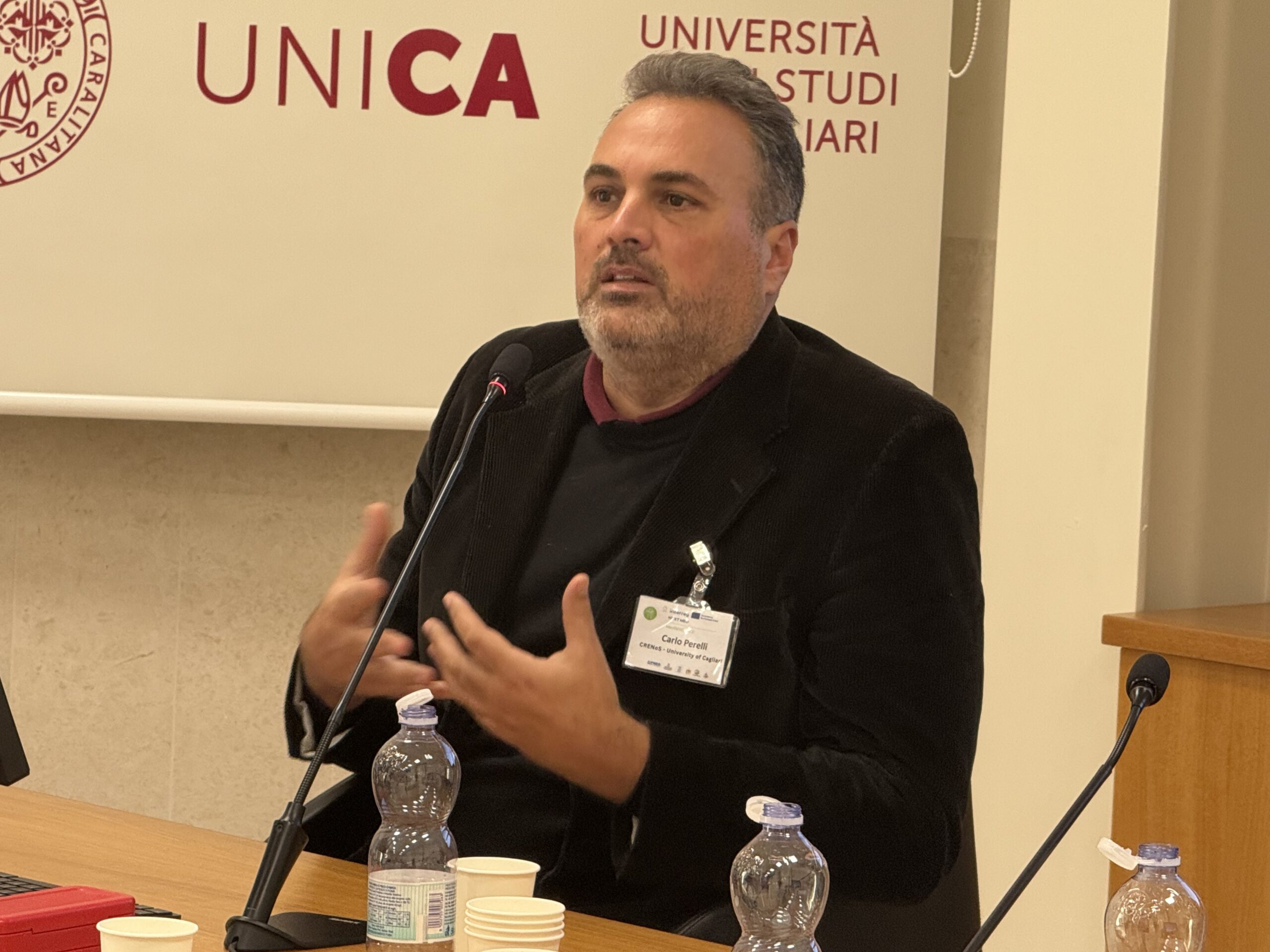
MedRESOURCE is a pioneering project funded by the Interreg NEXT MED Programme, and intertwines the cooperation of four countries: Italy, Palestine, Tunisia and Jordan. The initiative aims to provide sustainable management of wastewater sludge in the Mediterranean. Promoting the circular economy and environmental resilience. Read the interview with Professor Carlo Perelli of project partner CRENoS, “University of Cagliari”, to learn how this initiative aims to advance sustainable wastewater sludge management, promote circular economy solutions, and strengthen environmental resilience.
How did you come to set up this network of international cooperation?
The MedRESOURCE partnership is the result of long-term Euro-Mediterranean cooperation among research centers, public bodies and technical organizations working on shared environmental challenges. Rather than starting from scratch, the project builds on relationships and trust developed through previous cooperation experiences.
A key step in this process was the MEDISS (Mediterranean Integrated System for Water Supply) project, funded by the ENI CBC Med Programme. MEDISS focused on water scarcity and water quality issues by testing innovative solutions based on treated wastewater reuse and other non-conventional water resources. Beyond its technical achievements, MEDISS played a crucial role in strengthening collaboration with local institutions and final beneficiaries, creating solid working relationships that have continued over time.
This continuity clearly emerged during the MedRESOURCE Kick-off Meeting in Cagliari on the 14th and 15th of January 2026, where the presence and active involvement of institutional representatives and local stakeholders highlighted the strength of existing partnerships and their shared commitment to moving from experimentation towards more structured and transferable solutions. Indeed, the presence of high-level political representatives from Sardinia and Palestine at the Kick-off Meeting clearly underlined both the importance of this dialogue and the concrete commitment of institutions to support the development and implementation of the project.
Professor, what are the causes of the environmental and agricultural difficulties in your area?
For CRENoS, the main reference area within MedRESOURCE is Arborea, in Sardinia. Arborea is representative of territories classified as nitrate-vulnerable zones, a condition shared by several agricultural areas in Sardinia and in other parts of Europe.
At the same time, Arborea is characterized by the presence of wetlands and by a high vulnerability to climate change. These environmental features make the territory particularly sensitive to pressures related to water quality, nutrient management and agricultural practices. For these reasons, Arborea offers a highly relevant context for testing integrated solutions that aim to balance agricultural productivity, environmental protection and long-term resilience.
MedRESOURCE addresses these challenges by focusing on water scarcity, soil degradation and waste management at Mediterranean scale. In areas such as Arborea—characterized by intensive agriculture, nitrate-vulnerable zones and sensitive wetland ecosystems—wastewater sludge is still often inadequately managed, creating environmental risks and missed opportunities for resource recovery. Through MedRESOURCE, partners work together to demonstrate practical solutions that turn sludge into a resource, improving soil quality, reducing pollution and supporting more sustainable farming practices.
Professor Perelli, could please explain your tasks and goals within the project?
My role in MedRESOURCE combines project management with scientific coordination for CRENoS. I work to ensure that technical activities, capacity building actions and policy dialogue are well aligned and mutually reinforcing.
A central goal is to support the long-term uptake of project results. This means not only testing solutions in the field, but also strengthening skills, fostering dialogue with institutions and helping translate technical innovation into practices and policies that can be sustained beyond the project’s lifetime. In Arborea a strong cooperative system led to social and productive innovation practices resulting in our key actors for Living Lab activities.
Capacity building strengthens people and institutions, often producing lasting effects well after a project ends. Living Labs allow solutions to be tested in real-life contexts, encouraging learning, trust and local ownership. Policy dialogue is equally important: projects like MedRESOURCE operate at the intersection between innovation and regulation, and meaningful engagement with policy-makers is essential for scaling up results.
How does coordination between partners work?
Coordination in a project involving different countries and institutional systems is naturally complex. However, MedRESOURCE benefits from strong foundations built through previous cooperation experiences.
Shared governance mechanisms, regular communication and a common understanding of project objectives help partners work together effectively. Capacity building also plays a key role, as it helps ensure that technical solutions are adapted to local contexts and can be realistically managed by the actors involved.
Carlo Perelli is a lecturer in Political Geography at the Department of Political Sciences of the University of Cagliari and an associated researcher at CRENoS (Centre for North South Economic Research). He holds a PhD in Analysis and Governance of Sustainable Development, a Master’s degree in International Cooperation and Cultural Mediation, and a degree in Political Sciences. Within MedRESOURCE, professor Perelli serves as Project Manager and Scientific Coordinator for CRENoS activities. He is also a member of the Project Steering Committee. In this role, he supports the scientific coherence of CRENoS contributions and works to connect technical solutions with territorial realities and policy processes, with particular attention to capacity building, stakeholder engagement and the socio-economic dimensions of the Living Labs.
 Next Med