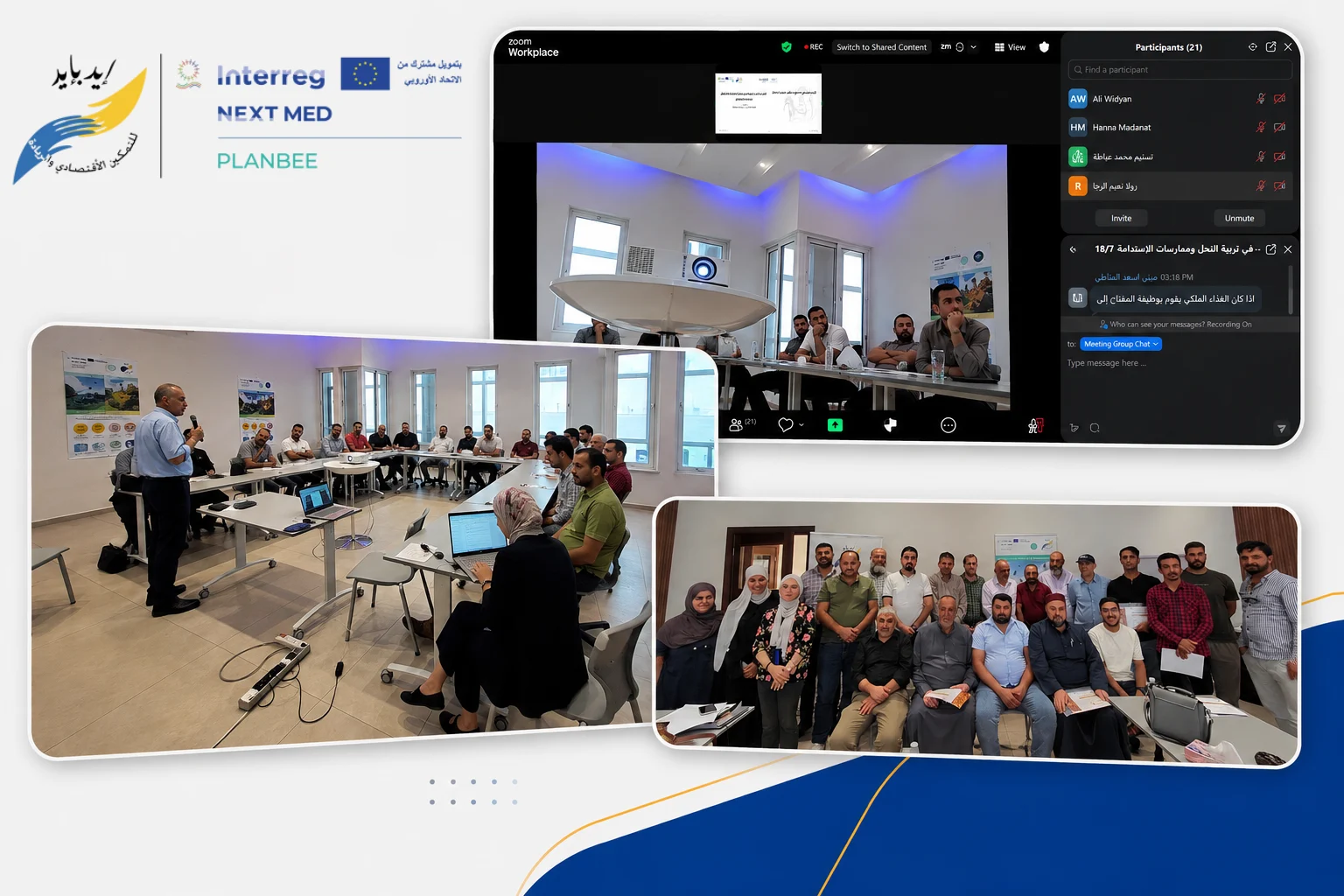
The PLANBEE project has successfully completed the Advanced Sustainable & Organic Beekeeping Training Programme in Jordan, further strengthening its commitment to promoting sustainable beekeeping practices and supporting the development of the Bee Economy across the Mediterranean.
The training was organised by Hand in Hand for Economic Empowerment and Entrepreneurship (HIH), the Jordanian partner of the PLANBEE project.
Delivered over two training days on 16 and 18 July 2026, the programme provided 16 hours of specialised instruction designed for active beekeepers wishing to improve the sustainability, productivity, and resilience of their apiaries through the adoption of modern and environmentally responsible practices.
The training attracted 48 participants from across Jordan, demonstrating the growing interest in sustainable beekeeping and the opportunities offered by the Bee Economy. To maximise accessibility, the programme was delivered using a hybrid format, with 24 participants attending in person at the Irbid Chamber of Industry and 24 joining remotely via Zoom.
The programme was led by Professor Dr Mohammad Al-Rababa’h, President of the Jordanian Beekeepers Union and Professor of Environment and Natural Resources Management at the Jordan University of Science and Technology. Drawing on his extensive academic and professional expertise, he introduced participants to the latest sustainable beekeeping practices and technologies that improve hive health, productivity, and environmental performance.
Participants explored a comprehensive range of topics, including advanced hive management and colony care, integrated disease and pest management, organic and sustainable beekeeping methods, and the conservation of local bee genetics to enhance colony resilience and adaptation to local environmental conditions.
The final training session focused on practical applications and the simulation of internationally recognised best practices, enabling participants to consolidate their newly acquired knowledge and discuss its implementation within their own beekeeping operations.
Participants who successfully completed at least 75% of the training programme were awarded Certificates of Attendance during the closing ceremony.
The training forms part of PLANBEE’s wider capacity-building programme, which is being implemented across all participating countries to equip both new and experienced beekeepers with the technical knowledge, practical skills, and entrepreneurial competences needed to thrive in a rapidly evolving sector.
Beyond improving beekeeping practices, PLANBEE promotes a broader vision of the Bee Economy—one that recognises bees as drivers of biodiversity conservation, sustainable agriculture, rural entrepreneurship, and innovative tourism experiences. Through specialised training, innovation, networking, and business support, the project is creating new opportunities for individuals and communities while contributing to a more resilient and sustainable Mediterranean region.
 Next Med